Part 2
In Part 1, The Gatsby connection” (See here), I outlined six of the facts that form the nexus between F. Scott Fitzgerald, Peter C. Gallagher and Jay Gatsby.
First, there is Fitzgerald’s immersion in the world of Great Neck and Port Washington-Sands Point and its elite Irish Catholic families, beginning more than eight years before the completion of “The Great Gatsby”; second, the financial support for the new parish that links Port Washington’s two leading Catholics, sand-& gravel heir Gallagher and Irish-born lawyer William Bourke Cockran; third, the high-profile use of the hydroplane; fourth, the whiff of illegality and industrial monopoly; fifth, the motor yacht and the well-documented yacht culture; and sixth, the Maxwell/Rolls Royce.
For the final nexus point, the seventh, I begin this concluding part of the story with family lore. According to my late mother, her grandfather, Peter C. Gallagher, was killed one night on his motor yacht, which was moored to his dock at his estate in Port Washington, as a result of a drunken brawl with one of his brothers. The fight was allegedly over Peter’s wife, Alice Mae or “Mimi,” who then threatened to go to the District Attorney and press charges. In an Irish Echo story about the Gallaghers published on March 13, 2013, entitled “Sidewalks of New York,” it was suggested that the unnamed brother had once loved Mimi, too, and that was one source of tension.

To ensure her silence, the family, or the company, paid Mimi $1,000,000 ($19,000,000 in 2026 dollars). The date of Peter’s death was September 21, 1924. For many years, a debate ensued within my family as to whether this account was true or not.
My mother, Helen “Chickie” Gallagher, knew her paternal grandmother Mimi well, as the matriarch lived for decades after her husband’s untimely death; however, she most likely heard the family stories from her own mother, also Helen.
Some years ago, after my mother’s death, I came across an obscure autobiography of one Daniel J. O’Connell, aka Capt. Dan, who enjoyed a thirty-year career as a U.S. naval officer and, upon retiring to San Diego, he took up surfing and became a local legend. The autobiography is what historians and journalists refer to as a “primary source,” as it originates from the subject and was taken down, or written, in real time. (“Autobiography of an American Surfer: Capt. Dan” – MastSurfboards.com.)
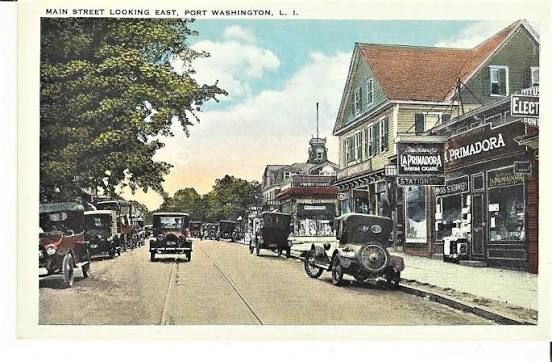
Port Washington, L.I., in the 1920s.
Capt. Dan was born in 1915 in New York City at a time when his father drove a truck for a sand and gravel company located “…at E. 49th and the East River and owned by Peter C. Gallagher.” Capt. Dan believed that his family first went to Port Washington-Sands Point in the summer of 1925. Since Gallagher died in 1924 it had to be earlier, as Capt. Dan’s account will bear out. The reason for going to Port Washington was that Gallagher had asked Capt. Dan’s father to come out for the summer and captain the AMURAY, and to bring his family. They were lodged in a large WW I officer’s tent on the grounds, and by all accounts young Dan and the other O’Connell siblings had the time of their lives. The former naval officer writes, “The estate ran from the Port Washington Yacht Club to the Manhasset Yacht Club and from the back bay to the main road…[f]rom the water, the land rose to what seemed like a good hill up near the main road.”
‘Cheerful mood’
Capt. Dan relates that when “Old Man Gallagher” was drunk he would sleep on the yacht as “…his wife could not stand him when he was in that condition.” According to Capt. Dan, “One morning in 1925 [actually 1924], my father found Old Pete dead in his stateroom on the AMURAY.” Capt. Dan makes no mention of the cause of death. Most relevant is his account of the locale of Gallagher’s death—the yacht. Gallagher died at night on his yacht moored to his dock in Port Washington. Importantly, based on Capt. Dan’s account, if he spent the night on the yacht it meant he had been drinking, which comports with yet another aspect of the family lore—he was drunk at the time of his death. Lending credibility to Capt. Dan’s account is that his story is not about the Gallaghers or their scandals. It is the story of Capt. Dan’s own life, which just so happens to have begun within the orbit of Gallagher’s wealth and privilege.
Recently, the Port Washington Public Library provided me access to the archives of the Port Washington News. The September 26, 1924 front page ran with the headline, “P.C. Gallagher Dies Suddenly On His Yacht.” The paper reports that he died alone in the early hours of Sunday morning, September 21, 1924. On Saturday night Gallagher, as the former Commodore, had attended an event at the Knickerbocker Yacht Club, making the rounds of the tables, shaking hands and in a “cheerful mood.” Club members and neighbors were stunned at his sudden death, especially as they had seen him just a few hours earlier. His closest friends were also stunned even though they knew he was planning to take a cruise south for a rest. They knew something about Gallagher’s demise was not quite right. Importantly, we know from Capt. Dan that if Gallagher slept on the yacht he would have been drunk and Mimi would have known that, as well as if he was with anyone and the identity of that person. There is no mention of the coroner performing an investigation as to the cause of death, which in 1924 in Nassau County was required if a person died alone or outside the presence of a doctor.
By Tuesday, Gallagher was being waked at home in Manhattan, attended by “hundreds.” The funeral Mass was held Wednesday morning at St Agnes on East 43rd Street, with 28 priests at the altar, and finally Gallagher took his last ride over the Queensboro Bridge to Calvary Cemetery accompanied by a cortege of over 220 cars. If the family lore is true, then the Gallagher machine shut down the scandal quickly and effectively. All things considered, then, the money paid to Mimi was money well spent.
Other relevant facts include where Gallagher is buried or not buried. Gallagher is buried at Calvary Cemetery in New York City with his in-laws, the Murray family, along with his widow Mimi, who lived for many years as the matriarch of my mother’s family. It seems Mimi wanted her husband nowhere near the plot where his homicidal brother might one day be interred. Cornelius and my great-great-grandmother, Annie, are buried in a separate plot, along with their daughter and two of their three sons who survived Annie upon her death in 1936 (Cornelius died in 1932). Interestingly, the third remaining brother is not in the plot, and his burial place remains a mystery. Whether or not that is the brother who allegedly killed Gallagher, and whether he may have been banned by Cornelius and Annie in 1924, also remains a mystery. What is known is that Peter Gallagher is buried with his in-laws, two of his brothers and his sister are buried with their parents, and the last brother seems to have disappeared from the family.
Novel inspiration
The timing of Gallagher’s death, or homicide, is potentially an important connection to “The Great Gatsby.” According to the Princeton Library repository, which holds the single surviving hand-written manuscript of “Gatsby,” Fitzgerald completed the manuscript in “September 1924” and then sent it to his typist. The exact date in September appears to be unknown or undocumented. Princeton further states that Fitzgerald sent the typewritten manuscript to his editor, Max Perkins at Scribner’s, in “November 1924.” Whether or not the date Fitzgerald sent his manuscript to his typist was in September or later in October is open to question. The typist was the longstanding typist for Fitzgerald and Gatsby is considered a short novel, which should not have taken a full month to type. If Fitzgerald had heard of Gallagher’s death in September 1924, he would have heard it from Shane Leslie. Although by then Gallagher’s co-benefactor and neighbor, Bourke Cockran, was dead, Shane Leslie and his wife would have learned that the “Commodore,” 43 years old, had died alone on his motor yacht. Given the shock of the Port Washington-Sands Point residents, the prominence given to the funeral, and the likelihood that Gallagher’s closest friends would have had suspicions, if not actual knowledge of the fight, the odds that Leslie found out soon thereafter are high, I’d suggest. Meanwhile, for the next four months Fitzgerald and Max Perkins exchanged edits, and on March 10, 1925, “The Great Gatsby” was published. Was Gallagher’s death the inspiration for Gatsby’s death? Both were discovered dead alone, not in the houses proper, but Gatsby in his pool (shot in the back while floating on a pneumatic mattress) and Gallagher on his motor yacht, at his dock, allegedly a result of foul play. Gatsby was discovered by his employees—chauffeur, butler, and gardener (along with Nick Carraway); likewise, Gallagher was discovered by the captain of his yacht, a long-time employee. There are too many points connecting Gallagher and Gatsby to ignore the almost simultaneous deaths of two tragic figures—one real and one fictitious.
Sands Point and Port Washington are two adjoining villages on the Cow Neck Peninsula and, as mentioned, make up the area named East Egg in Gatsby. The Gallagher estate was on Manhasset Bay adjacent to the Manhasset Bay Yacht Club. The Bourke Cockran estate was not much more than a country-mile to the northeast and toward the center of the peninsula. Bourke Cockran’s “The Cedars” was an estate built on and around a farm. Gallagher’s estate was on a rise above Manhasset Bay (the “courtesy bay” in Gatsby), leading to a dock where the AMURAY was moored, with a wooden swim float anchored further out in the bay. Summers at the Gallagher estate were spent entertaining, motoring, yachting and, when the need arose, flying a hydroplane across the Long Island Sound. In 1917, the young Fitzgerald would have been impressed by the gentle opulence of the Bourke Cockran estate, and the dignified presence of Bourke Cockran. But Fitzgerald and Shane Leslie did not experience the kind of energy found in Gatsby at the Bourke Cockran estate (or the Vanderbilt or Guggenheim estates)—instead, they found it at Gallagher’s nearby estate on the bay.
Witness Chapter III of Gatsby, “There was music from my neighbor’s house through the summer nights. In his blue gardens men and girls came and went like moths among the whisperings and the champagne and the stars. At high tide in the afternoon I watched the guests diving from the tower of his raft, or taking the sun on the hot sand of his beach while his two motorboats slit the aquaplanes over cataracts of foam.”
‘Sartorial glory’
Later, in Chapter IV, “It was the first time he had called on me, though I had gone to two of his parties, mounted in his hydroplane, and, at his urgent invitation, made frequent use of his beach.” One, however, does not have to delve within the borders of Gallagher’s estate to find the Gatsby template front and center. Just witness Commodore Gallagher in the summer of 1921, well before the Great Neck years and the writing of Gatsby, as he steers Knickerbocker Yacht Club into the big leagues of yacht racing and launches the club into the Roaring Twenties, as reported by the Port Washington News on July 8, 1921, “There isn’t any doubt that Commodore Gallagher has put the Knickerbocker Yacht Club on the map…and the Fourth of July celebration shows how he plans to make everybody enjoy themselves all the time.”
The News reports further, “But nothing at the club nor within range of binoculars would equal the sartorial glory of Commodore Pete himself. He wore a yachting suit of soft, creamy white serge. There were stripes on the arm, and the commodorial stars were embroidered in silk, while the buttons were reported to be of solid gold….and there was dancing all day long and all evening to the liveliest kind of jazz music. The dancing, of course, was somewhat interrupted by an elaborate fireworks display, and there wasn’t any doubt within a radius of five miles the Knickerbocker was celebrating. The aerial bombs sounded like siege guns.” Thus, in one fell swoop, Fitzgerald finds the Gatsby “sartorial” template, the jazz, the dancing all day and night, and a fireworks display seen over all of Manhasset Bay as well as Long Island Sound. A party hosted by Commodore Gallagher, seen by most of the Gold Coast, and reported on the front page of the reigning Gold Coast chronicle—the Gatsby template on a silver platter, or more appropriately, on a silver loving cup.
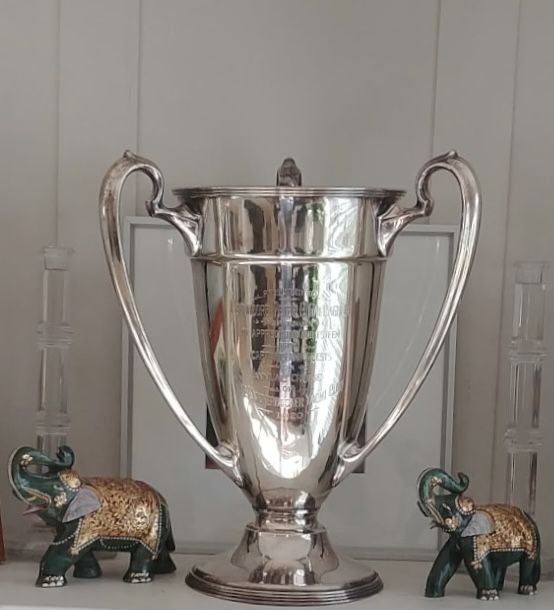
The cup presented to Commodore Peter C. Gallagher by the members of
the Knickerbocker Yacht Club in 1920.
In “Gatsby,” Fitzgerald creates a literary snow globe, where his reader can visualize the location as if high above the bay, observing the divers, swimmers, yachters, and flyers as they crisscross the water and sky on a bright summer day. It was Gallagher, I argue, who presented the panorama we find in “Gatsby,” filled with the fast-paced action of a new post-war generation taking over society. Gallagher had the relative youth, the wealth, the style, the clubs, the Manhattan home, the summer estate on the courtesy bay, the winter estate in Palm Beach, and command of six hundred sand miners as well as dozens of tugs and barges plying the waters of Long Island Sound, the East River, the North River (Hudson River), New York Harbor and beyond. The Commodore would likely have lit Fitzgerald’s fancy and provided inspiration for the grand and ultimately tragic figure of Gatsby.
Fitzgerald was the finest literary alchemist of his generation. He was the new, youthful writer who spanned the transition of American fiction. With This Side of Paradise, he brought literature kicking and screaming out of the Gilded Age to a generation that valued fast cars, drinking, sex, and jazz and shunned the prior generation who had delivered its youth to the meat grinder of a European war fought for the glory of monarchies. He was America’s first true cultural rock star, and he and Zelda were the first power couple, whose antics and shenanigans were reported on and eaten up by a public transfixed with their glamor and energy. With the publication of Gatsby Fitzgerald presented his masterpiece, a novel that defined an entire decade, which ended with his own literary and personal fade-out and a nation’s hangover filled with poverty and despair. Many readers may think of Fitzgerald as a frivolous writer, a dreamer, a lost soul who just stumbled upon his own genius, but any serious Fitzgerald scholar knows when it came to his writing—his art—he was deadly serious. He mined the real world for facts and figures, street grids, cars, current affairs, business failures, court cases, and, most especially, characters that he could mold into his own. Like any alchemist, Fitzgerald took the raw ore of real people, often a combination of several people, and elevated the everyday into something magical, something real yet on a higher plane. That is the essence of great literature and Fitzgerald had it in spades. It is what Shane Leslie meant when he wrote, “ —perhaps I shall remember the book long after I have forgotten the background. Yet the background is real and the book is art—artificial art but really wonderful.”
Old money & new
Like his literary snow globe, Fitzgerald created a literary chessboard for his locations, where any given piece could move diagonally, horizontally, vertically or jump right over an object—like a bay or the Long Island Sound. Perhaps it is true that Nick’s cottage resembles the “gray house” modeled after Scott and Zelda’s first summer home in Westport, Connecticut, which made its debut in Fitzgerald’s second novel, “The Beautiful and Damned.” So Fitzgerald flew the cottage over to Great Neck, where Fitzgerald and his friend Ring Lardner had often sat on Lardner’s porch, drinking ale and watching the continual party next door as it progressed all day into the evening, into the night, and, finally, into a new dawn. The actors, dancers, writers, producers, bootleggers of Great Neck were combined with the old money society couples from Port Washington-Sands Point and other points along the Gold Coast. Even a prince called “Duke” joined in the fun. Fitzgerald presented the Jazz Age as it was, where newfound fame and money mixed with old money, entertainers mixed with industrialists, and any other mix of characters Fitzgerald’s fertile imagination could think to invite.
Within this three-dimensional chessboard Fitzgerald was master, in my view, moving Gallagher’s style and exterior across the bay to Great Neck and placing William Burke Cockran’s estate on the courtesy bay complete with Gallagher’s dock, adding a green light for the ultimate literary and symbolic reference point. Likewise, exterior characters were meshed together so that Gallagher’s style, wealth, liquor-fed parties, and high-speed motorized vehicles—air, land and sea—were gifted to Gatsby, no longer a church benefactor, scion of a family business empire, husband and father, but a dark and nefarious character who pines for a thinly-veiled Zelda in the form of Daisy—the most passionate relationship in Fitzgerald’s life. The smooth flow of a southern beauty is unique and Fitzgerald, fresh from frozen St. Paul, Catholic prep school, WASP-laden Princeton, and army officer training, never knew what hit him and never fully recovered from the hurricane of Zelda Sayre.
I would say to a new generation of Fitzgerald scholars and literary historians: go forth and explore Port Washington, because that is where it all begins—the most unexplained venue in Fitzgerald and Gatsby lore. The same train will take you to the same station that Fitzgerald and Shane Leslie arrived at when they visited Bourke Cochran in 1917. It is last stop on the line, at the top of Main Street. From there, venture over to the Port Washington Public Library and the Cow Neck Historical Society. The records are not yet fully digitized, so one must become a miner, not for sand, but for the answer to a literary mystery that remains unsolved.
Amble down Main Street toward the courtesy bay. At the bay, the road will take a ninety-degree turn to the left and will run adjacent to the water. Presently, Main Street will become North Plandome Road. You will pass the Manhasset Bay Yacht Club and then arrive at the Dolphin Green Apartments, where more than a century ago Gallagher’s estate stood on a rise, with a lawn running down to the water, ending at a dock where the AMURAY sat, the final stage for a tragedy about to befall the prince of a vast empire that reached west toward the greatest city in the world. Allow the voice of Nick Carraway to wash over you, “Gatsby believed in the green light, the orgiastic future that year by year recedes before us. It eluded us then, but no matter—tomorrow we will run faster, stretch out our arms farther…. And one fine morning——so we beat on, boats against the current, borne ceaselessly back into the past.”
James Rodgers is a maritime lawyer who lives with his family in Manhattan. He is the author of the novel “Long Night’s End.”