
When retired attorney and Vietnam veteran John J. Reilly got the call to join a group of Fordham law grads heading to the El Paso Detention Center in Texas, to aid beleaguered immigrants facing deportation, he felt he had to say yes.
"I had been volunteering up in the Bronx providing advice to immigrants who were fearful of being arrested by ICE," he said, "and when the Dean Emeritus of Fordham Law John Feerick put out his call, I felt I couldn't refuse."
If you sign up, you gotta march, and as a Fordham Law Review Grad, New Yorker John felt he had no option but to pack his bags for El Paso. But there was something else as well: his Irish forebears.
"My great-grandmother Mary Brennan was a refugee from the Irish Famine," explains John, visibly choking up. "She arrived in New York just prior to the Civil War and married my great-grandfather Patrick Reilly in 1865. They had six children, three boys and three girls. One of those boys was my grandfather John Reilly who I knew and remember well.
"My great-grandfather died in 1889, at the age of just 47, and when my great-grandmother applied for an Army pension, she signed the application with an X. She died soon afterwards, and her younger children, then orphans, were reared by a relative named Catherine Brennan whose mother had died on Christmas Day on the ship which brought her family to America. How could I refuse?"

Rather confusingly named El Paso Camp East Montana, and built on the site of a former internment camp for Japanese Americans, the privately-run, sprawling US Immigration and Customs facility, located along the Texas-Mexico border, is home to around 3,200 detainees who have been rounded up across the U.S.
The Fordham team which included two immigration judges who had been fired by President Trump, co-ordinated with a local not-for-profit providing legal assistance to detainees. "Our job was to interview and screen 90 detainees who the local group had chosen on the basis that they seemed to have a good defence against their deportation," explains John. The Camp East Montana migrant detention facility, shown Jan. 25, holds thousands of detainees from across the country. (Corrie Boudreaux/El Paso Matters)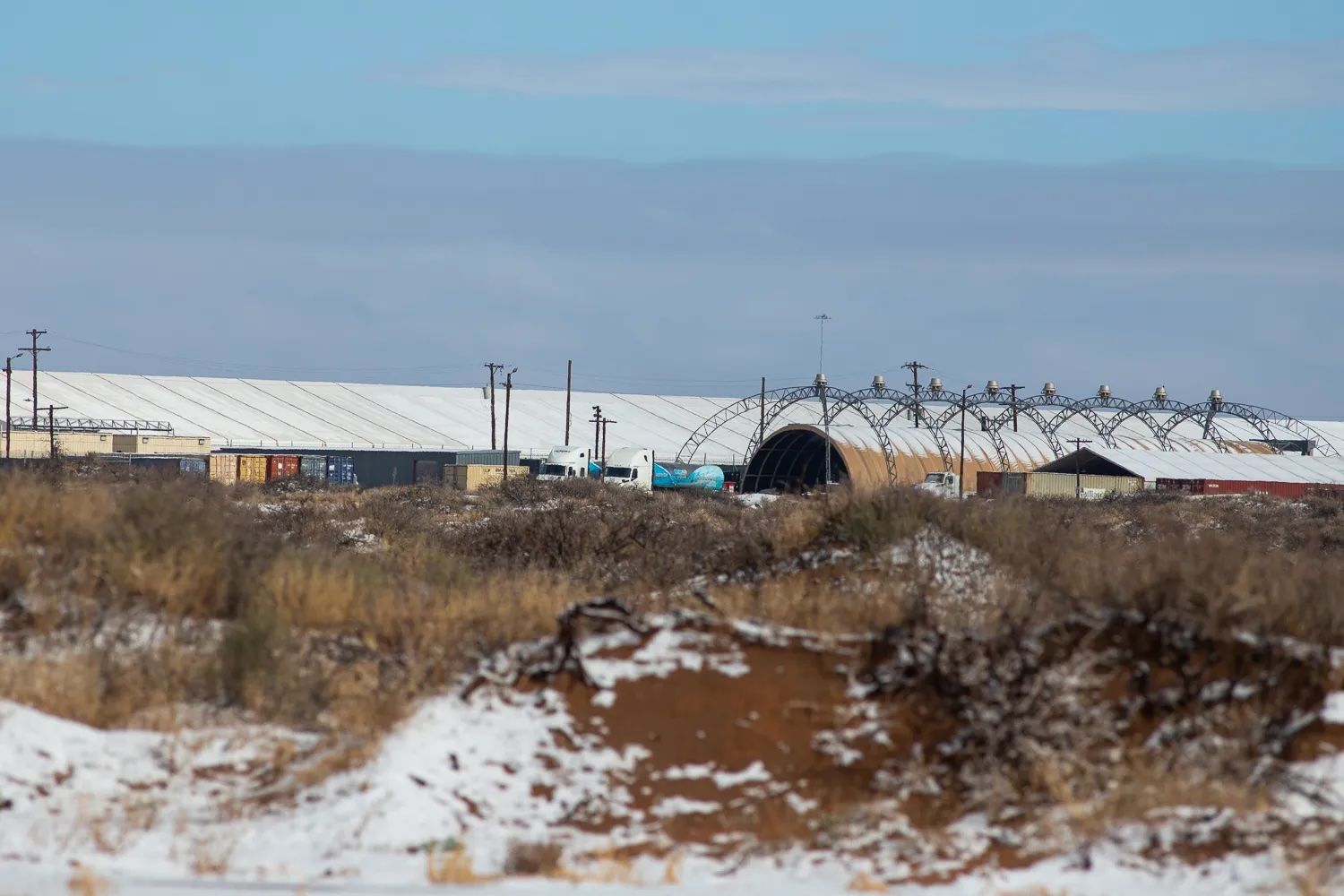
From 3-10 January this year, the Fordham team on the El Paso detail split into pairs, with each retired attorney buddying up with a multi-lingual Fordham law student. As it turned out, ICE could only locate 45 of the detainees the team had wanted to interview — "even though it's a prison for goodness sake" — making them available to the lawyers in a large, gymnasium-style hall. "I have to say that for all the talk about protecting America from 'the worst of the worst', the people we met were ordinary immigrants chasing the American dream," says John. "In fact, in all my time both volunteering with a Quakers' relief project for immigrants in the Bronx and in El Paso, I have yet to meet a hardened criminal. Some have lived her for decades, paying taxes and rearing their families. They are hardworking people."
For John, the entire White House assault on immigrants is "based on a lie". "No doubt there are some bad people among those being held but to get that in perspective, it's a very small percentage of the total."
Slammed for its harsh living conditions, the El Paso Detention Center, currently battling a measles outbreak, has seen several deaths, including a suspected homicide, and is now the focus of a contract review by the Department of Homeland Security.
"One person died the day we arrived," recalls John. "I'm told they want to increase the detention capacity to 10,000 but they clearly can't cope with 3,200. And among that number are many people who have signed up for self-deportation but still find themselves locked up months later. The only conclusion you can reach is that the operators are trying to make more money by continuing to hold them."
John said his most troubling encounter was with a distressed father-of-two. "He was the biggest guy in the room, sitting at a table on his own and really standing out," says John. "He was a huge, muscled black guy who had fled his native country and who had, it seemed to me, a good asylum claim. He had escaped his home country with his wife and children after his house had been blown up by gangs. They had travelled first to Chile then worked their way up to the U.S. and to the American Heartland where he was working in a food processing plant. But one day he is stopped by state cops and as he can't answer their questions — he speaks no English — they arrest him and accuse him of resisting arrest which is a felony in the state. After two months in detention, he's advised to plead guilty in order to get released, which he does but not realising that once he receives a felony conviction, he has no asylum claim. He was totally f***ed because once convicted, he was arrested by ICE and shipped down to El Paso. We explained that the solution would be for lawyers to go to back to get the conviction expunged but as we were exploring his options, this big, tough guy starts to cry. It really broke my heart."
There was, though, some light amidst the gloom. "In this country, everyone is entitled to due process but only one-in-ten of the El Paso detainees actually has legal representation," says John. "But on our last day, we got to go to court to represent some of those we had identified as having a strong case. The highlight was getting one woman released — it was as if she had won the lottery."
Modest wins cheered the Fordham team. "I would like to think that I made a small difference," adds John, "by not making it easy for this administration to simply run these ordinary people out of town."
In a report released after the Fordham visit, Lisa Landau and Emerson Argueta of Fordham Law School’s Feerick Center for Social Justice decried conditions at Camp East Montana.
"Working people living peacefully in our communities are being 'disappeared' to places far from their communities," they write. "Masked ICE agents hiding their badges are arbitrarily sweeping people off the streets – sometimes in a factory raid, but increasingly in indiscriminate 'operations' while people are engaging in their everyday lives: returning from work or putting their garbage out; and often — shockingly — at courthouses, where people dutifully appear for their court dates.
"What we learned (in El Paso) underscored our feeling that...we don’t recognize our country anymore," they declare, adding, "while emptying our towns and communities of people who have been contributing – by paying taxes, caring for children or the elderly, working in stores, on farms, in construction – we are losing on every front. We are losing our neighbors and people shouldering necessary jobs. We are losing tax dollars because we are paying a daily rate (upward of $150) for private companies to 'house' each deportee after having spent $1.2 billion to build the largest U.S. detention center ever. But the most important loss is this one: we are losing our humanity, paying to imprison people from our communities to a place where basic standards of food, medical care and sanitation are not being met and violence abounds."
For John J. Reilly, the visit to El Paso left him moved and disturbed in equal measure. But he also returned home uplifted in the knowledge that he had repaid, in part, a debt to his Cavan forebears. "Every time I looked at someone in El Paso, I saw my great-grandmother Mary Brennan looking back," he says. "Washed up in a foreign land, she was a terrified, desperate refugee fleeing persecution and hoping for a fresh start in this great country. You know, the descendants of this illiterate immigrant went on to achieve the American dream. I'd like to think the Mary Brennan of the 19th Century would approve of my work for the many Mary Brennans I saw in El Paso."