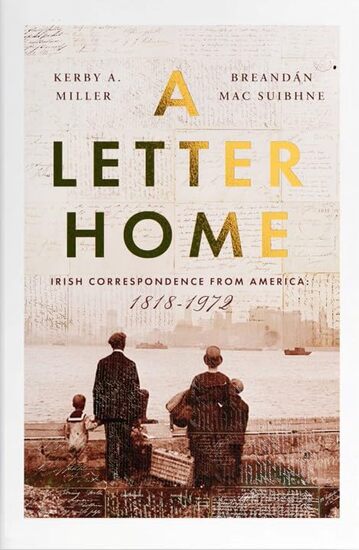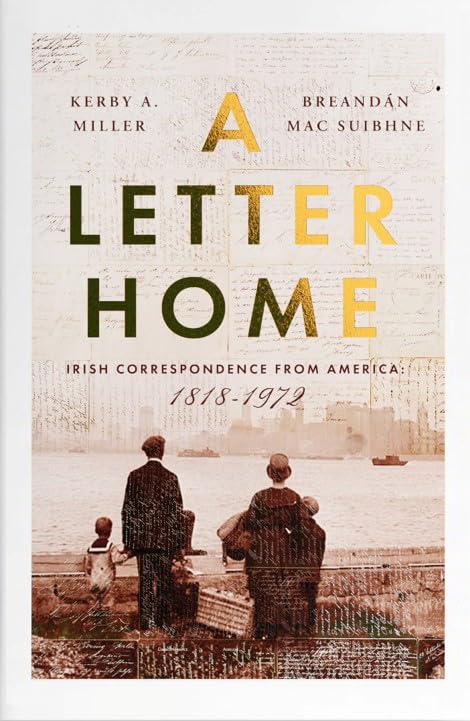
A Letter Home” has its roots in a landmark work of history published in 1985. By the time, Kerby A. Miller finished writing his study “Emigrants and Exiles: Ireland and the Irish Exodus to North America,” he’d read an estimated 5,000 letters
His research began in Berkeley in the early 1970s and he continued over the decades to seek out Irish immigrant letters.
The current volume, which is subtitled “Irish Correspondence from America, 1818-1972” and co-written by Miller with Breandán Mac Suibhne, has 62 letters.
Mac Suibhne also has a landmark and acclaimed book to his name. “The End of Outrage: Post-Famine Adjustment in Rural Ireland” was selected the Irish Non-Fiction Book of the Year by the Irish Times in 2017, while the Royal Irish Academy and the American Conference for Irish Studies awarded it their top prizes.
The historian teaches at the University of Galway, where he is a director of Imirce: The Kerby A. Miller Collection.
The Irish Echo in recent days sent the two historians a few questions about their book.
Do you have a favorite in the 62 letters in “A Letter Home”?
Kerby A. Miller: There are so many poignant letters that it’s difficult to single any out. But I’ll never forget the lines written by a Mrs. Nolan from south Kilkenny, begging her son in Rhode Island to send the passage money so that she and “little Dickey,” her youngest child, could escape poverty and hunger: “never I thought,” she wrote, “that it would come my turn to beg no more.”

Kerby A. Miller with some emigrant letters. [Special Collections, University of Galway]
Another very poignant letter was written in 1877 by Mary Malone, a “lonesome and downhearted” domestic servant in upstate New York, to her family in County Waterford. She wrote that “my wages is so little” that she could not send any money home. “I am not capable of earning big wages like other girls who can cook and do the large washings and fine ironings”; she had never learned those skills, she lamented, because “I was sent away from my mother when young to the farmers to work out in the fields.” Those letters are the tip of the iceberg, for there were at least a million Irish like Mrs. Nolan, who failed to escape the Famine, and there were millions more like Mary Malone, who lacked marketable skills and found that the United States was no “promised land.”
Breandán Mac Suibhne: That is not an easy question to answer—there are so many letters and such diversity of experience. Still, for brutal pithy eloquence, you can’t beat a letter by John Costello, a labourer from Croagh County Limerick, who was working in a lumber camp in the Pacific Northwest in the 1880s: “Sooner than I would work for a farmer in Ireland,” he wrote, “I would cut off my good right hand,” It really reminds us—as Kerby always does—that while the landlords are the great villains in the popular imagination, and for many good reasons, farmers often brutally exploited the laboring poor.
Another favorite of mine is a letter by Helen and John Lenehan, who emigrated from Roscommon to work in the New York subway and city hospitals in the 1920s. Writing home in 1972, they rage against all the changes that have come over New York. The city had been teeming with Irish people when they arrived. But the Depression and the War and changes in emigration law staunched the flow to the States in the mid-1900s. By 1970, there were 251,000 Irish-born people in the U.S., down from almost 600,000 in 1940, and almost one-in-three of them were over 70 years of age.
There is a certain irony in that letter, too. John died in 1976, but Helen lived to be 90, dying in 1996. She saw the last great wave of Irish emigrants to the U.S., when in the 1980s and early ’90s over 100,000 Irish people, many of them graduates, preferred the precarity of undocumented employment in America to the certainty of unemployment at home.
And 1996, the year Helen died, is notable for the Republic of Ireland experiencing positive net migration for the first time, that is, more people coming into the state than leaving it. The financial crash of 2008-09 reversed that trend, but since 2014 positive net migration has been the norm in the South and it has become the norm in the North too. And strikingly, North and South, many of Ireland’s immigrants now work in health and public transport, the very sectors in which John and Helen established themselves in New York.
Kerby, you have long been concerned with how emigrants understood their emigration and how they framed it. Could you give a few examples of that from the letters?
Miller: I think that a combination of social, political and cultural circumstances shaped how the Irish understood and framed their emigrations, and of course those changed greatly over time. A skilled weaver who left Ulster in, say, 1820, had different dreams than an Irish-speaking laborer who left West Kery in 1900; and American economic opportunities changed as well. For example, before the Famine many Irishmen wrote that they sought, and often achieved, what they called an “independence” in America, which could be understood in terms of ambitions for upward mobility and riches or, more likely, for the secure self-sufficiency that was the goal of family farmers and craftsmen. During the Famine, however, the hope of most emigrants was sheer survival, and after the Famine, in the late nineteenth and early twentieth centuries, when America was dominated by huge industrial corporations, “independence” was rarely possible, and so the goal was steady work, decent wages, and the chance to have the home and family life that Irish conditions had denied them.
Breandán, how did the two of you get to know each other?
Mac Suibhne: Kerby and I got to know each other many years ago, in 1992 or 1993, when I was a young graduate student at Carnegie Mellon in Pittsburgh, Pa. As I recall, my supervisor, David W. Miller, introduced us at an American Conference for Irish Studies annual meeting (I think it was at Villanova). I had been a great admirer of his work since reading “Emigrants and Exiles” at college. Irish historians back then were a conservative bunch, but there was nothing conservative about Kerby: he was deeply concerned with ordinary working people—the vast majority of Irish emigrants—and with understanding how they lived through the big changes that made modern America, most especially, from the mid-nineteenth century, with how people from poor rural backgrounds came to terms—or didn’t come to terms—with industrial capitalism.

Breandán Mac Suibhne.
Anyhow, we kept in touch and later, when I was back in Ireland about 2005 working for Field Day—the theatre and publishing company, established by Brian Friel and the actor Stephen Rea—the critic Seamus Deane and I commissioned a collection of essays from Kerby for a book series in Irish Studies. It was a great honor: any publisher would have been lucky to get it. Anybody who has read and enjoyed his “Emigrants and Exiles,” should try and get their hands on that book, “Ireland and Irish America: Culture, Class, and Transatlantic Migration” (2008). And failing that, they can pre-order his next book “Best We Forget: Irish Encounters with American Society,” which will be published in March 2027.
Irish immigrants, perhaps a good deal more than others, expressed their fondness for “home.” What did they mean by that?
Miller: The Irish had a proverbially strong attachment to their families and to the places and landscapes where they were born and raised. Emigrants like Tim Cashman, a laborer’s son from east Cork, wrote fondly of the crossroads dances and also of the songs and stories they had heard and sung at the firesides of their parents’ cabins. But there was also a political context, because many, perhaps most, emigrants believed that the poverty and lack of opportunities that obliged them to emigrate were the direct or indirect results of landlordism and what they often called, in their songs as well as letters, British tyranny. I think that this was one reason that Irish American nationalism was so strong. The Irish abroad believed that emigration would cease once Ireland was free. Sadly, that turned out not to be the case, because the long-term effects of British imperialism and capitalism remained.
Mac Suibhne: Here, at the University of Galway, we had a graduate student in history, Helen Sweeney, who did a fine MA dissertation that drew on the correspondence of a fellow called Mick McGee who worked as a tunneller and miner in Pennsylvania, Illinois and Colorado in the 1870s and early ’80s. Helen argued that Mick was always trying to dig his way back home—that so strong was the tug of home that gathering the wherewithal to be able to establish himself at home was his prime objective. The poor fellow died in a mining accident in Leadville. Helen’s MA will be published by Four Courts Press next year.
Kerby, you have written that “After the Famine, most Irish emigrants were the sons and daughters of landless agricultural laborers, who were often more exploited by farmer-employers than were the latter by their landlords.” Could you comment on that in the context of the letters?
Miller: Yes, references to class-conflict and to the exploitation of laborers and servants by what were often called “strong farmers” comes through in many letters, perhaps most clearly in the one written by John Costello from County Limerick, which Breandán mentioned earlier. However, I think that complaints in letters and songs about harsh landlords and evictions were most common. After all, they were at the pinnacle of what one historian called the “hierarchy of oppression.” Their “big houses” and carriages were the most visible signs of their power, just as their usual Protestantism and British origins symbolized the conquests and confiscations that, Irish Catholics naturally believed, were the ultimate causes of Irish poverty and emigration.
Have there been times when, even as professional historians steeped in the primary sources generally, you’ve been taken by surprise by things contained in the letters?
Miller: I was surprised at first by the remarkable and often the unusual eloquence of so many of the letters, especially, I think, the ones that were written in an English that was heavily influenced by the Irish language, still so prevalent in the Irish countryside, or, among Irish Protestants, by young people who had first learned to read via the King James Bible. But I was also deeply impressed by the emigrants’ efforts to tell harsh truths about American society and the hardships, exploitation, and prejudice that their friends at home were likely to encounter if they emigrated. So, although there was a common belief in Ireland that emigrants’ letters were full of delusions about American “streets paved with gold,” I almost never discovered any letters that were not very realistic. Very often, in fact, the emigrants wrote that they knew their recipients did not want to read or know about anything negative about America that might discourage emigration—because, whether the United States was “the land or promise” or, as others warned, “the land of sweat” or “the land of snakes,” emigration for most young people was unavoidable.
Mac Suibhne: I don’t think you ever really get over the pity of it all—young people leaving home in their late teens and early twenties, bidding goodbye to those who reared them, never, in most instances, to see them again. Young people growing up who only knew some siblings by name, who never met elder brothers or sisters in person—and who only ever glimpsed their personality in letters from America—there is a great sadness there. But that was the system—there was no place for them, they had to leave. Yes, that never ceases to surprise: you think you have seen it all, but then reading a letter you suddenly realise how young the writer had been when they left and the length of time they were away, and yet they are still writing, still missing home.
Breandán, tell us something about the Imirce database.
Mac Suibhne: While Kerby is still a very active researcher, on retirement from full-time teaching, he started to consider what should happen to his voluminous collection of transcripts of emigrant letters and memoirs which, over the years, many scholars had travelled to Missouri to consult. Ultimately, in 2020, he and his wife Patricia decided to donate it to the University of Galway. There was a certain symmetry to the decision, not least as Galway is in the heart of the west of Ireland, the part of the country that felt most severely the ravages of emigration from the time of the Famine. In accepting this extraordinary gift, the University committed to making the material accessible online and to continue the work of collection through regular appeals for more material.
The Imirce digital repository has proved a boon to students of Irish and American history, to artists and writers, and to genealogists. And if it connects researchers across time with Irish emigrants, it connects, too, the descendants of those emigrants with the homes that they left behind. I would encourage Irish Echo readers to poke around Imirce site on the University of Galway Library website, and to rummage, too, in drawers and cupboards—and if they have any letters, sent or received by Irish emigrants, get in touch with the project. We’d love to add copies of the material to the database.