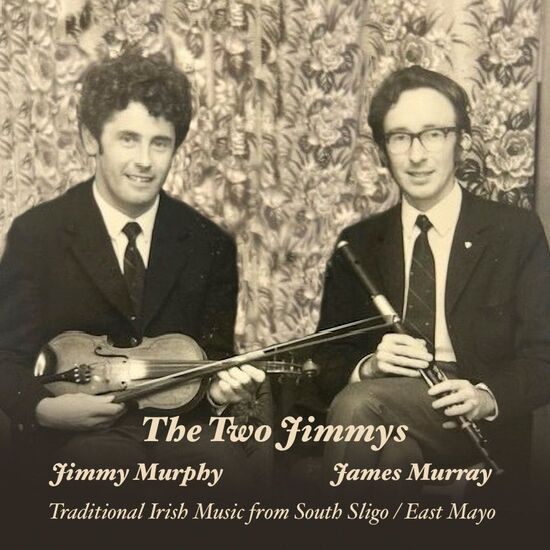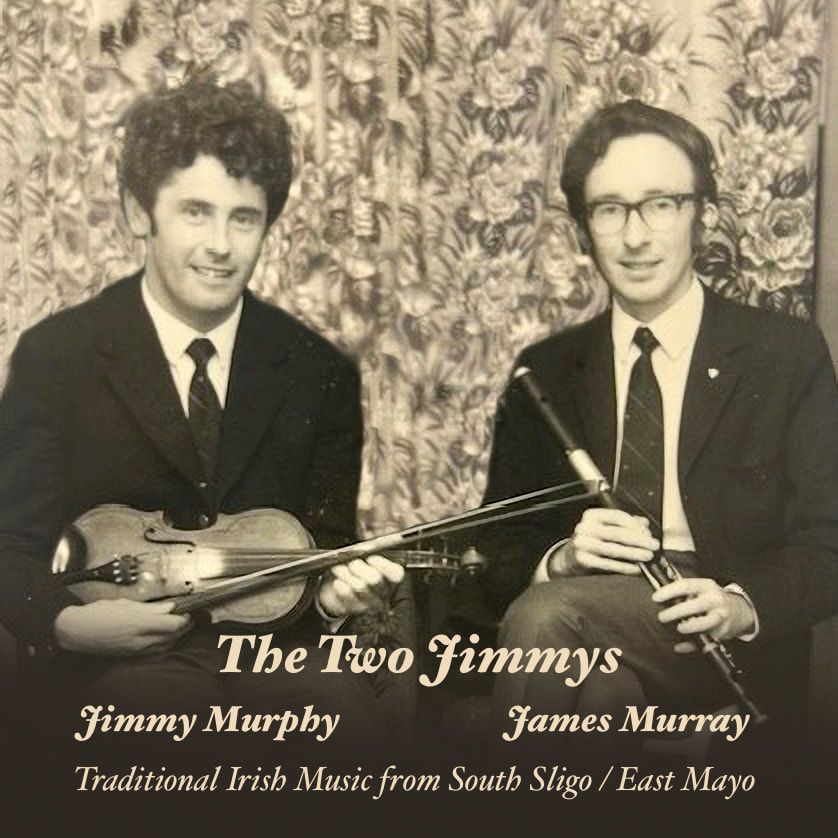
In the media yoke this week is a real cracker of an album from fiddle player Jimmy Murphy and flute player James Murray called “The Two Jimmys: Traditional Irish Music from South Sligo/East Mayo.” Murray and Murphy, who played together for over 40 years, notably at a pub in Gurteen, Co. Sligo, called the Róisín Dubh, had a special rapport and played music that was informed by the extraordinary musical heritage of their home places. This album, which was recorded at a house session in Tubbercurry in 1982, is pure drop, old fashioned traditional music, delivered in a most satisfying manner. It captures the magic these two musicians shared and is a must have for traditional music lovers.
Murray and Murphy are archetypal tradition bearers with a long past together. Murray was born into a musical family in Tubbercurry, Co.Sligo, and his music came from a much revered generation of older musicians, many of whom would only be locally known. Considered one of “the last surviving musicians with a direct link back to the original tradition bearers,” he is a special flute player who plays the music in a way that cannot be argued with.
Murphy, who passed away in 2022, was born in Meelick, Swinford, Co. Mayo. Like Murray, he was from a musical family whose music was shaped by a number of local influences. However, his most important influence was Fred Finn, the great Killavil fiddler, from whom he learned repertoire and bowing. It’s a striking connection to a much larger tradition helps give this album the depth it has.
But what this album is about is the music and the playing here is of a uniformly high quality. Should I be paying most attention to “The Kerry Reel / …”? “The Legacy / …”? “The Providence / …”? “The Chicago / …”? Yes. Any or all of them – they’re all great. Each track has a real brilliance that will keep people listening because there’s real soul here, which makes it nigh-impossible to single out one track over another. Sure, you can get into the weeds over nuances like ornamentation and tune setting, but even then, you’re haggling over details, not questioning the life in the playing. It’s the long, warm hug you get when you walk into a room with a fire going in the hearth – you sit and enjoy it because it what love sounds like.
If one were to find something about this album to knock – and that someone won’t be me – it’s that it does sound like a homemade recording made in 1982. But for the person who would dismiss “The Two Jimmys” on the grounds of audio fidelity, I’d ask this: what would a studio setting have changed? Would Murphy and Murray have sounded so at home had they been making this music in a controlled studio environment, with sound reinforcement and a professional engineer making recommendations about how to sound “correct”? Certainly not. Certainly not.
What makes “The Two Jimmys” special is that it captures a pair of tradition bearers making music that’s crippling in its simplicity and beautiful in its expression, doing it entirely for their own edification. It’s a remarkable window on how traditional music should work. This is real deal, bedrock stuff that will immediately attract true connoisseurs. If you love Sligo music and the heritage of Coleman, you’ll recognize the importance of this album. If you love the album Fred Finn and Peter Horan made together, or either of the albums Horan made with Gerry Harrington, this album will delight you as well. It’s a must have. The album can be purchased through Richie Piggott’s website, https://www.richiepiggott.com/. And the kicker? All the proceeds for this album go to Cystic Fibrosis Ireland. Run, don’t walk, to pick up this one.