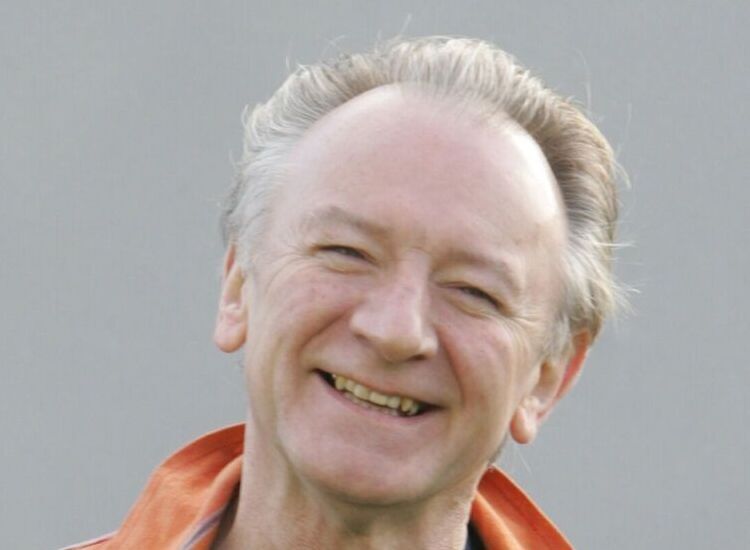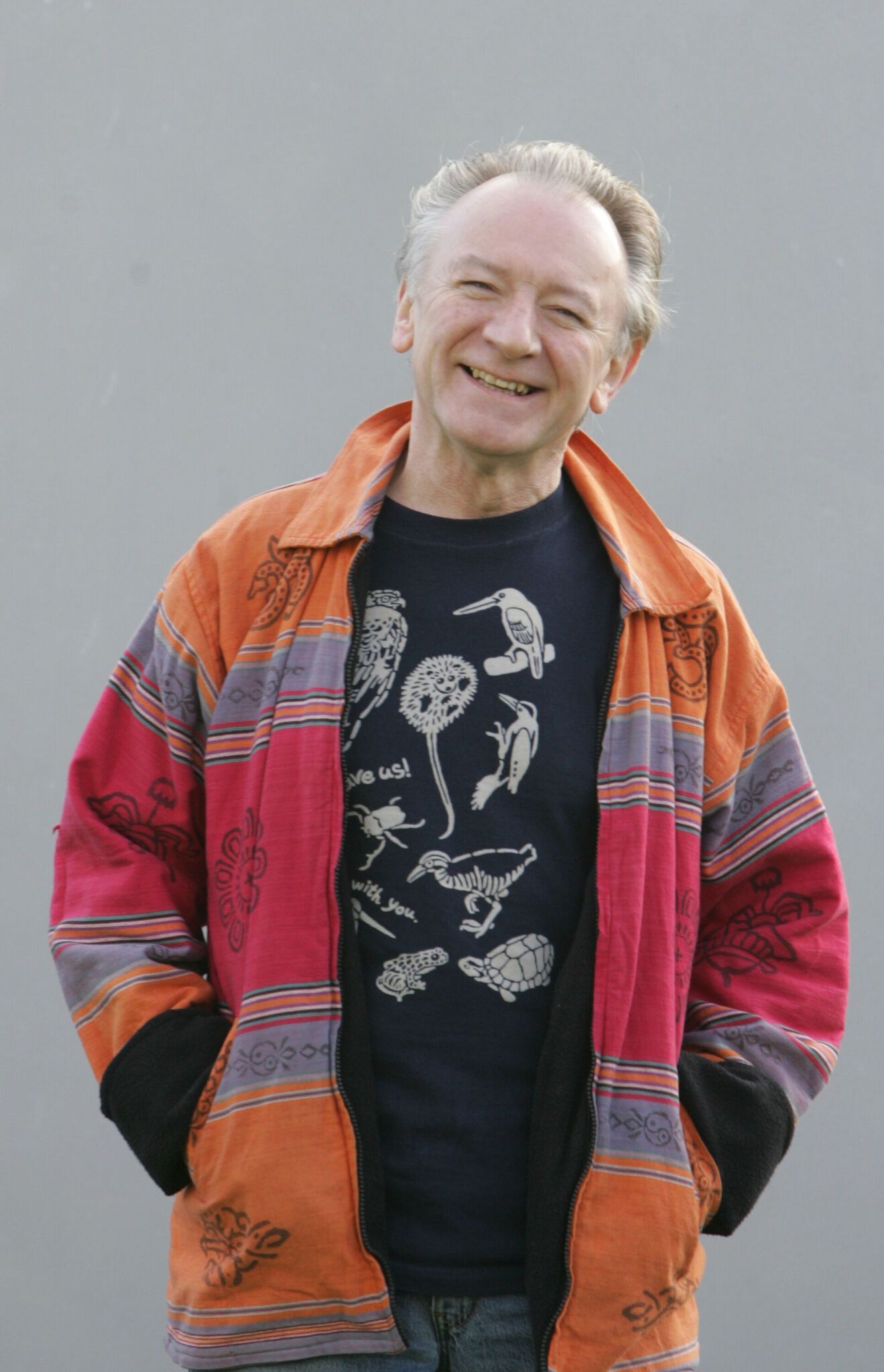
A significant loss to report this week in the death of Dónal Lunny, at age 79. Perhaps the finest guitar
and bouzouki player Irish traditional music has produced, Lunny was a pioneer of the 1960s folk
revival and a towering figure ever since, co-founding the bands Planxty, The Bothy Band, and
Moving Hearts, among others.
Lunny was born in Tullamore, Co. Offaly, and grew up in Newbridge, Co. Kildare, where he
was a childhood friend of singer Christy Moore, with whom he performed when teenagers as the
Rakes of Kildare. In 1965, he moved to Dublin where he was heavily involved in the music
scene, in both the folk clubs and in groups including the Parnell Folk (with Mick Moloney, Sean
Corcoran, Johnny Morrissey and Dan Maher), Emmet Folk (with Moloney and Brian Bolger),
and Emmet Spiceland (with Bolger and Brian & Mick Byrne).
In 1970, he connected with Andy Irvine and together they performed as a duo, running a
popular folk club in Dublin. The following year, Lunny and Irvine, along with uilleann piper Liam
O’Flynn, were invited to perform on Christy Moore’s album “Prosperous.” This group become
Planxty, whose eponymous 1973 album helped change the face of Irish music. Lunny appeared
on all of the group’s early albums but left the group a short time later to form Mulligan Records. He

would eventually rejoin the group in 1979 and stayed with them until 1983.
After leaving Planxty, Lunny maintained a sharp upward trajectory. In 1974, he produced
and played bodhrán on Mick Hanly and Mícheál O’Donnell’s album “Celtic Folkweave.” The
musicians assembled for this album included Tommy Peoples, Matt Molloy, Triona Ní
Dhomhnaill and Liam O’Flynn and their chemistry led to the formation of Seachtair, with Tony
MacMahon. Although MacMahon brought the group together, Lunny functioned as its music
director and chief organizer, and it eventually became the Bothy Band, whose first album “1975,”
released on Lunny’s own Mulligan label, again changed the face of traditional music.
In addition, Mulligan Records became an important label, with Lunny producing and
playing on albums like “Andy Irvine/Paul Brady,” Matt Molloy's self-titled solo debut, Mick Hanly's
"A Kiss in the Morning," Liam Weldon's "Dark Horse on the Wind," Kevin Burke's "If the Cap
Fits," Jimmy Crowley's "Boys of Fair Hill,” and Matt Molloy, Paul Brady, Tommy Peoples's
eponymous album, in addition to many, many others. Each one of these records is a classic,
beloved by traditional music fans for decades.
Lunny formed Moving Hearts with Christy Moore in 1981 to explore the intersection of
traditional music with rock and jazz. Although the first iteration of the group included Declan
Sinnott, Keith Donald, Eoghan O’Neill, Brian Calnan and Davy Spillane and was hugely
influential, several other many fine musicians passed through over the years, including Mick
Hanly, Kevin Glackin, Declan Masterson and others. Lunny was the group’s primary musical
arranger and producer and under his leadership the group made six celebrated albums.
Lunny continued to make superb music through the 1990s and into early 2000s with
projects such as Coolfin (which brought together Sharon Shannon, Seán Smyth, Nollaig Casey,
John McSherry, and Jean Butler, among others), Mozaik (with Irvine, Bruce Molsky, Nikola
Parov and Rens van der Zalm), LAPD (with Liam O'Flynn, Andy Irvine, and Paddy Glackin) and
Usher's Island (which included Irvine and Glackin, Michael McGoldrick and John Doyle).
Lunny’s musical influence transcended the legendary bands in which he was a member.
He composed music for film and television in “Play for Today” (1980), “Eat the Peach”
(1986), “This is my Father (1998), “Bringing it All Back Home” (1991), “The Last of the High
Kings” (1996), “A River of Sound” (1997) and others. He worked with highly influential
traditional singers like Frank Harte, Maighread Ní Dhomhnaill, and Róisín Elsaftay as well as
popular singers including Kate Bush, Van Morrison, Mark Knopfler, Elvis Costello, and Sinead
O’Connor. Although Johnny Moynihan is widely credited as the one who introduced the Greek
bouzouki into Irish music, Lunny in fact developed and popularized the flat back model most
commonly used today.
Lunny’s importance to traditional music was widely recognized in his life. He held an
honorary doctorate in music from Trinity College Dublin in 2008, was artist in residence at the
University of Limerick in 2009, and then again at University College Dublin in 2021. He
received the Gradam Saoil (Lifetime Achievement Award) from TG4 in 2017, the BBC Radio 2
Folk Awards Lifetime Achievement Award in 2018, and the RTÉ Radio 1 Folk Awards Lifetime
Achievement Award in 2025. In addition, he was elected to Aosdána, Ireland's state-sponsored
affiliation of creative artists, in 2006.
Lunny was a brilliant, universally beloved musician. There are few who have led a more
expansive, nuanced, and extraordinary life in the music. It is hard to overstate how much he
achieved over the decades. The influence he’s had – and will continue to have – is
considerable, and his absence will be felt far and wide.