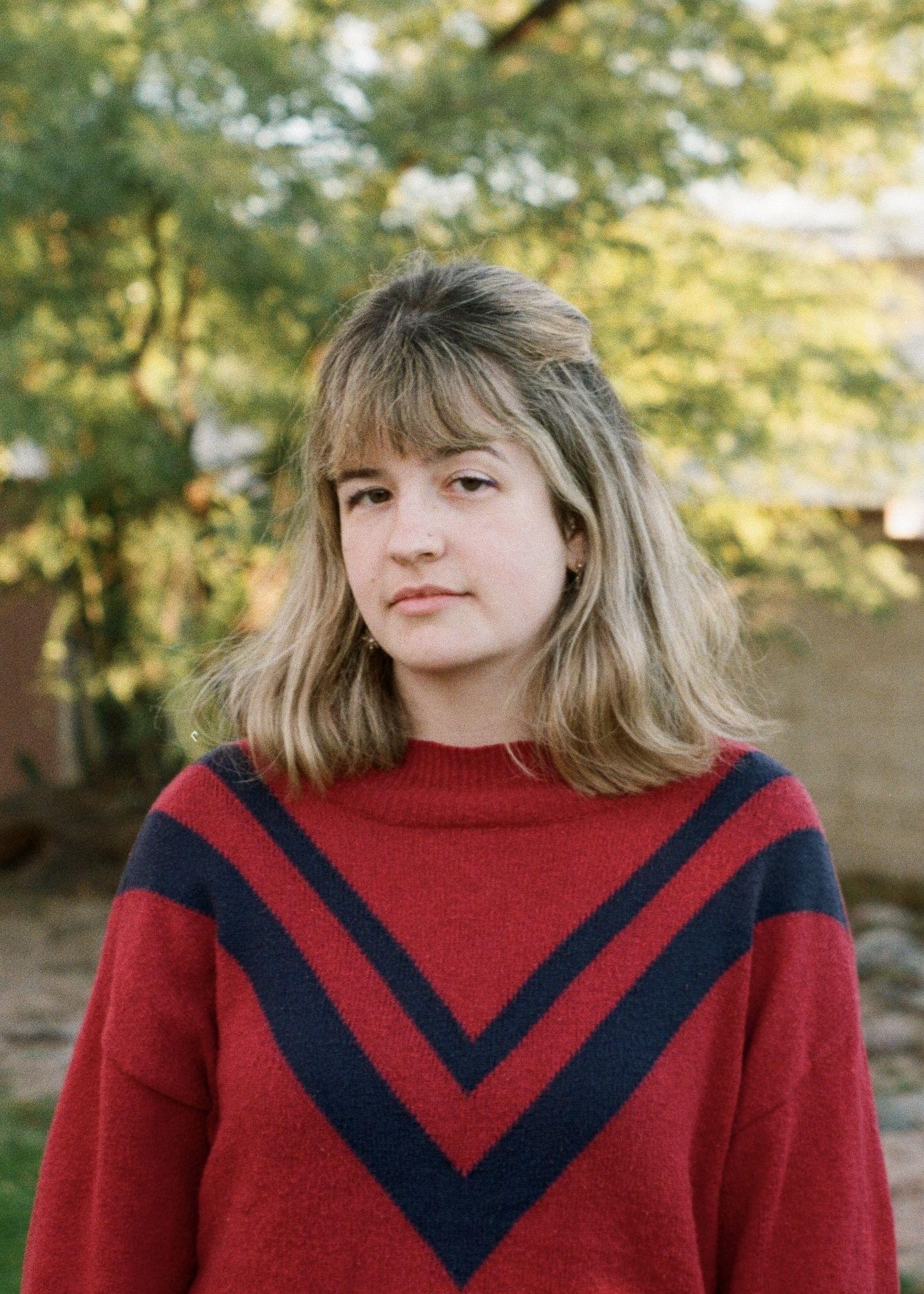
It’s an autumn Tuesday in Dublin, and I’m walking past the row of redbrick houses in Cabra, heading to the writing group I attend every week.
Orange leaves shuffle by my ankles in the cold breeze, and the sun is low in the pink sky. But there’s something else hanging in the air as well, at least for me: my visa is up and soon I may have to leave this place.
It wouldn’t be the first time I had to leave Ireland against my wishes. In 2023, my mother, back in Arizona, became terminally ill and I travelled home to spend the time with her before she died. My mother was a writer, as am I, as is my father. A three-pointed star, a constellation of three writers who used to live side by side in the same house and are now scattered, one as far away as a human can go.
After she died, I returned to Dublin. It took months for me to find my footing to any degree. I returned to University College Dublin, where I’d previously done a course when I first moved to the city, and pursued my MFA in Creative Writing.
I began teaching writing to undergrads, and eventually also found a home in a local writing group, Open Page Writers, based out of a cafe in Stoneybatter. I’ve never believed that art is the way out of the maze of grief, because there is no way out, but I do believe it’s something to do with the weight of it all. If it provides anything, it provides a shape to something formless and inescapable. What would we do without that?
I truly believe that Dublin is the best city in the world to be a writer. The country itself is a statistic-defying cluster of talent and community. There is an Irish way of writing, and a long list of notable names within the tradition. Which, in a manner both natural and completely deserved, is a great source of pride for the country.
In a recent writing workshop I attended, put on by The Stinging Fly at the Irish Writers Centre, I was bewildered when someone said of my writing: "You’ve got American sentences." Inspired by Irish writers, living in Ireland for five years, I was surprised that my style of writing betrayed me as easily as my accent. American Sentences.
The country supports its writers. The Irish Writers Centre has courses constantly running from the inside of its beautiful multi-story Georgian home. The Stinging Fly offers various workshops over the course of the year. The Irish Arts Council grants generous bursaries annually.
The Ireland Chair of Poetry gives awards to developing poets as well as students. The Basic Income for the Arts provides 2,000 creative workers with 325 euros a week. No great sum, but providing three years of stability and assurance that many artists go their lives without.
Up-and-coming literary magazines are able to pay their contributors thanks to national support. Many of my writer friends and I have been lucky enough to avail of these opportunities. I worked as a contributing editor for The Belfield Review, produced by UCD and the Museum of Literature Ireland, and have received money from both the Ireland Chair of Poetry and the Arts Council, whose funding allowed me time to work on a collection of poems and essays about my mother, an emotionally difficult and personally important project.
This is a far cry from what I see happening in the United States. In May 2025, my social media was plastered with local arts organization decrying the defunding of the National Endowment for the Arts.
Theater companies, community-based arts groups, literary magazines, and other institutions opened their emails to find their funding gone overnight, with the possibility of the total eradication of the NEA being discussed in the White House. Critics of the NEA describe it as wasteful and anti-American, although this, to me, reveals a crater-sized hole within America's perception of itself. It is not that there is no American writing to be proud of, but that the nation refuses to be proud of it.
In fact, after the blow of finding my sentences to be obviously American, I was buoyed by a group discussion of Cormac McCarthy, Toni Morrison, and Flannery O’Connor. Their sentences, too, fell under this description.
If you’re wondering what denotes an American sentence versus a European or Irish sentence, it was put to me this way: American sentences are forward leaning while the latter are more circuitous and reflective. It is difficult not to see this same basic psychology reflected in their treatment of the arts: America wielding the scythe with its eyes pressed shut, chopping into the future with no reverence to the past. One could go further and say that the U.S. as a nation was founded on ideals such as these, its roots tunneled through a thicket of eradication and dismissal.
Meanwhile, the past lives side by side with the present in Ireland in a way it does not in the United States. In "The Red Mouth" by Irish author Sheila Armstrong, the various protagonists discover animal and human remains in the tough soil of the peat bog and feel deeply connected to the distant lives of these preserved creatures. Layers of frozen centuries, these lost lives rising up from below the earth, as though time is a spiral you can dig your spade into.
Dublin is full of celebrations for the writers who have come before: Oscar Wilde reclining on a boulder in Merrion Square, blocks of lemon soap for sale at Sweny’s Pharmacy where Leopold Bloom bought a bar for his wife in Ulysses, Joyce’s head carved from stone and often rain-soaked at Stephen’s Green.
And it’s not just in the past. Literary events at independent bookstores such as Books Upstairs on D’Olier Street often sell out, debut writers who have literary success appear on television, and even my local writing group in Stoneybatter is seeking a new venue to be able to accommodate the thirty or so writers who now attend the weekly sessions. The country is right to fund this sort of thing. The funding isn’t reviving some dead form, or even keeping writing alive; the country is facilitating and supporting something that has perpetuated itself through centuries, something vitally important to its people.
Being a writer has a connotation of loneliness. In some ways, it is lonely. You make every effort to translate your private world into something that can be understood by others, knowing fully that no translation is ever perfect, knowing that your sentences might unwittingly reveal something you don’t recognize about yourself.
But it’s not lonely to be a writer here. Not in the slightest. Just in the coming weeks, I am workshopping with my MFA cohort from UCD, meeting friends from Stinging Fly Summer School for a pint, having coffee with a couple friends one-on-one to discuss our work, and planning to read at a friend’s open mic. And I’m no special case, I’ve just gone where the writing has taken me.
So yes, as I walk down Prussia Street, the cloud cover gradually darkening overhead, I feel a deep sorrow knowing that, in some administrative office in the city, they are deliberating over my visa appeal to stay in this country.
It’s funny that I’ve found such brightness here, in a city which lurks in a state of perpetual gloom. When I arrived back three years ago, I discovered it was a fitting place to be in mourning, and it still is, but I’ve done a lot more than mourn here.
As I near my destination, the wind picks up and my skin is touched by a light, misty rain. I see the lights on behind the fogged windows of the cafe, the blurred faces of friends perched behind laptops, drinking coffee and wine and laughing as the day fades away. I try to memorize this picture of home.