LABOR DAY 2026
County Waterford, you’re going to need a bigger boat!
Any mention of a shark bite in the media is likely to unleash the imagination. Headlines a few weeks back about the hospitalization of a fisherman off the coast of the sunny Southeast proved no exception.
One thought the perp might be a great white, who’d heard some shark talk of the Wild Atlantic Way and had decided to take a look for himself, particularly those less traveled eastern parts of it.
Our “Jaws” expert here at the Irish Echo, though, said the damage was likely done when the creature was landed onboard in a careless fashion by the victim or his colleagues.
“It was a blue shark,” he said, and thus not much of a threat.
Well, that was disappointing.
However, we still have the movie, which 50 years on is ever more a fable for our time.
The “bigger boat” line was spoken, improvised indeed, by actor Roy Scheider (whose mother was Irish American, in case you didn’t know) in the role of Martin Brody, the police chief of Amity Island, Mass.
Early in “Jaws”, Brody is struck on the face by the distraught woman whose son is the second known victim of the shark. She’s singled out the police chief for blame and we feel for him as he advocated closing the beach after the first death.

“She’s wrong, Martin,” says Mayor Larry Vaughn (Murray Hamilton), who’s standing beside him.
“No, she’s not,” Brody says.
As police chief, he could’ve disregarded pressure from the mayor and the business community, and insisted on closing. He’s wracked with guilt over the boy’s death.
“Jaws” is one those iconic movies that the small town can be a stand-in for the nation – which is, in this case, America.
It speaks to some of the issues of our times — when, for instance, should we shut down in the interests of health and safety?
We also see experts denigrated while denial is promoted along with wishful thinking.
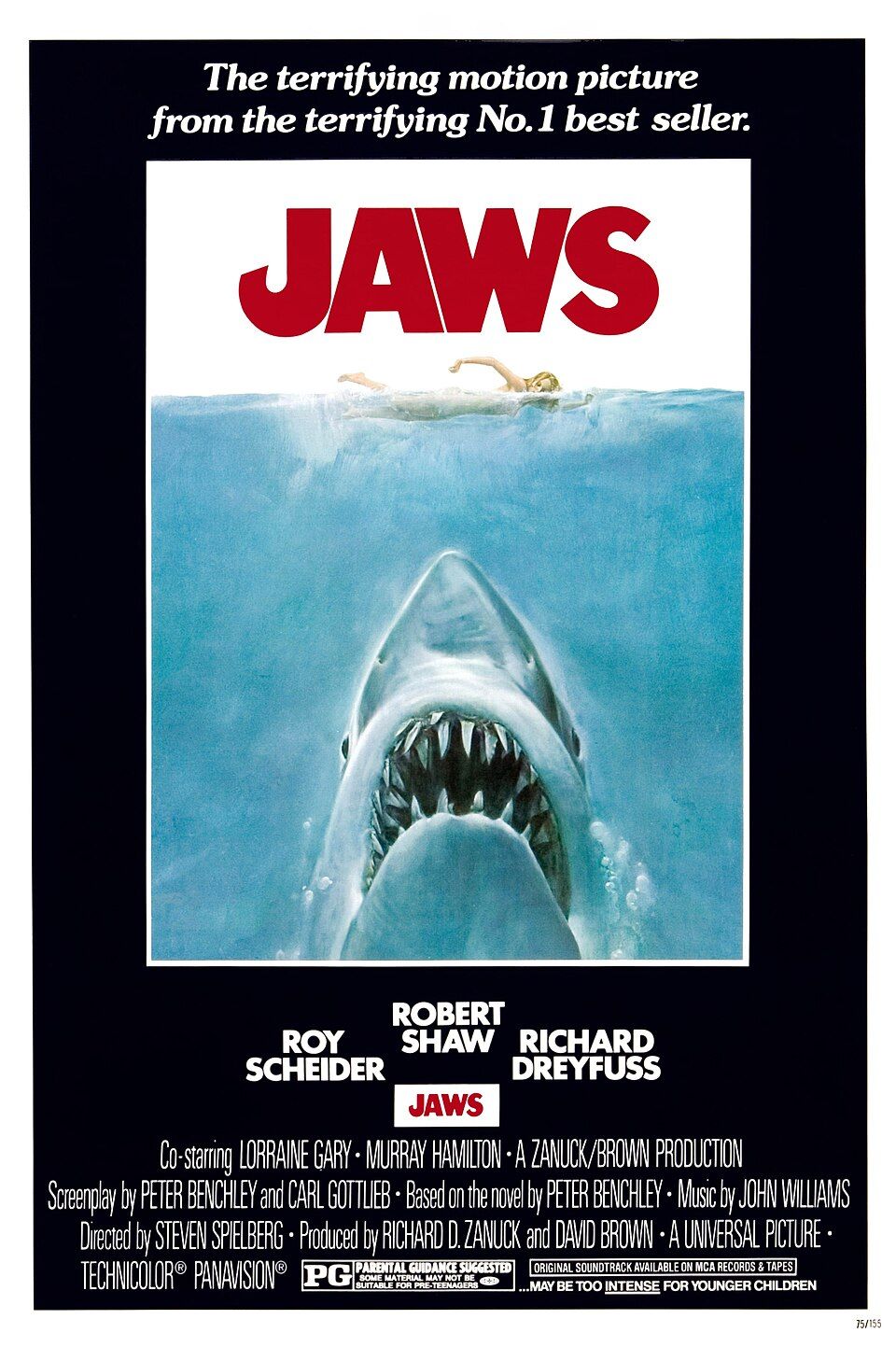
Marine biologist Matt Hooper (Richard Dreyfuss) is the expert in “Jaws.”
After four deaths, two of them rather public, the town eventually sees sense and takes action with its hiring of shark hunter Quint (played by English actor Robert Shaw, who lived in Ireland for many years and died there in 1978).
Director Steven Spielberg was largely unknown to the cinema-going public at the time. The writer of the novel, and of the screenplay’s first draft, Peter Benchley, was the big name, as “Jaws” had been flying off the bookstore shelves over the previous year, and he was the son and grandson of prominent writers Nathanial and Robert (who also appeared in movies).
One of Spielberg’s changes was to make the characters more likable. He said that reading the novel he found himself rooting for the shark. The book by most accounts is readable but forgettable; the movie, on the other hand, is a timeless classic. The book with its mafia theme maybe more grounded in the realities of power, whereas Spielberg’s version is more centrally about heroism and doing the right thing.
DENIAL IN MONTANA
There is no idyllic past in which people did the right thing, especially when it came to making profit. We only have to look at the case that some labeled “America’s Chernobyl.”
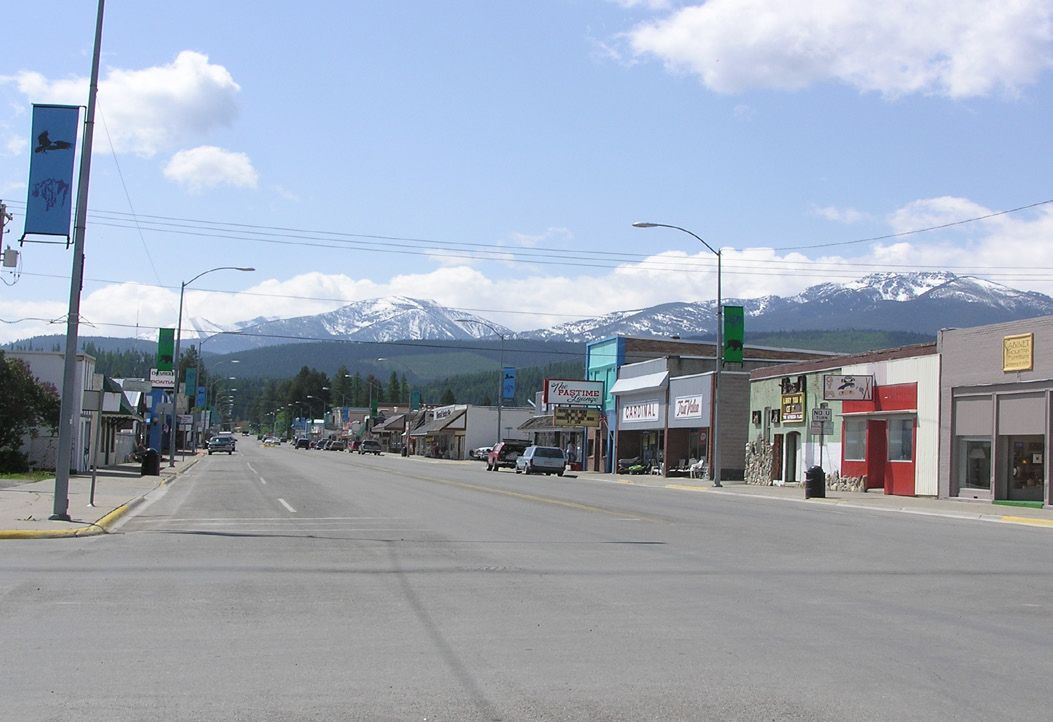
The place was Libby, Mont., and W.R. Grace & Co. was the corporation involved. It took over the running of the vermiculite mine there in 1963.
Vermiculate has a thousand uses, but is “tinged with tremolite, a naturally occurring and particularly virulent form of asbestos.”
So wrote Max Levine a quarter of a century ago. Levine is known primarily as a poet, but he has also written non-fiction features. “Killing Libby” is a notable one and was collected in the volume entitled “The Best American Magazine Writing 2002.”
W.R. Grace had abandoned the mine in 1990 in anticipation of legal problems and things were to come to a head by the turn of the millennium.
Levine wrote, “Although the company possessed detailed knowledge of the asbestos hazards to which its workers had been exposed, it had kept that knowledge to itself. State and federal governments had also been aware of the risks.”
Scientists had been arguing publicly in the 1930s that asbestos was something that needed to be handled with great care. And the state of Montana had expressed its worries about Libby’s vermiculite mine as far back as 1942.

Denial is a river in Egypt. [NASA Johnson Space Center]
After 1963, though, the new owners doubled production.
“True, the miners died young,” Levine said, “but danger was an accepted part of their daily routine, grousing about pain and misfortune was not. Miners kept their suspicions about the vermiculite dust that covered their work clothes to themselves.”
He added, “By 1995, a few families had noticed that miners’ wives were dying of their husbands’ ailment, and the miners’ children, too, learned that they often shared it, as if the hazards of the trade were genetically passed on.
“But not until 1999 did residents begin to notice that asbestosis was showing up in people who had never been at the mine and never lived with miners. Still there was no organized outcry about the contamination until the end of that year, when the Environmental Protection Agency began a belated full-scale investigation into the town’s legacy of pollution.”
Levine continued in his article, which originally appeared in Men’s Journal, “The EPA discovered that the asbestos had probably shortened the lives of most of the 1,898 workers who toiled at the mine.
“What’s more, the effects are ongoing. An astounding one third of Libby’s residents are believed to have contracted asbestos-related lung disease.”
Levine told the story of a 64-year-old man suffering from full-blown asbestos. Les Skramstad, a native of the town, had worked as a rancher, logger and mechanic, and he had been employed by the mine for just three years.
“Full-blown is when you got a death sentence,” he said.
Skramstad took an action against W.R. Grace & Co. in 1997.
“He won a judgment of $660,000 against the company, which has made him something of a pariah in town,” Levine wrote.
Skramstad said he “carried it home and gave it to my wife and three of our five children. That’s a pretty poor percentage. My daughter Laurel, she’s got three kids. She’s got it. And my boy Brent, he’s got it real bad, like me, full-blown. My grandfather lived to be 88. My dad lived to be 78. I may not make it 68. Brent, he may not make 48. Any man should look out for his family first, and being that I had a hand in their destiny, that’s pretty grim.”
THEME PARK
Mike Powers, another of Levine’s interviewees, arrived in Libby in the early 1980s and poured his savings into the farm of a local legend who’d died a half century before. That was E.N. Alley, who’d started the mine and conducted his experiments on the farm. Powers was diagnosed with asbestos-related lung disease, and was one of those victims who’d never worked in the mine nor lived with anyone who did.
“Maybe,” Powers told Levine, “W.R. Grace will buy this farm and turn it into an asbestos theme park.”
The EPA discovered that asbestos-related lung disease happened in Libby at 60 times the national average. It also learned that W.R. Grace had “pumped so much asbestos fiber into the airshed here, it hung in the center of town in concentrations that were probably 20 times higher than the present occupational-exposure limit.”
“Murder” was the term used by one EPA official on condition his name not be used.
Skramstad said, “Well, if I strangled a single person —and that what it amounts to if you’ve got asbestosis, you suffocate—I’d be in the penitentiary. And yet they do it to families, they do it to kids, and they get away with it.”
He said, “It ought to scare the hell out of the whole town, but it don’t.”
Even at this point, Levine reported, the town was divided into factions on the issue.
“Some…think the health hazards have been overblown by shiftless residents looking to cash in at the expense of W.R. Grace. Many have refused to be examined for asbestosis, not wanting to condone the hysteria. Businessmen worry about the local economy,” he wrote.
One woman who’d just lost her husband to asbestosis overheard a store clerk say, “I’m sick of hearing about asbestos. We won’t be done with this until they all just die off.”
SUPERFUND
On May 8, 2009, a Reuters report began, “A federal jury in Montana acquitted chemical company W.R. Grace & Co and three of its executives on Friday on all counts in an asbestos environmental case, and its stock surged 36 percent.
“The company and executives had been charged by a division of the Justice Department with knowingly endangering the lives of mine workers and other residents of Libby, Montana, near the Canadian border, and ignoring warnings by state agencies.”
The Reuters piece, further in, said, “The EPA began removing asbestos contamination in 2000 and Grace filed for bankruptcy protection from cleanup costs in 2001. The EPA filed to recover costs in 2003 and Grace agreed to pay $250 million in March 2008. The payment was the largest cash recovery under the Superfund law for cleaning up polluted sites, the Justice Department said at the time.”
A month after the verdict, on June 17, 2009, the EPA declared its first ever public health emergency, which covered the towns of Libby and nearby Troy, Mont.
By 2015, the EPA had spent $425 million in Superfund money on cleanup in Libby and the surrounding area. It announced at the end of 2018, it had removed "more than one million cubic yards of contaminated soil," and the cleanup was complete, except around the location of the former mine itself.
In Levine’s article, there’s one reference to a union, though it’s not clear if it was very active or well-organized. Not that that in itself would’ve been an automatic counterweight to a multinational company that wielded enormous clout as a taxpayer and contributor to political campaigns. When black lung first emerged as a concern, mineworkers leader John L. Lewis was wary about expending political capital on it. After his time his union did take the lead in combating the illness and campaigning on it.
There was no equivalent in Montana. And “a series of EPA memos in the early ’80 addressing the health risks at the mine were allowed to languish.”
During the Reagan years, the president was looking at ways to trim the budget so he could enact tax cuts and to that end, the Grace Commission was established. It was named for its chairman, J. Peter Grace, a friend of Reagan’s and the president and CEO of W.R. Grace & Co.

President Ronald Reagan addressing the nation from the Oval Office on tax reduction legislation in July 1981.
The year Levine’s article was published, 2002, the EPA’s inspector general said that the “EPA did not place emphasis on dealing with asbestos-contaminated vermiculite due to funding constraints and competing priorities.”
In 1968, back even before the EPA was founded, the U.S. Public Health Service warned W.R. Grace about asbestos at its Libby facility, saying “the dust concentrations are 10 to 100 times in excess of the safe limit.” To no avail.
Some of this came out in court actions, like the one taken in 1997 by Les Skramstad, who proved to be a compelling witness. Here’s one exchange:
Q. I understand you have some psychological problems?
A. Yes.
Q. Tell me about those.
A. I have a little problem once in a while justifying my existence on this planet.
Q. Since you were diagnosed with asbestosis, have you experienced an increase in the frequency of bouts of depression?
A. Somewhat, yes.
Q. And what do you think it is attributable to?
A. Lack of air.