The central figure represents Harry Bridges, from Anton Refregier’s 1948 murals at the Rincon Center, in Downtown San Francisco.
In 1941, Woody Guthrie and Pete Seeger wrote a song praising him. In 2001, the governor of California declared July 28 to be his day. American high schools and research institutes, boulevards, parks and plazas bear his name in 2026. But perhaps most important of all, the San Francisco headquarters of the International Longshore and Warehouse Union is called Harry R. Bridges Memorial House.
Harry Bridges was born 125 years ago — yes, on July 28 — and led an iconic three-month strike that began when he was still 32, which many thank for the middle-class lives that they lead in the 21st century.
On the San Francisco waterfront, longshoremen and their seafaring allies led their maritime strike in the spring and summer of 1934, which “plunged the West Coast into a state of virtual class warfare.”
Historian Ellen Schrecker wrote, “There was the usual police harassment and American Legion vigilantism; early in July, when the employers and the police tried to open up the docks, a full-scale battle took place.”
Two workers were shot dead by police and scores were wounded on July 5, “Bloody Thursday.”

The Roosevelt administration asked all sides to submit to arbitration and the longshoremen returned to work, provisionally, at the end of July.
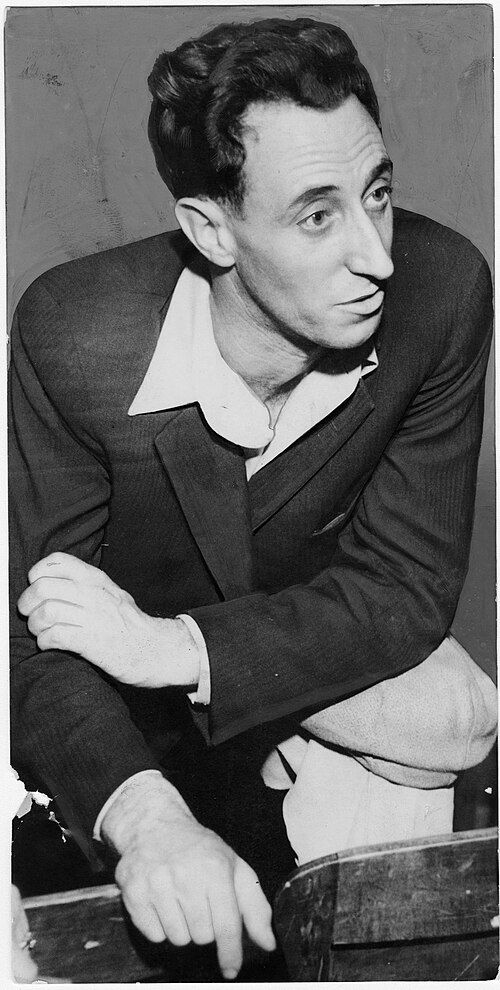
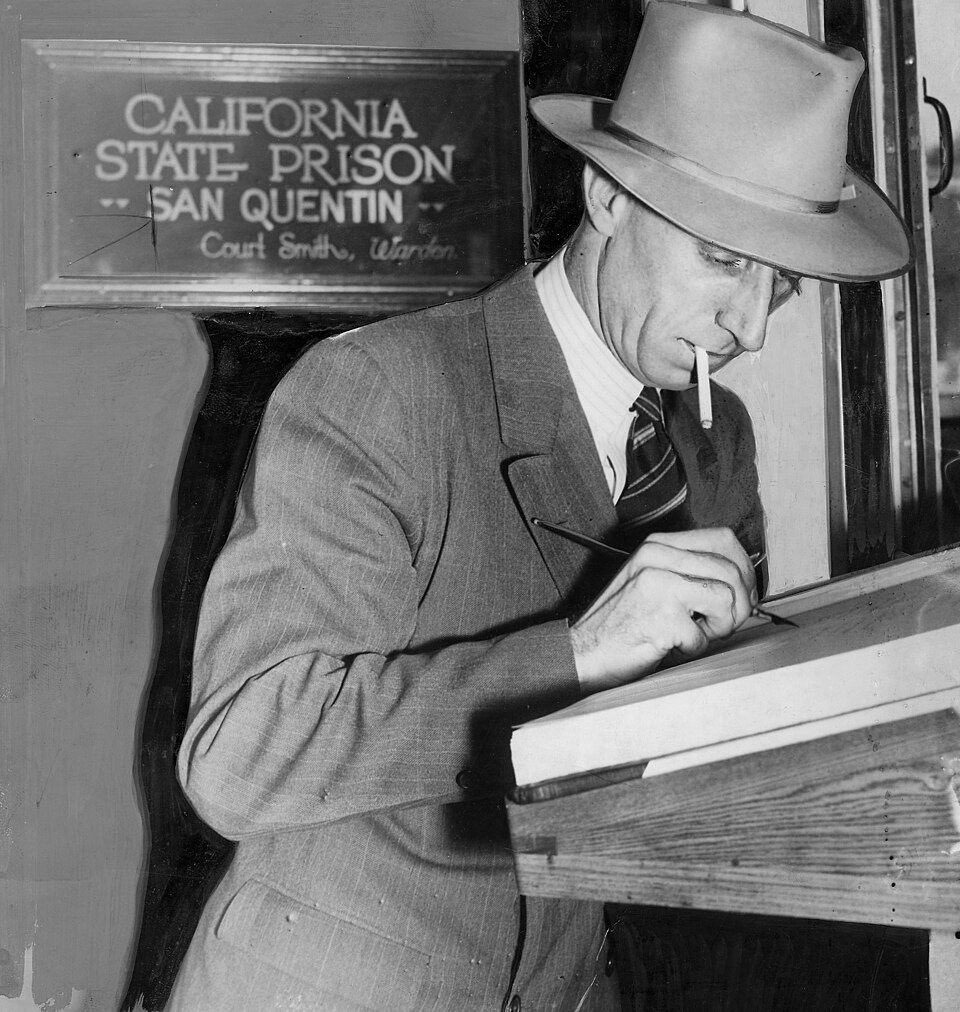
Harry Bridges pictured on July 9, 1934, during the strike.
In “Harry Bridges: Labor Radical, Labor Legend,” historian Robert W. Cherny writes that the final decision, announced in October, was “a smashing victory” for the longshoremen.
“When the fighting stopped and negotiations began,”, wrote Schrecker, the union was “in control of the hiring system on the docks and soon able to extend its influence beyond the Bay Area to the entire West Coast. By the end of World War II, Bridges and his men even organized the workers in the sugar cane and pineapple plantations of Hawaii.”
Bridges was a Roosevelt and New Deal loyalist for the most part, and close to Labor Secretary Frances Perkins, and yet FDR allowed the FBI to go after labor radicals, especially
those considered close to or in the Communist Party. Indeed, an agent was caught red-handed trying to bug Bridges’s hotel room.
FDR really enjoyed hearing about that, saying to FBI Director Hoover, “By God, Edgar, that’s the first time you’ve been caught with your pants down!”
In “Many Are the Crimes: McCarthyism in America” (1998), Schrecker wrote, “From the moment he emerged as the main spokesman for the waterfront workers early in 1934, Legionnaires and business leaders clamored for his deportation. The issue became a national crusade. For the next two decades, it would be possible to gauge the strength of anticommunism by the intensity of the campaign to deport Harry Bridges.”
Alfred Renton Bryant Bridges was born in Kensington, a suburb of Melbourne, Australia. His father, Alfred Sr., was a successful suburban realtor; his mother, Julia (née Dorgan), was a devout Catholic of Irish heritage.
The young Bridges joined the merchant marine as a teenager, and, inspired by Jack London, was drawn to a life of “seafaring and socialism.” He adopted the first name of a favorite uncle, Harry, a world-traveling socialist, and became involved with Australian unions and, in the U.S., the Industrial Workers of the World.
Bridges, after spending time in Mexico and New Orleans, decided to stay on in San Francisco for work.
“It was common then to go from seafaring to longshoring, despite the brutal, irregular rhythm of the docks—being on the water wasn’t any easier,” writes E. Tammy Kim in a review of Cherny’s book.
Believing the IWW’s tactics to be ineffective, and rejecting the company union, a group of workers, with several Communists and fellow-travelers among them, decided to form a local of the East Coast-based International Longhoremen’s Association. It was that local that led the 1934 strike, but without the backing of the ILA leadership in New York.
The West Coast broke away to form the ILWU in 1937, and Bridges led it until his retirement in 1977.
Even though during the McCarthy period the union was expelled from the CIO, he was always popular with the rank and file, which stood by him during his legal battles to stay in the country.
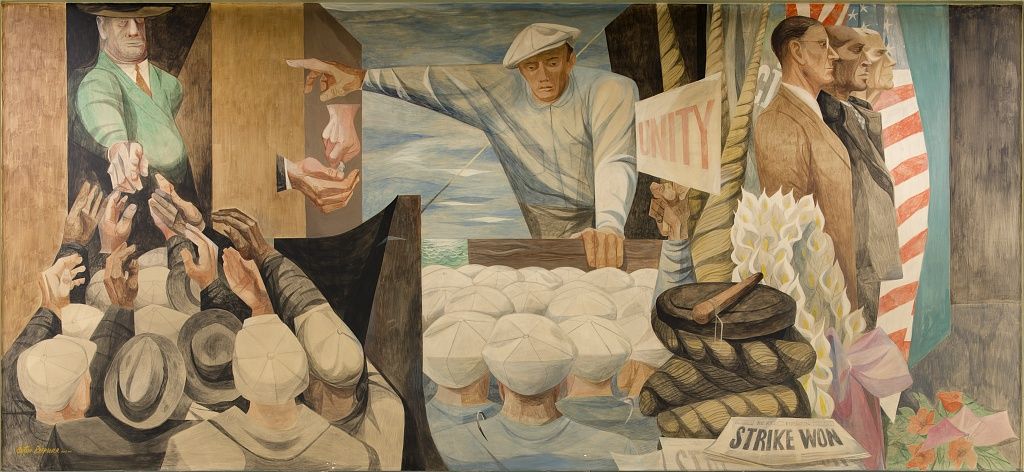
The central figure represents Harry Bridges, from Anton Refregier’s 1948 murals at the Rincon Center, in Downtown San Francisco.
In our own time, the U.S. House of Representatives passes resolutions to repeal the Affordable Care Act; 80 years ago, its obsession was sending Harry Bridges back to Australia. Twice, though, the Supreme Court made 5-3 decisions in his favor, in 1945 and 1953.
Some historians, such as Schrecker, say that Bridges probably was a signed-up Communist at the height of the party’s influence, much like they assume the Transport Workers' leader Mike Quill was in New York, until he publicly broke with it. Bridges didn’t make such a break, but his biographer, Cherny, argues instead that however close he stuck to the party line he wasn’t a member, nor subject to its discipline.
It likely helped that Bridges had lots of non-Communist secret admirers in politics and in the labor movement. The Jesuit campaigner the Rev. John M. Corridan, the model for the priest in “On the Waterfront,” and a critic of the ILA and its president Joseph P. Ryan, would point to the West Coast as the way to go. Those worried about a security breach in American ports, Corridan argued, should focus their attention on the mobbed-up East Coast docks where “shape-up” hiring practices were still used, and not on the allegedly Reds-influenced San Francisco.
Kim writes that Bridges ruled “democratically and without scandal,” if for too long, while Cherny says he set his own salary “well below that of the best-paid ILWU longshore workers.”
Harry Bridges died on March 30, 1990, at age 88. He’d been married three times, and had four children and a stepchild. His widow, Noriko Sawada, whom he wed in 1958, gave Cherny access to his papers for the biography, which was published in 2023.