Late one night in October 1992 television viewers across the United States watched - some in disbelief, others in anger - as one of the musical guests on Saturday Night Live did something shocking.
The guest was Sinead O’Connor. Paul Elie of Georgetown University recalled the scene in his 2025 book "The Last Supper."
“She produced a photograph of Pope John Paul II, held it up the way a priest elevates the Eucharist, and tore it in half and then again and again, scattering the pieces on the stage.”
As Elie said, it was more than “a desecration of the pope." It was a potent very public sign of the distance that had opened up between the Church in Ireland and the growing number of disaffected Catholics.
Sinead O’Connor doesn’t immediately come to mind in the context of Church-State relations, even in circumstances where citizens of the State had turned their backs on the Church because of mistreatment at the hands of priests and nuns. But her bold gesture sent a powerful message.
O’Connor’s criticisms of Catholicism were especially controversial in parts of Ireland but also a brave representation of a shift that was taking shape in society away from the Church, whose deep influence began to collapse later that decade over a string of clerical child abuse scandals.

Some symbolic acts are so freighted with significance that they resonate beyond the power of mere words. In the context of Irish Catholicism at the latter end of the 20th century, that one act by Sinead O’Connor in 1992 had dramatic effect and lasting repercussions. It was just an episode, though, in a long tawdry tale.
The story of church-state relations in Ireland is a multi-layered one, laced with controversy. And while that story was well told up until the end of the 1970s, the “dark underbelly” - of which the Magdalene laundries, mother and baby homes and industrial schools (such as Greenmount in Cork and Artane in Dublin) were prime examples - didn’t feature prominently.
That didn’t really change until another scandalous episode - the shocking revelations of the sexual abuse of children by members of the clergy - forced its way into the public domain and resulted in the hugely-damaging Murphy, Ryan, Ferns and Cloyne Reports.
Prior to that Catholic Ireland was stunned when the Irish Times, in a front-page story in May 1992, broke the news that the Bishop of Galway, Eamonn Casey, had fathered a child in secret with an American woman named Annie Murphy.
Journalist Mary Kenny, in her 1997 book "Goodbye to Catholic Ireland," caught the reaction: “Among the best-loved of these new-style, outgoing, social-justice, television-friendly clerics was Father Eamonn Casey, later to be the Bishop of Galway, later again to be at the centre of a sex scandal which shocked and scandalised Catholic Ireland when it was revealed that he had had a mistress, fathered a child, and paid off mother and son with diocesan money."
For many older Catholics in particular that shameful episode was an eye opener. For younger Catholics it was a turning point. But the power and prestige the Catholic Church had enjoyed since independence in 1922 had been shaken long before then.
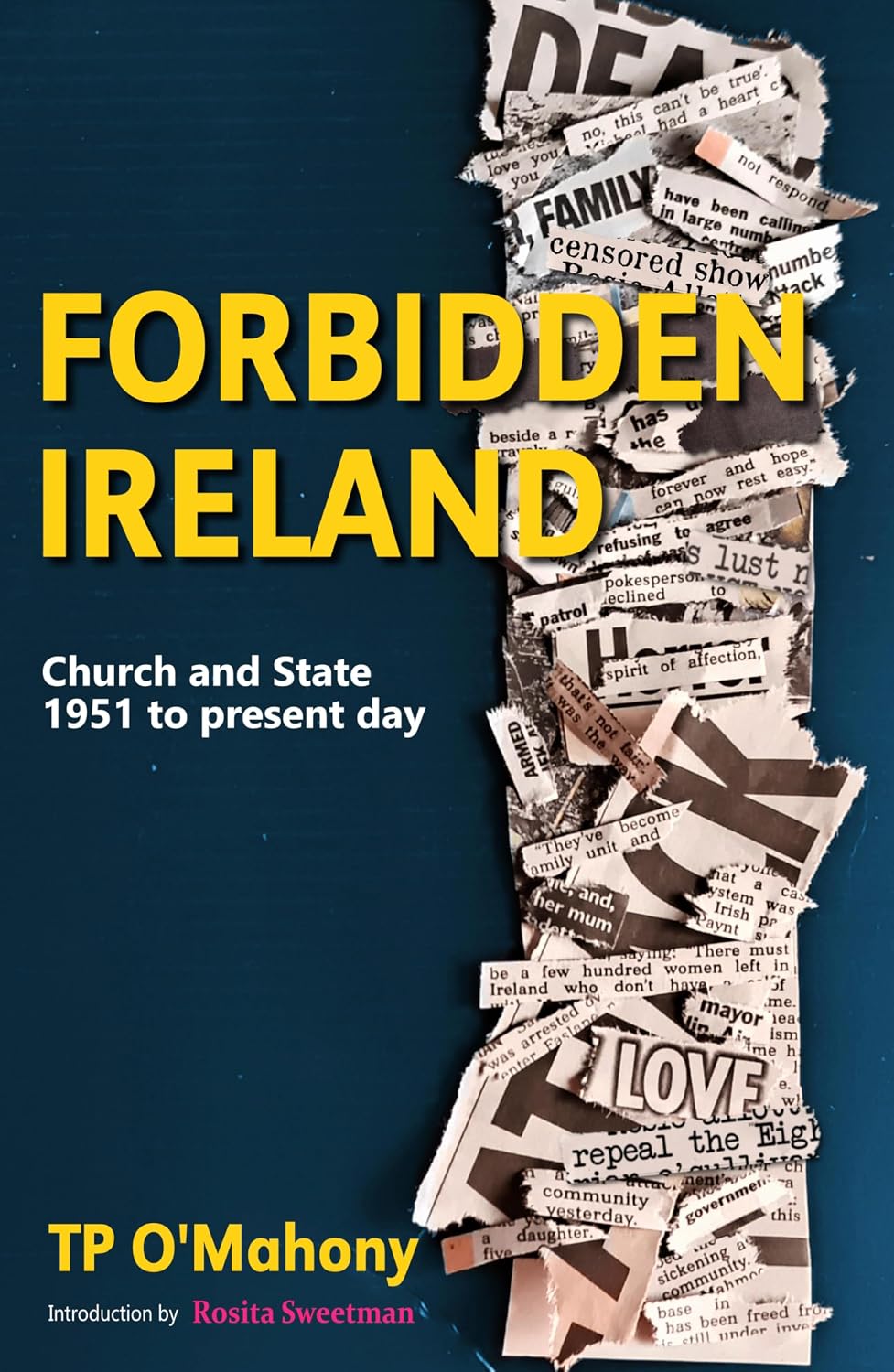
In "Forbidden Ireland" I set out to tell that story, to bridge the gap in the church-state narrative in the Republic - a gap during which the Eamonn Casey-Annie Murphy scandal paled into insignificance against the background of a spate of new and large-scale sexual scandals and cover-ups. It was during this period that the tectonic plates underpinning society in this country began to shift decisively.
This is the story of how the Irish State moved from a cosy symbiotic partnership with the Catholic Church since independence into open opposition and even segued into an antagonistic relationship.
Nobody has painted the background picture to all of this better than Mark Hederman, the former abbot of Glenstal Abbey in County Limerick: “Throughout most of the 20h century in Ireland, the Catholic Church was involved in a symbiotic structural entanglement with the Irish Free State as this reality unfolded socially and politically.
“As the song says, both went together like a horse and carriage. This seemed normal and almost providential to the majority of Ireland’s citizens for the first half-century of our existence.
“Then, very suddenly, in a period of 20 years, more or less, the horse collapsed or the carriage crumbled, whichever way you choose to look at it; the Catholic Church melted away. How could this have happened?”
Multiple dramas were played out before it did happen. The emergence of an antagonistic State followed a long and mutually fruitful “horse-and-carriage” period dating from 1922.
The famous anti-Vatican speech in 2011 in Dail Eireann by the then Taoiseach Enda Kenny - rightly described as a “philippic” and leading to the closure of the Irish Embassy to the Holy See - was the most dramatic example of this antagonism.
The evolution of State-versus-Church dynamics began in 1951 with the confrontation between Archbishop McQuaid and Health Minister Noel Browne in the “Mother-and-Child” crisis. McQuaid won but this was, in the words of broadcaster and historian John Bowman, a “pyrrhic victory."
The book title derives from the fact that in a number of key socio-sexual spheres the Church suffered a series of morally damaging setbacks, beginning with what was traditionally “forbidden" - contraception, then homosexuality, divorce, abortion and same-sex relationships.
The Irish bishops had embraced a Maynooth version of the domino theory. Their fear was that if the link between sex and procreation was broken, then “anything goes” and the floodgates would open.
The Humanae Vitae controversy had serious implications for papal authority, and this had ripple effects throughout the universal Church. In Ireland, the moral monopoly the Church had enjoyed since independence had started to crumble long before the publication of the Ryan and Murphy Reports in 2009.
"Forbidden Ireland" traces seven decades of Church-State conflict and the social transformation that followed. The story goes from the shadowed realities of the mother and baby homes and Magdalene laundries to the repeal of the Eighth Amendment. At the heart of the story are the women who refused to remain silent. Their courage forced Ireland to confront itself and change.
In the meantime, the State has been involved in a stand-off with the Church about appropriate redress for victims of the Magdalene laundries and mother-and-baby homes, with some voices calling for the seizure of the assets of the religious orders.
Then, in August 2019, in his address in Dublin Castle in the presence of Pope Francis, the then Taoiseach, Leo Varadkar, said he believed that the time had now come to build a new relationship between Church and State in Ireland - a “new covenant for the 21st century." What ”shape” might this take?
Any move towards a “new covenant” should provide for a formal separation of Church and State - such as enshrined in the First Amendment of the U.S. Constitution or the 1905 Separation Law in France. This is overdue, especially since the Good Friday Agreement of 1998 and the subsequent enhanced prospects of a United Ireland - and could be most efficaciously done in the context of a new secular Constitution (replacing the 1937 model), a new foundational document for a new Ireland. This might require a constitutional convention.
Both church and state will look very different fifty years from now. The task, the challenge, is to ensure that this “difference” - in a world where authoritarian leaders, oligarchs and billionaire owners of social media corporations care less and less about the civic consequences of economic power and wealth inequality - is fashioned in a way that will be conducive to human flourishing and the promotion of the common good. That will require a very novel and innovative relationship.
"Forbidden Ireland" points the way.
"Forbidden Ireland" by TP O'Mahony and with an introduction by Rosita Sweetman is published by Mercier Press, www.mercierpress.ie. It is available on Amazon and the Barnes & Noble website.
TP O'Mahony was born in Cork in 1939. From 1967 to 1989 he was religious affairs correspondent with the Irish Press and thereafter with the Irish Examiner. His previous books include Why the Catholic Church Needs Vatican III (Columba Books, 2010) and Has God Logged Off? The Quest for Meaning in the 21st Century (Columba Books, 2008) and The Politics of God (Veritas, 2023).
Rosita Sweetman is one of the founders of the Irish Women's Liberation Movement and has spent five decades as a writer and activist at the forefront of debates on feminism, the Catholic Church and the Irish State. Her books include On Our Knees (1972), On Our Backs: Sexual Attitudes in a Changing Ireland (1979), Feminism Backwards (Mercier Press, 2020) and her memoir Girl With a Fork in a World of Soup (Menma Books, 2025). She has written for the Irish Times, the Sunday Independent, and the Dublin Review of Books.