Former President Bill Clinton opened this year’s Clinton Global Initiative conference in New York urging attendees to “step into the void created by governments pulling back from foreign assistance.”
“We know that we can’t completely fill the hole that retreating governments are leaving behind,” Clinton said, calling for new ideas and resources to protect hard-won progress.
For more than two decades, the Clinton Global Initiative (CGI) has brought together leaders from politics, business and philanthropy to tackle global challenges. This year’s theme was “How Do We Get It Right?” and included discussions on responsible AI, democracy, global health, climate resilience, humanitarian response, and more.
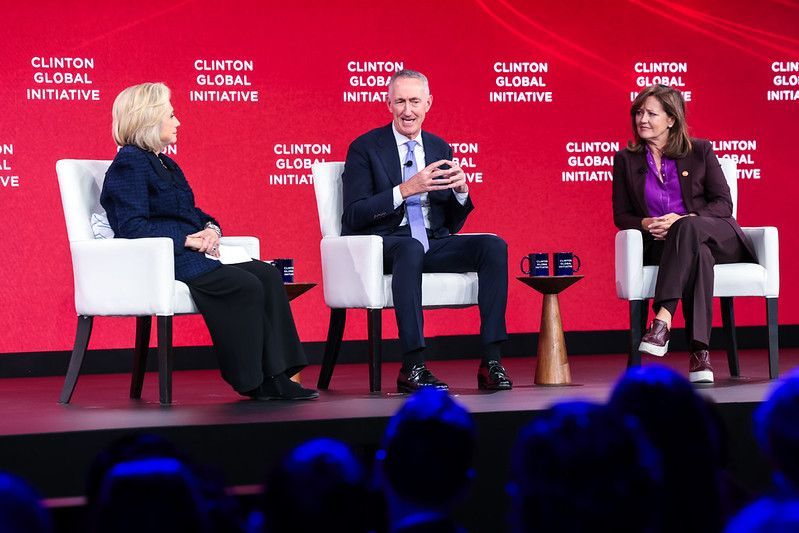
Irish American Gilead Sciences CEO Daniel O’Day returned to CGI to share an update on one effort aimed at keeping that progress moving.
At the conference in 2025, Gilead highlighted its efforts to expand access to its twice-yearly lenacapavir drug by allowing generic manufacturers to produce it. Generic versions are expected to be available for about $40 per person per year in 120 low-and middle-income countries beginning in 2027.
At the gathering, O’Day, joined by Elton John AIDS Foundation CEO Anne Aslett, told attendees that while low-cost generic versions are being prepared, Gilead will supply its HIV prevention drug to 24 low-and middle-income countries through partnerships with the Global Fund and PEPFAR.

As O’Day put it: “A breakthrough is the starting point, not the finish line. Availability is only the beginning. Adoption, reach and measurable public health impact depend on collective action and partnerships.”
The same tension between innovation and impact came up again in discussions about AI.
Secretary Hillary Clinton discussed responsible AI at the conference, saying that addressing its risks through international agreements is something global leaders should discuss now. She also cautioned against assuming that open-source AI models are always beneficial, noting that “in the case of AI, they can actually pose additional dangers.”
LinkedIn co-founder Reid Hoffman echoed the need for safeguards, supporting a proposed “kill switch” that would require developers to have the capacity to shut down their systems if needed. “It’s not a natural thing for a company to put in, so it’s a good intervention,” he said.
The conversation then broadened from AI safety to the wider questions of how technology is shaping information and democracy. Filipino American Nobel Peace Prize laureate Maria Ressa warned that AI could affect trust and people’s ability to make independent choices.
“The fight for truth is already here,” she said, calling on leaders to “fund the facts,” “demand safety by design in AI,” and “collaborate.”
Ressa urged leaders to act to protect the shared reality that progress depends on. Her message was simple: “Do not waste your power.”
In the “Rewriting the Humanitarian Playbook” session, Academy Award-nominated actor and founding ambassador of the War Child Alliance, Carey Mulligan, discussed how the organization is adapting as humanitarian needs outpace available resources.
With more than 520 million children affected by conflict, War Child Alliance CEO Laura Miller announced a $100 million “Childhood Beyond Conflict” initiative to build a coalition focused on children’s mental health.
Mulligan welcomed the commitment to action, speaking about the need to move beyond a model in which physical survival is considered enough.
“Every child deserves more than survival. They have the right to safety, protection, education and hope for the future, regardless of where they are born.” The new initiative is intended to help advance that goal.
That theme of finding new ways to sustain progress resurfaced in the final session.
Former USAID Administrator and U.S. Ambassador to the United Nations, Samantha Power, shared a story of optimism in “The Optimism Strategy” closing session.
Power returned to CGI to update a 2024 USAID Commitment to Action. The initiative was designed to scale up funding to protect children from lead poisoning through the “Partnership for a Lead-Free Future.”
According to Power, lead poisoning affects up to one billion children worldwide. After USAID was defunded a month after the initial launch, Power and coalition partners adapted and continued to pursue the effort.
She announced that private-sector commitments have stepped up to fill the void, with $550 million devoted to lead detection and lead-poisoning prevention.
Power finished with, “The partnership is rolling out a playbook that is working and will have an impact.”
The idea of acting before success is guaranteed carried through to President Clinton’s closing remarks.
“We’ve got to prove that hope can be justified and is worth fighting for,” Clinton said.
He emphasized that hope is not a denial of reality, but a belief that the future can still be shaped by what people choose to do. At a time of unprecedented challenges, the message was to keep going, adapt, and find new ways to move progress forward.
Find information on all 60 Commitments to Action announced at CGI 2026, and all public sessions at clintonglobal.org.
Maura Kelly is a marketing and media executive, Emmy Award-winning producer, and active member of the global Irish diaspora.