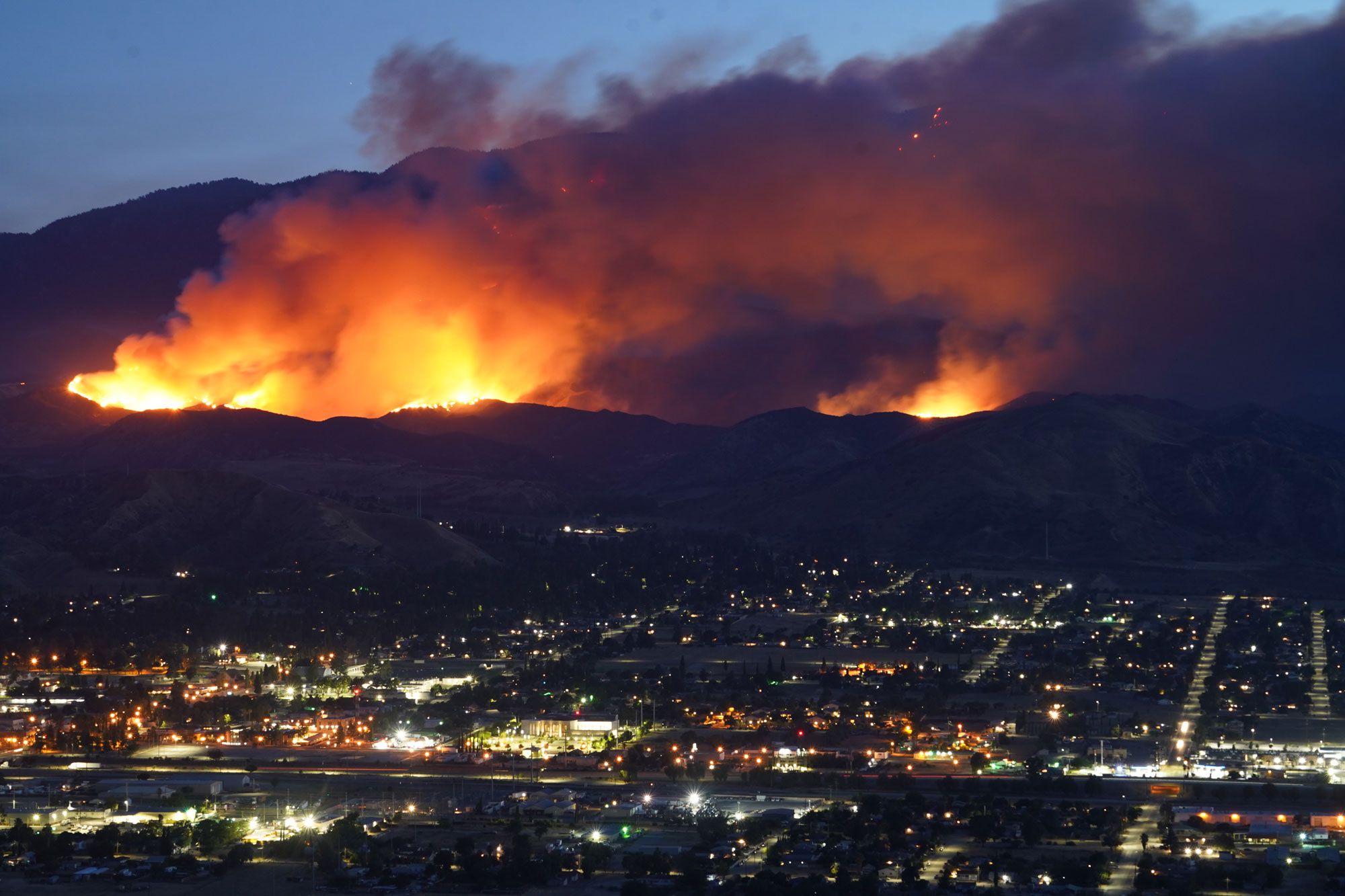
The New York Times’s Claire Brown wrote exactly one year ago: “As wildfire season starts earlier in California and climate change is leading to more extreme fires, tens of thousands of firefighters across the country are heading into weekslong shifts to battle the blazes. In many cases, they are breathing toxic smoke and ash for days on end.
“As investigative reporter Hannah Dreier reported last week, unmasked firefighters in the United States are developing serious illnesses at young ages and dying of cancers that typically afflict much older people.
“As Dreier writes, ‘it would be unthinkable for urban firefighters — those American icons who loom large in the public imagination — to enter a burning building without wearing a mask. But across the country, tens of thousands of people who fight wildfires spend weeks working in toxic smoke and ash wearing only a cloth bandanna, or nothing at all.’
“Some of the health risks could be avoided if they wore protective masks, like half-face respirator masks with replaceable filters, or disposable N95 masks. But the Forest Service, which employs the country’s largest share of firefighters, won’t allow them to be worn.”
The OPB (covering Oregon and Pacific Northwest), an independent non-profit media organization, updated this last month with a report entitled, “Forest Service gives first-ever respirator recommendations to wildland firefighters.”

“For years, scientists have known that wildfire smoke is bad for people,” began the piece by Rachel Sun of Northwest Public Broadcasting. “Data published in the scientific journal Environmental Research shows that wildland firefighters have higher rates of mortality from lung cancer and cardiovascular disease.
“Now, for the first time, the Forest Service is recommending the use of N95 respirators in federal wildland firefighting, along with increased decontamination protocols in the form of showers, gear cleaning and clean air recovery.
“‘It’s still somewhat uncommon for people working in wildland fire to use respirators,’ said Heather Heward, a senior fire ecology and management instructor at the University of Idaho.
“‘On the fire line, there are people that wear N95 masks when they are exposed to smoke,’ she said. ‘I would say it’s definitely the exception more than it is the rule.’”
The reporter added, “Heward, who works in controlled burns, said part of the reason is that respirators can be uncomfortable and impede airflow. It also has to do with established norms in the workforce.
“If a practice is normalized by leaders, more people might get on board, Heward said. Workers also tend to become more open to safety measures as they get older.”
Heward told Sun, “As they get 10, 15, especially 20 years in, they’re having friends die of long-term illnesses. And it’s terrifying.”
“The changes are a long time coming,” Heward said.
“The frustration was that we know that smoke exposure is bad for us. And yet when asked which filtration device we should be using, the answer was, ‘Oh, none of them, we haven’t studied it enough.’ That was an unacceptable answer to a lot of people.”
In a statement, the U.S. Forest Service said it is expanding access to N95 masks as an interim measure.
“We understand this is not a long-term solution, but until National Fire Protection Association respirator standards are revised and a full OSHA-compliant respiratory protection program are developed, the agencies are taking immediate action to reduce smoke and contaminant exposure during this fire season,” the statement said.
The article, summarizing Heward’s view, continued, “At the same time, respirators are only one way of reducing the health risks for wildland firefighters. But they can’t be used for every scenario. Federal guidelines discourage the use of respirators during strenuous activity or when they could hinder communication. There is also a need to look for other ways to reduce overall health risks.
“For instance, she said, some mop-up operations may expose firefighters to more particulate matter from smoke and soil disturbance than is necessary from a fire safety perspective.
“ There are absolutely instances where a fire was not mopped up thoroughly and then started to move again. That is an important thing to prevent. And there are lots of other times where the specifications of the mop-up are really just to keep people busy,” Heward said.
Past measures to improve firefighter safety have included moving base camps to reduce smoke exposure and the introduction of fire-retardant clothing and hard hats.
“There are a lot of unanswered questions when it comes to wildland fire health risks, Heward said.
The report continued, “She also worries that recent and proposed cuts to scientific funding and within federal agencies may lead to a chilling effect on researchers who are government employees or rely on federal grants.
“When doing research, you need to be open to all of the answers that the data have for you,” she said. “And that might be that we’ve been doing things wrong and that people are getting sick.”
“Heward said more research is needed to understand wildland fire health risks, and implement practices that can keep fire personnel healthy.”
Heather Dreier, the second New York Times reporter referred to earlier, wrote a story last December about a Washington State firefighter who had a history of ill-health connected to his job.
It began, “Luis Martinez was still trying to figure out how to tell his 11-year-old son that his cancer might be back when his phone rang. He squinted to make out the name of his son’s soccer coach.
“The coach wanted to know if Luis could drive his son, Rooney, to a tournament in Seattle, three hours away. A last-minute dropout meant their team suddenly had a chance to compete against the best players in the state.”
A little further into the piece, the reporter writes, “A road trip would mean more time together after Luis had spent months away on wildfires.”
It’s a remarkable story [read it here, via subscription] putting a human face on wildfires and a series of other pressing American issues via Martinez and his 11-year-old child.