[This article appeared in the July 8 issue of the Irish Echo]
“Fly Now — Pay Later.”
John Minihan liked that concept promoted by Pan Am and so he decided he’d make his first trip to New York, a city that had been in his thoughts since childhood days and nights spent transfixed in the Savoy Cinema in Athy, Co. Kildare.
He was back again as the honored guest last week of Irish Arts Center and the government by way of the National Gallery of Ireland, which is exhibiting “Visual Poetry: The Photography of John Minihan” in Dublin through Oct. 11.
It was 1972 that first time and already at age 26 Minihan was well established professionally — a half decade earlier he’d become the youngest ever staff photographer at the Evening Standard in London.
He had remembered the skyscrapers from the movies, such as in reruns like “The Naked City” (1948), which starred Dubliner Barry Fitzgerald as Lt. Dan Muldoon.
In more recent times another innovative NYPD drama, “The French Connection,” had traveled to big screens across the Atlantic. In that one, Gene Hackman played Jimmy “Popeye” Doyle. The character was a fictionalized version of narcotics cop Eddie Egan, who also had a part in the movie and whom the photographer met on the West Coast in 1975.

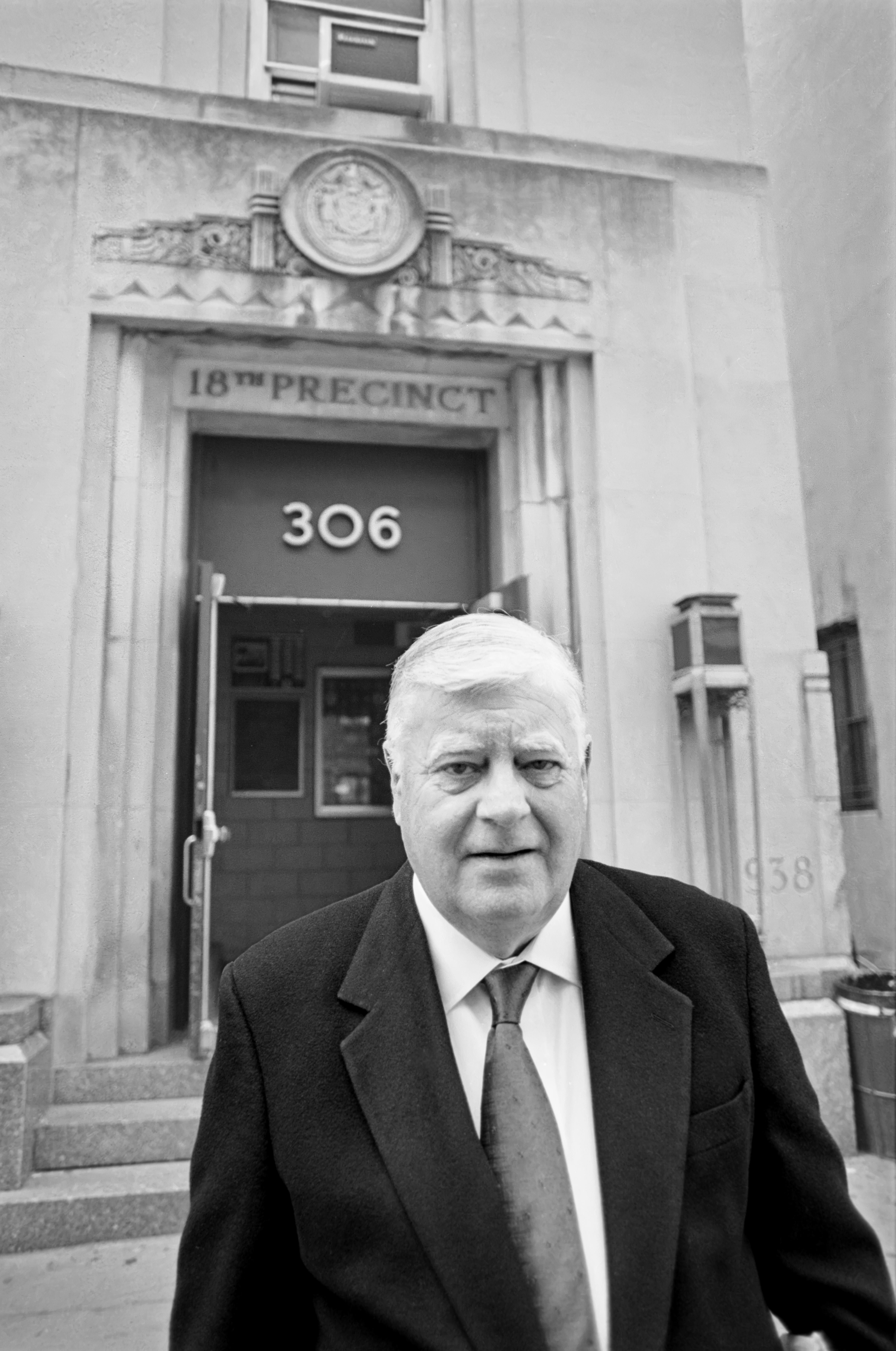
His aim in 1972 was to photograph Irish cops, and he did so at the 18th Precinct. He was fascinated generally by the grittiness of the city, he remembered during a phone interview from West Cork a few days before making the recent trip with his wife Deirdre.
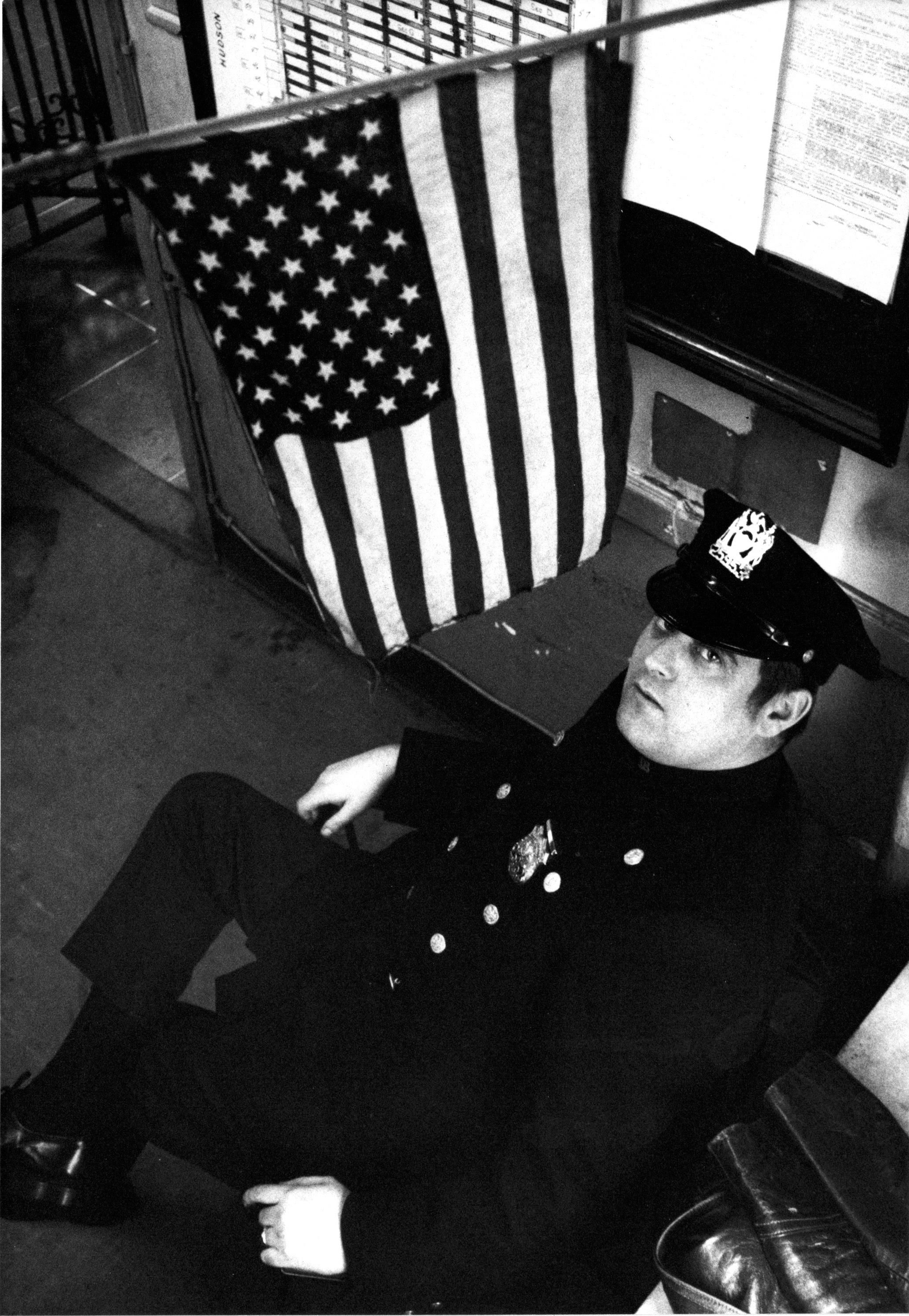
Officer Pat Thomney photographed by John Minihan inside the 18th Precinct in 1972. For a photo of him in 2008, see below.
“I booked into a hotel on Broadway, near 42nd Street. That’s when 42nd Street was 42nd Street,” he said, “Like Soho in London, was Soho, and not full of coffee shops as it is today. When it was full of life and energy.”
At that time, “prostitutes and pimps, gangsters, barristers, theatre writers at the Daily Telegraph” were to be found in its “little bars and seedy little clubs.
“It was an amazing time to be young.”
He added, “And New York was like that the first time for me.
John Minihan was born in Dublin in 1946. His father was already deceased and he's only known him through his wedding photograph. His mother handed the baby over to a sister and her husband, who lived with their son and daughter in Plewman’s Terrace, Athy.
He was to meet his mother just one more time, when he was 7. She remarried in England and had three more sons. He is in contact with his half-brothers despite his abandonment by the parent they shared.
It worked out for Minihan, though, with his aunt and uncle. “They couldn’t have been more loving,” he said. “It was a wonderful time.”
Early visual influences included the Savoy Cinema. “I saw everything on the silver screen,” he said.
There were the memorial cards he saw in people’s prayer books at Mass. “Seeing the photographs of a loved one always intrigued me,” said Minihan, who remains an adherent of the faith. He was also drawn to the cards that featured religious art by Botticelli and others.
He can remember the excitement at the news that the photographer would be coming to the school the next day. Of course, everybody got dressed up when getting their picture taken, a tradition going back to Victorian times.
His uncle, “an amazing man,” worked at the malt house in Athy and so was involved with the complicated process that made Guinness stout, which was then shipped out to consumers from St. James’s Gate, Dublin.
That connection between the capital city and the town was referred to in Patrick Kavanagh’s “Lines Written on a Seat on the Grand Canal”:
“And look! a barge comes bringing from Athy
And other far-flung towns mythologies.”
Minihan’s aunt was a cleaner for the family who owned the town’s biggest store. Her daughter wrote home from London suggesting there were better opportunities there. And, so it proved. His aunt got a caretaker and cleaning position in a home in the Barons Court district, which had 12 apartments for spinsters who’d been civil servants. A spacious apartment came with the job.
The 12-year-old Minihan, who was being educated at the Christian Brothers in Athy, now enrolled at St Edmund’s Secondary Modern in Fulham. At 15, he got a job as an office boy for three months and about this time he won a photo competition with the Evening Standard. By age 16, he’d secured an apprenticeship in the Daily Mail dark room and entered a world he still inhabits.
He was sent on a day-release course (one day a week) to the London School of Printing and Graphic Art as part of his training.
“I learned absolutely nothing. Generally the teachers were failed photographers and they’d show you how to photograph a wet fish on a plate with a couple of pieces of parsley,” he said.
The atmosphere back at the newspaper, the “epicenter, the heartbeat of photojournalism,” he said, was the real learning experience.
There were more than 25 staff photographers at the Mail and a “coterie of freelancers.” Some had their specialties such as sports, Court (or royal coverage), fashion, theatre and so on.The apprentice was influenced by a man named Len Joseph, a scientist by profession who had a specialty in photographing theatre productions; he encouraged his interest in the relationship between writers and photography.
Music, however, was the subject that moved the teenage Minihan most during these years, when the Who, Rory Gallagher and the Animals were emerging. He had access to the materials he needed and he could double his weekly income with one photograph, of say the Beach Boys and Brian Wilson, for Melody Maker or New Musical Express or any of the half-dozen papers dedicated to popular music.
Later on, in 1969, Minihan heard that a photographer he much admired, Richard Avedon, was visiting London from America to profile the Beatles, and he thought he’d like to take his photograph, which he did at the Connaught Hotel. It’s among those images being added to the National Gallery of Ireland exhibition as part of new rotation from this week.
Other American influences were Edward S. Curtis (1868-1952), the ethnologist known for his work with Native Americans, and Andreas Feininger (1906-1999), a sometime Life staffer whose writings about photography also had an impact on the Irishman. He fondly remembers the era of magazines like Life, the London-based Picture Post and Paris Match, and cites W. Eugene Smith’s 1948 photo essay “Country Doctor,” which documented in Life the work of Dr. Ernest Ceriani in Kremmling, Colo., and others like it, as an important journalistic breakthrough.
Minihan had been doing his own documenting since the beginning of his apprenticeship, traveling back to Athy to photograph life there. That work became the 1995 book “Shadows from the Pale: Portrait of an Irish Town.” One particular sequence of images within that project became associated with the story of his meeting and photographing one of the great literary figures of the 20th century.
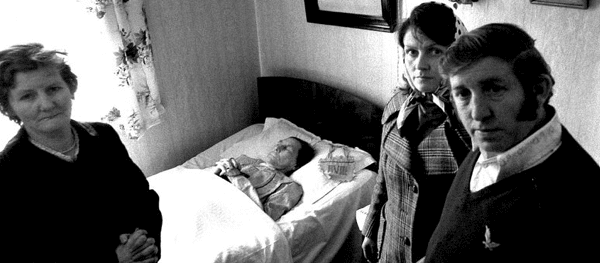
The family of Katy Tyrrell in the wake room, Athy, Co. Kildare, 1977. © John Minihan
In 1969, a shout came over from the subs’ desk, or copy desk in American parlance, “Some reclusive Irishman has won the Noble Prize for Literature.” It was an appeal for a photo of Samuel Beckett, of which there was none to be had. “From that moment,” the photographer said, the Dubliner “was on my radar.”
They would eventually meet in 1980, but in his interview on stage at Irish Arts Center last week, Minihan spoke about another memorable episode from that year. One morning, a prominent royal correspondent reported that Prince Charles was no longer involved with Lady Sarah Spencer; instead, her younger sister had become the focus of his romantic interest. Minihan was the first press photographer to arrive at her place of work as a nanny after that news broke.
The future Princess Di, the most famous woman in the world, was a little more accessible than Beckett on a different occasion. The photographer showed up at the Hyde Park Hotel, acting on a tip that the playwright and novelist had checked in. It came from a good source, an Irish friend named Liam who worked there. The information was passed on to him as he was setting down his equipment in a Notting Hill pub after an assignment. He picked up his cameras again and made his way to the hotel.
“There’s no one here of that name,” the receptionist said.
“She’d been primed,” Minihan said.
However, he had a certain advantage — he knew about Beckett’s passionate interest in photography. So, he left a note, which told about the work he’d been doing in his home town in County Kildare and said he would call at 9 the following morning.
When he duly called at 9, he was put through to Beckett’s room.
At their first meeting, the writer was impressed with what some have called the “Beckettian” quality of his Athy photos, but most notably with the sequence known as “The Wake of Mrs. Katy Tyrrell,” which focused on two nights and three days on the journey from the deathbed to the grave.
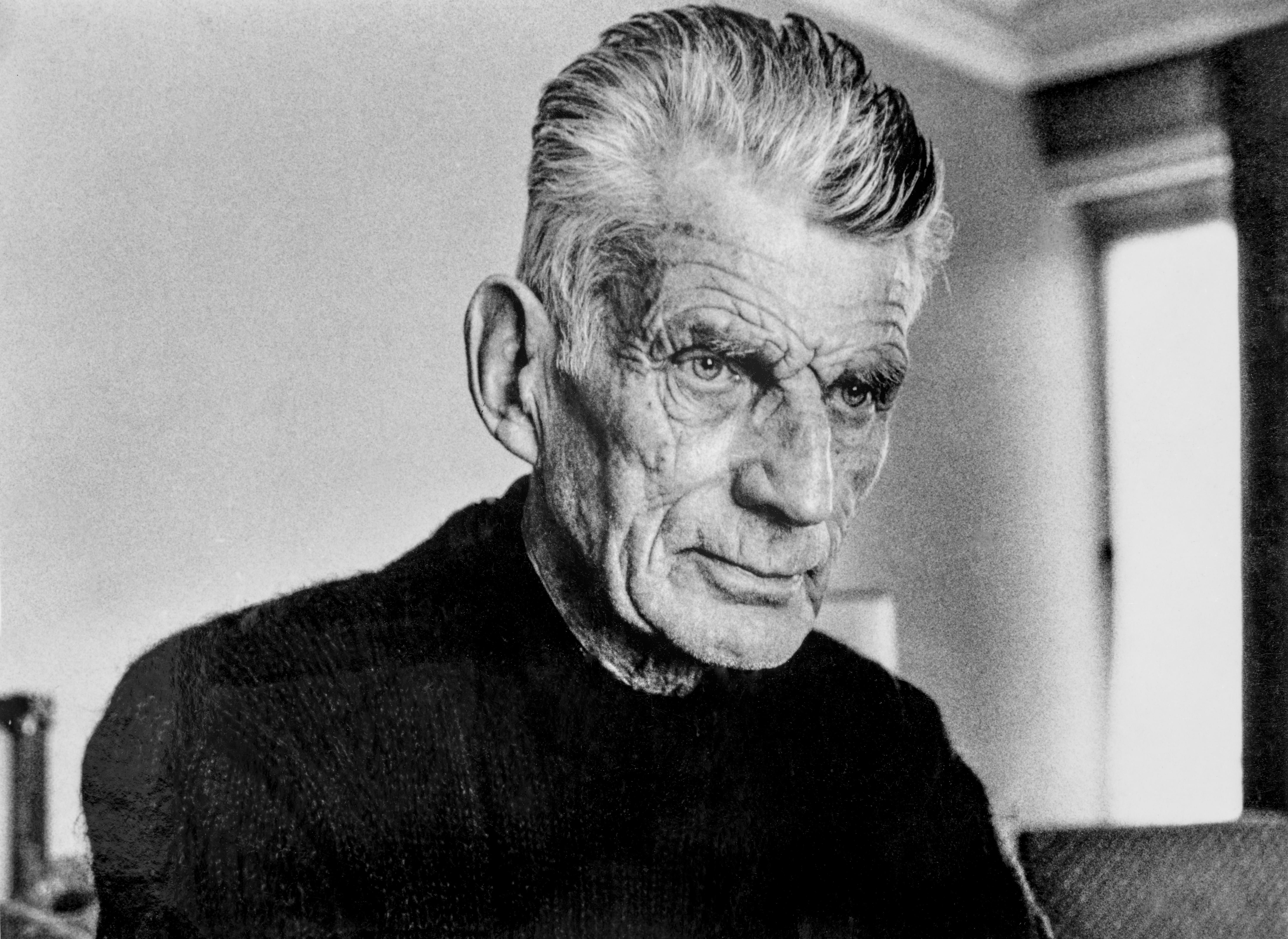
He took his first photos of Beckett in his hotel room 46 years ago, and one of them is in the collection of the National Portrait Gallery in London. In another, reproduced above, the Nobel laureate is almost smiling. (The American writer and artist William S. Borroughs called Minihan the “painless photographer” because of the rapport he could quickly build with a subject.)
Minihan said that Beckett’s fascination with the visual arts followed that of George Bernard Shaw and J.M. Synge, and it led him to apply to work with Sergei Eisenstein as an assistant in the Soviet Union. He’d seen “Battleship Potemkin” (1925) at an impressionable moment in Paris, and so did another famous Dubliner, also in Paris on a subsequent occasion. That was Francis Bacon, the painter. Minihan always tried to get Bacon together with the playwright. “He couldn’t see the parallels,” he said of Bacon, though they shared many friends.
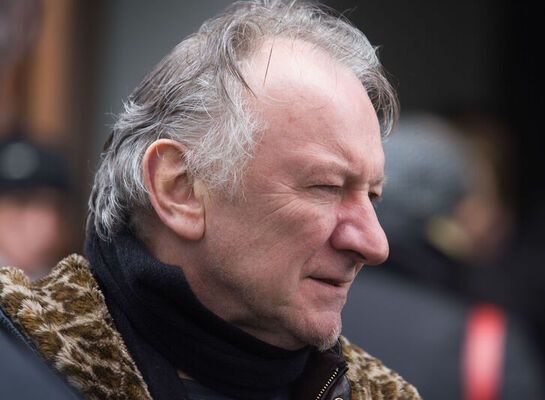
Minihan has taken photographs of 20 productions of “Krapp’s Last Tape,” an estimated 18 of “Waiting for Godot,” and 12 of “Happy Days.” Last year, Gary Oldman, now a knight of the realm, asked him to photograph his production of “Krapp’s Last Tape” in York and again when it traveled south to the Royal Court, London.
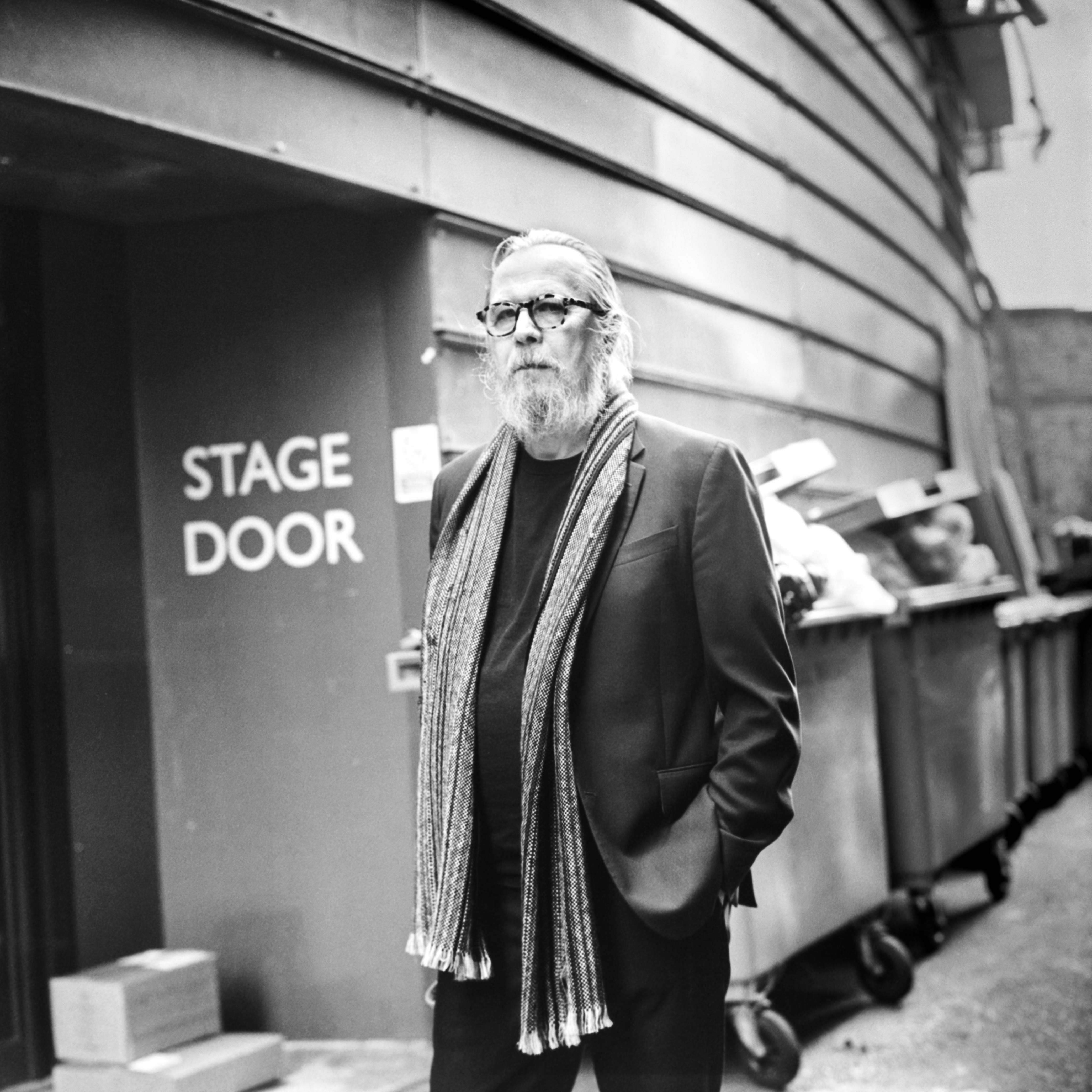
Gary Oldman photographed by John Minihan in 2025.
“I want to stay as relevant as I can in the world of photography without becoming a victim to corporate assassins,” said Minihan, the father of two sons and a daughter, who is raising her family, his three grandsons, in Leicester.
He shows up with his Rolleiflex, which can take just 12 photos, in black and white, not because he’s a purist, but because the pictures are superior in his view.
“Everything is digital. Everyone is looking, but nobody is really seeing anything,” he said.
Digital can have its uses, for instance in the theatres of war, but more generally he likens it to “climbing a mountain with a helicopter.”
For Minihan, the “digital world” is on par with the “pagan world,” which is primarily interested in money and power.
“It’s paramount,” Minihan said, turning to the subject of his Catholic faith.
He recalled a moment in 1953, standing on the road when his aunt was being taken away in an ambulance to the county hospital.
“I knew how pivotal she was in my life and I needed her. I remember praying to the Holy Blessed Mother for her well-being,” he said.
His aunt died in 1980 in Dublin and was buried in Athy; his uncle died in 1970 in London and was buried there.
“You have to believe in miracles,” Minihan said.
He went through some health battles of late, but put them behind him in time for his 80th birthday, and the celebration of it.
Part of that is a renewal of the Irish Department of Foreign Affairs and Irish Arts Center’s collaboration on the “To Love Two Countries” exhibition, commissioned two decades ago when Niall Burgess was Consul General in New York.
The current consul general, Gerald Angley, another admirer of Minihan’s work, introduced him at last week’s event, during which the photographer was interviewed by Irish Arts Center’s Rachael Gilkey and Sarah McAuliffe of the National Gallery of Ireland.
Of course, the big event is the National Gallery’s exhibition in Dublin, the first ever dedicated entirely to one photographer. It opened on Minihan’s birthday in March.
He celebrated the milestone locally in a quiet way.
“We had glasses of mimosa in my favorite coffee shop in Skibbereen,” Minihan recalled. “It was marvelous.”
For more information about “Visual Poetry,” visit here.
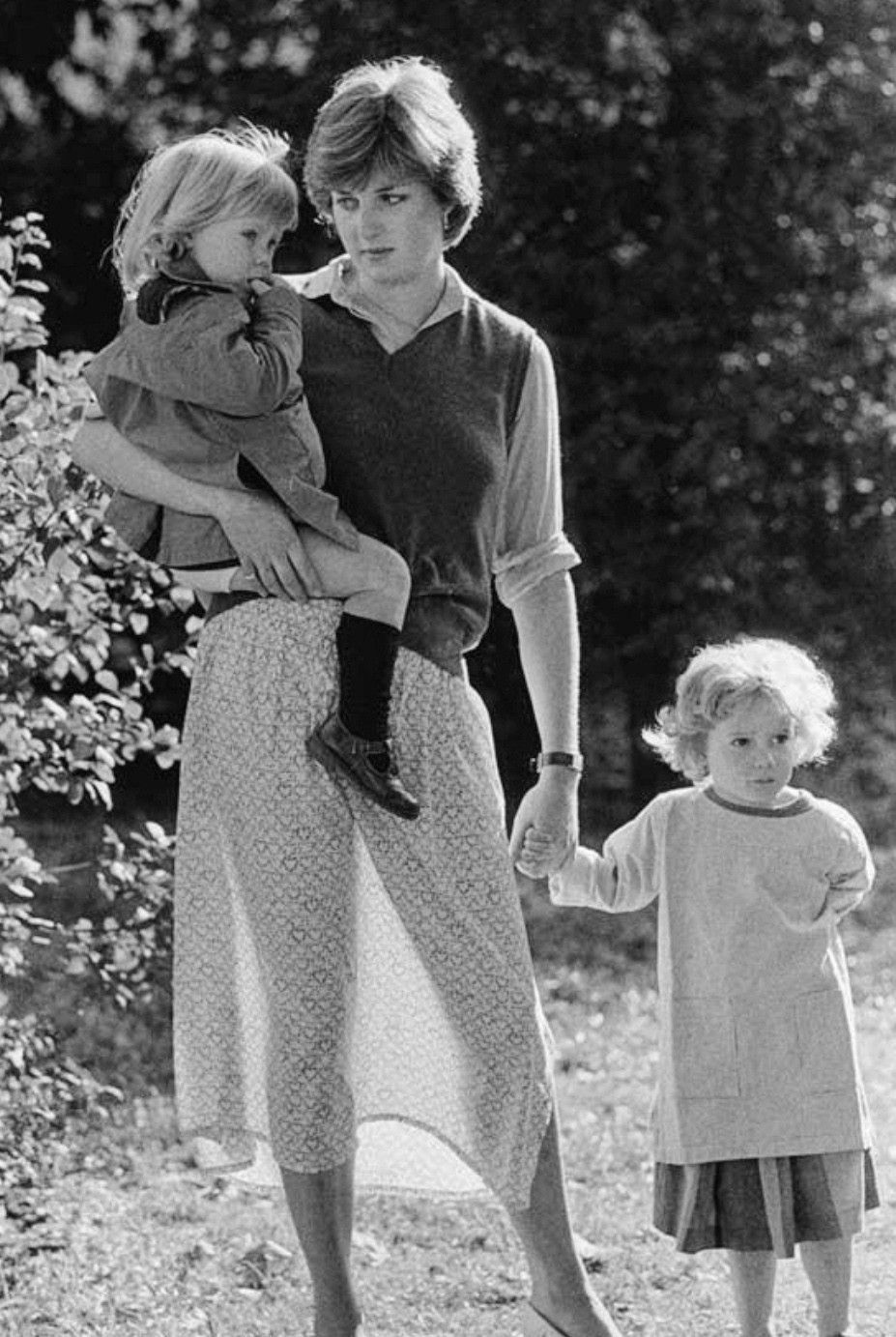
Lady Diana Spencer in 1980.
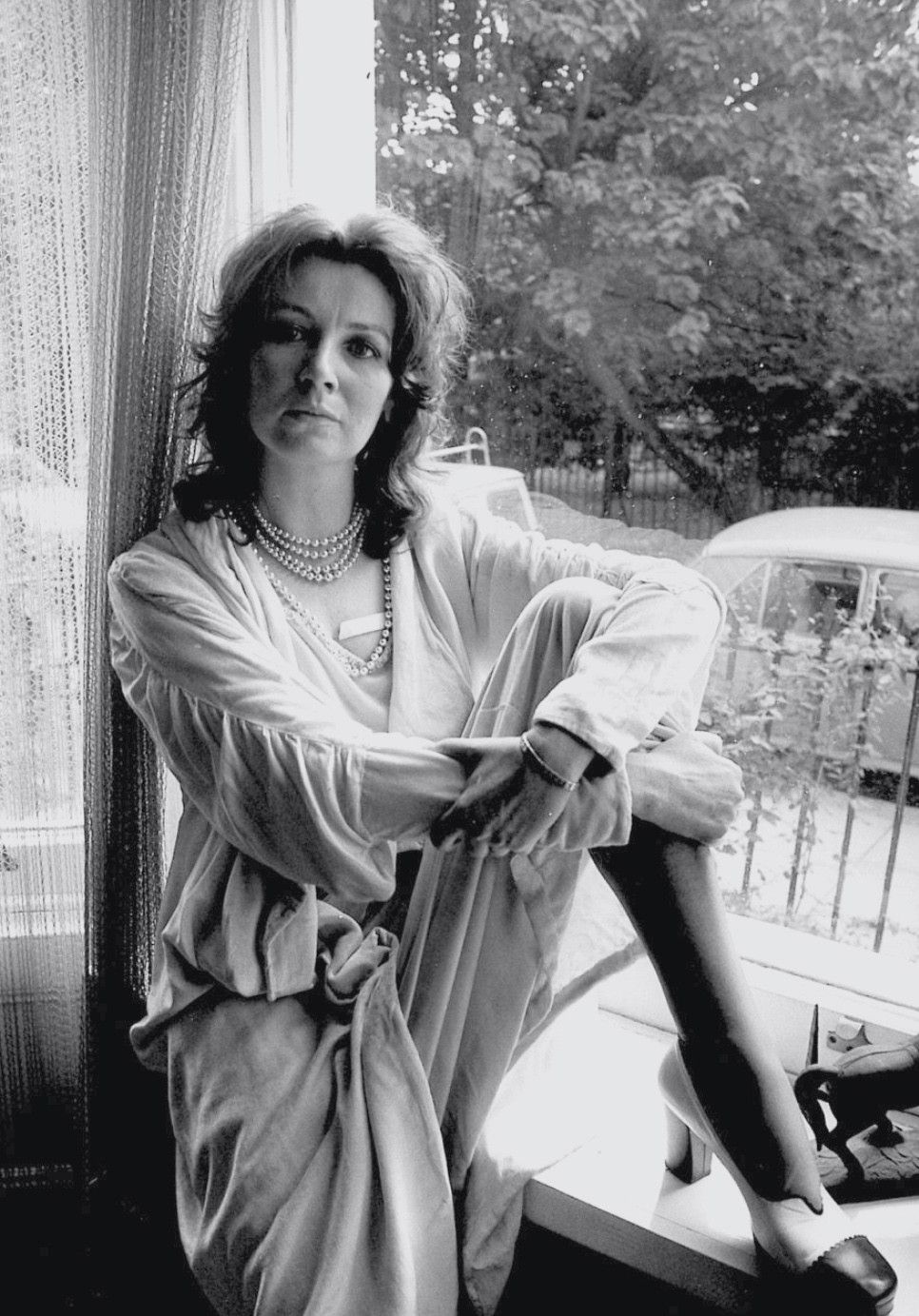
Novelist Edna O'Brien. [Photo by John Minihan]
Below: Pat Thomney outside the 18th Precinct in 2008. [Photo by John Minihan]