We pick up our contingent from Tarrytown, N.Y., railroad station. We are to drive from there across the old Tappan Zee Bridge and head out west. We will encounter no traffic of any significance on our way to attend the American Literary Association’s Annual Conference in Chicago.
We don’t see anything of nighttime Pennsylvania, but by the time we get through an Ohio sunrise to Indiana, the lavender is warmed and tickling the cattle.
Altogether twelve hours and a few short stops later we see the White Sox stadium and get to Bridgeport, Chicago. At first looks it’s a neighborhood not unlike those of Philly, Boston or even Salford in Lancashire.
Later, we find out about the tradition of Irish immigration to this place. The locals are proud of those that had forged its identity through their labor on the Erie Canal, right here, down the street, and out to the lakes. Some of the families are still here.
We stayed at The Polo Inn on South Morgan and a warmer, more informative, open-minded staff you couldn’t hope to meet.
Mary Pat Kelly, once of this parish, got us a room in the place. She has lots of connections and as a geo-historical tour guide, she is invaluable. Her roots were in evidence as we met family members and neighbors that talked like they were still kids outside on the once upon a time cobblestones, dodging coppers and gangsters alike. At least that’s how I imagined their youth.

---
We made our way downtown to the Palmer House Hilton.
“It’s where the brownie was invented!” I heard that a few times.
The Palmer House has settled into its elegant, if shady, history as a Gilded Age gem, whilst other newer buildings shake their steel, glass and platinum, vying to be the next big thing, trying to overshadow those that came before.
Our conference is on the 3rd floor, so we get to gasp at the deco and the décor.
Lori Cassels, IAW&A’s West Coast representative, has organized our association’s involvement in this worldwide annual event.
The convention is full of knowledge and academia and fervor for literature. With societies pledging allegiance to those such as Poe through those such as Cormac McCarthy - with plenty of room in between for those of any stripe, dot or tartan.
At one point I imagined a “sentence off’” between nimble Nabokov fans and rampant Rabelaisian yobs taking place in the lobby, on the escalators, one up - one down. You know like The Warriors but in tweed and dickie bows versus lederhosen, using verbosity instead of flick knives.
There were so many panels to go to and just sit and listen to others’ erudition, but we had our own to get on with.
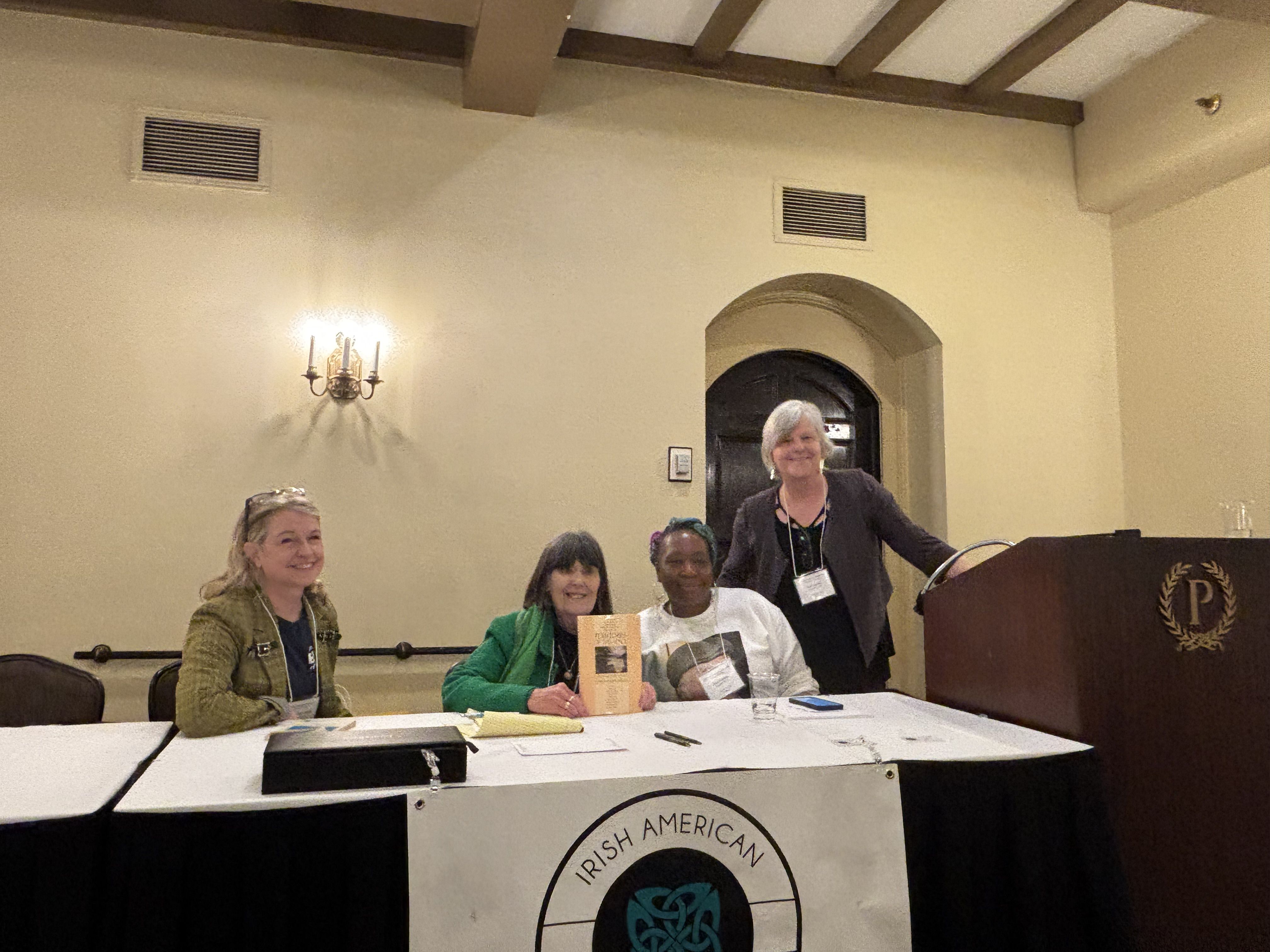
Irish American Writers and Artists presented a panel comprising three talks on the Friday, May 21: “Crossroads, Critics, and Conferences: Legacies and Impact.”
Our panel chair, Lori Cassels, introduced Miss UneeK, Kate Shea Kennon and Mary Pat Kelly.
Myss UneeK is a writer, rapper and multi-slam winner. Her talk centered on Malachy McCourt’s influence on her and, in broader terms, the crossroads between the Irish American experience and the African American experience that she has encountered in New York City - through words. The advice and example of McCourt was not only literary but humanistic and welcoming. Uneek has not given up her rap battles just yet, but she is leaning towards stories that have a more empathetic heart and exploring her own personal history through narrative.
Kate Shea Kennon is an assistant Dean at Fordham University, and she wondered how she would follow Myss Uneek’s powerful personal essay. Kennon’s subject was Joseph Hurley, a supportive theater critic who wrote for The Irish Echo for over 20 years. Hurley taught Kennon a lot in terms of being a champion for Irish playwrights coming to America. His reviews for Conor McPherson, Martin McDonagh and specifically Enda Walsh, had a lasting effect on Kennon. She is now on the board of Origin Theater. Kate Shea Kennon is a lecturer by profession but one that draws you in to her subject, rather than preaches. Joseph Hurley knew his stuff and was never cruel in his critiques. He needs to be remembered for his passion and compassion.
Mary Pat Kelly has lived many lives already. She was a nun, has written Scorsese’s biography, worked on “SNL” and penned many novels of her own. Her talk centered on the Irish Women’s Conference in 1990. Mary Pat discovered a theme in this afternoon’s talks, one of “reaching out.” It’s not exactly mentorship, but advice through experience to help and guide those searching for their own validation.
The struggle for women’s voices to be heard, for women to even work was not something accepted or acceptable, even in recent history. Popular Irish women writers, was there such a thing? There may have been two or three even as late as 1990. Maeve Binchy, Edna O’Brien…
Mary Pat is a gifted and natural storyteller who can go off on a tangent with the best of them. Her memories are relevant to the point. Her stories about women’s involvement and influence on the peace process in Northern Ireland come from personal involvement with the shakers of the day.
MPK held aloft a collection of stories that found an audience and gained credence for the writers within, 1989’s Territories of the Voice (IAW&A’s own Kathleen Walsh D’Arcy was an editor). It was an articulation of the repression that Irish women had suffered, and only once that repression had acknowledgement then there could be a forward momentum away from it.
All three of these talks involved modern Irish American writers that are accessible to us, relevant to us, and sometimes even known to us. These talks were not dry, in an academic sense, they were the opposite of that. They were packed full of personal history, anecdotes and some emotion. It was an unconventional convention, for us at least.
We had time then in downtown Chicago to look at sculptures and the lake, and to sample a deep-dish pizza, but it was the people we met that made a lasting impression.
We had a long drive back to New York, but Lori still had work to do. She was to chair a panel on the Saturday that included Jonathan Goldman of the James Joyce Society.
Lori Cassels adds:
On Saturday, May 22, Irish American Writers & Artists second panel’s talk: “Irish Writers Transatlantic Impact. From James Joyce to Colm Toibin and Elizabeth Cullinan to Alice McDermott” was given by LLC International University professor Dr. Ausra Paulauskiene from Lithuania.
A theme of her paper was the Irish mother’s desire and hope for their children to enter the religious life with an emphasis on the often strain between mothers and daughters as depicted in Toibin and McDermott’s work. Which prompted me as chair to share a quote from Alice McDermott’s speech when she accepted Irish American Writers and Artists-Eugene O’Neill Lifetime Achievement Award:
“Of course I recognized certain traits in O’Neill’s Irish Americans—the fragile gentility, the easy recriminations, the incendiary nature of the long unspoken when it’s doused with alcohol.
“Here was a play that acknowledged the terrible of family life, the awful burden of family love. A play that also in its serious, its yearning, its grim poetry, offered a tribute to the dignity of that love, that striving. O’Neill understood the depth of our longing to love those to whom we are (in O’Neill’s words) in tears and blood forever bound.”
After a heartfelt homage to the late Brendan Costello who was eager for Irish American Writers and Artists to participate in the ALA conference; final panelist, distinguished Professor Jonathan Ezra Goldman from New York Institute of Technology and President of New York's James Joyce Society spoke on Joyce's influence on the arts and literature scene of New York City in the early 20th century. All panels were well received and enjoyed stimulating Q&A.