In 1996, Frank McCourt, a retired high school English teacher who was born in Brooklyn but raised in Limerick, became a literary sensation with the publication of his memoir, “Angela’s Ashes.” The book begins with these lines: “My father and mother should have stayed in New York where they met and married and where I was born. Instead, they returned to Ireland…”
The year before “Angela’s Ashes” was published, Brendan Loonam, a high school English teacher who was born in Banagher, Co. Offaly, but raised in the Bronx, made his literary debut when the late, lamented Thomas Davis Irish Players produced his autobiographical play, “Gone Away with a Sailor.” The play begins with these lines: “I was on my second ramble through Jane Eyre, languishing, you might say, when I got the word about the job.” The allusion to a novel whose plot includes a marriage that began happily on one side of the Atlantic before descending into rancor and madness on the other side subtly, almost imperceptibly, foreshadows the tale to come. For the theme of Loonam’s play could be summarized by inverting McCourt’s opening lines: Loonam’s mother and father should have stayed in Ireland where they met and married and where the playwright was born. Instead they emigrated to America.

No other work of Irish-American literature I know uses the painful process of chain migration as its dramatic core. Through a lyrical set of intertwined monologues of the mother (“She”) and father (“He”), the play narrates the Larkin family gradually disintegrating and struggling to regenerate itself in the new environs of the Bronx. This narrative reveals the terrible costs of a particular piecemeal approach to emigration: first to depart are the father, Tom, and the oldest son, Sean; then the only daughter, Annie; then the next son, Peter; then the next son, Tosh; and finally, the mother, Kitty, and the youngest son, Kieran.
Both Loonam’s play and McCourt’s book end in New York. In “Angela’s Ashes,” that ending is framed as Frank’s escape from the poverty of Limerick and the dysfunction of his own family; he has returned to the promised land of America, a birthright his parent’s reverse immigration stole from him. As such, “Angela’s Ashes” is ultimately a comedy, whereas “Gone Away with Sailor” offer the audience no such happy ending. In his penultimate lines, He/ the father/ Tom Larkin confesses: “Sure what’s the use? The bed could be as wide as the Atlantic Ocean for all the space that’s between us now, and there’s no boat I’ve ever seen that could cross it.” Following this, in one of the plays most touching lines, She/the mother/Kitty explains to Kieran: “We started down a wrong road; a long time ago, for all the right reasons, and, sure, we're stuck on it now and we have to make the best of it.” Clearly, the audience has witnessed a kind of tragedy unfold.
The Iago-like villain of this tragic plot is the unseen but constantly discussed Babby, the sister of He who sets the whole painful process in motion. At first, her actions call to mind the well-meaning Aunt Lizzie from Brian Friel’s “Philadelphia Here I Come!” –the yank aunt trying to do right for her kin left behind in backward Ireland. But as the story progresses, Babby spins scheme after scheme, becoming ever more controlling, constantly whispering counterproductive advice into the ear of her brother, who, under her tutelage, becomes a dour disciplinarian obsessed with reputation and respectability, more sinning than sinned against for sure.
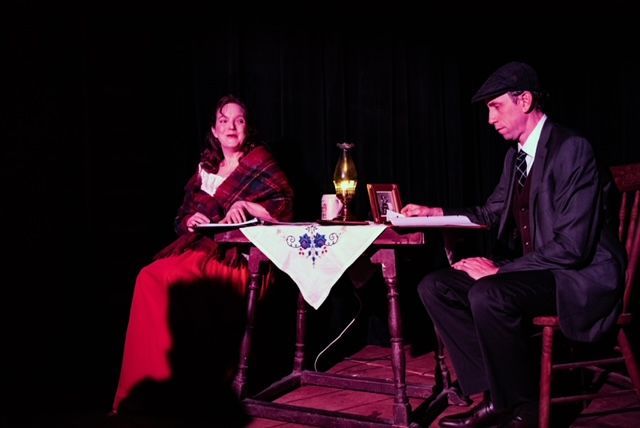
Last Thursday and Friday evening the Amateur Comedy Club, under the able direction and elegant set design of Stephen Butler (no relation to the author of this review!), presented a staged reading that brought this tragic play back to life on the New York stage for the first time in 30 years. Jeannie Dalton as “She” epitomized the full emotional range of a dutiful wife and loving mother struggling and suffering to hold a family together. And Kevin Gregory as “He” embodied the stiff, awkward carriage of a tall man whose stubborn pride and small, suspicious mind wreck the family’s chances of a happy reunion. This performance was all the more poignant given that Brendan Loonam was not there to witness it, having passed in 2019.
Though much less well-known and more compact in form than “Angela’s Ashes,” “Gone Away with a Sailor” is just as powerful a work of art. A dramatic rendering of one family’s resilience in the face of rupture, it offers important insights into the emotional toll of emigration, family separation and reunification. It can help us to think more about the complicated relationships at the root of our own Irish family trees. It could also help us to think more about the experiences of friends and neighbors whose families may have journeyed from other countries to America under similar patterns of chain migration.
For all these reasons, one can only hope that this two-night table reading is just the beginning of the play’s renaissance.