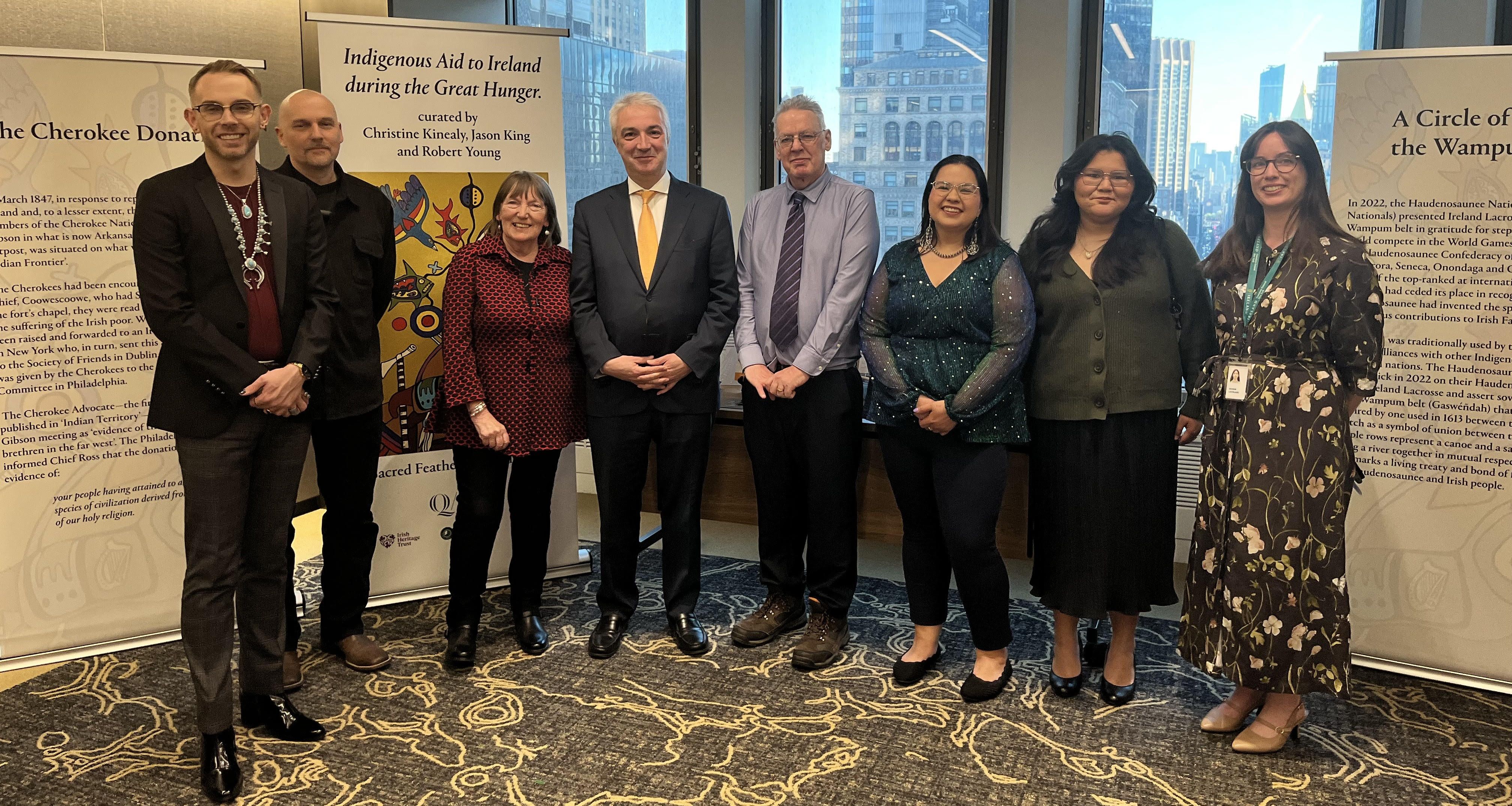
The Irish Heritage Trust has launched a new video entitled "Closing the Circle: Honouring
Cherokee Aid for Ireland in 1847" at the Consulate General of Ireland in New York.
Speaking at the launch, Consul General Gerald Angley paid tribute to the Cherokee Nation that “raised funds for the starving population of Ireland in 1847 just a few years after suffering oppression on the
Trail of Tears themselves. This extraordinary act of kindness and selflessness deserves to be
remembered and celebrated well into the future."
In the spring of 1847, members of the Cherokee Nation contributed generously to Irish and Scottish Famine relief under the leadership of Chief John Ross (1828-1866) this less than a decade after they themselves had been forcibly removed, in 1838, from their homes in the south eastern United States and on to the Trail of Tears to Indian Territory in what is now the State of Oklahoma. Their donation was comparable in scope to that of the Choctaws, though less well known.
Cherokee Principal Chief Chuck Hoskin Jr. pays homage to the generosity of his ancestors in The Closing the Circle video.
“When we were marched across the country with our political system ripped apart, with our economy torn to shreds and having to rebuild, that was still within the living memory of Cherokee people as the famine struck Ireland," he said.

“As we were learning about what was happening to Ireland and Scotland, it spoke to us. It was something we remembered, not through some distant history of ours, but in the living memory of Cherokee people.”
This living memory and the traditional Cherokee cultural value of Gadugi—working together in mutual support of the common good—helped inspire their efforts to alleviate Irish and Scottish hunger in 1847, according to Chief Hoskin.
“When this was happening to Ireland, we were still in the midst of rebuilding our own nation, our own society. We could have well said: ‘we don't have a penny to spare. We don't have any resources to spare.’ But I think we did what any great society does when it can, which is to say that what we share
actually enriches us. This story of what our ancestors did during that difficult period of history is
something that inspires me and I think inspires all Cherokees.”
The profound sense of desolation suffered by the Cherokees on the Trail of Tears is recounted by Gayle Ross, a direct descendant of the renowned Cherokee Chief John Ross.
“Chief Ross led the people through a very difficult time as they confronted the horror of removal," she said.
“Along with all of the death and destruction that existed throughout the tribe, Chief Ross suffered some very personal losses. His wife, Quatie Ross, died on the way to Indian Territory," added Krystan Moser, Senior Cultural Resource Manager, Cherokee Nation Cultural Tourism.
The Cherokees had to draw on their traditional cultural values and rituals such as Gadugi and the Green Corn Ceremony to cope with such adversity. The importation of Indian Corn as a substitute for the failed potato crop became deeply stigmatized in Irish folk memory, yet corn remains a sacred food for the Cherokees.
“When things were difficult for us during the time of removal, we relied upon these traditions to maintain our identity, which reinforced our community resiliency and our ability to survive as a people," said Ryan B. Mackey, Cherokee Language Master.
“Without the ceremonial activity that undergirded our values of Gadugi, and working together, we wouldn't have survived.”
These traditional Cherokee cultural values also helped prompt their generous contributions to Irish and Scottish Famine relief in 1847.
“When I think about what was happening in Ireland in 1847, I believe that our people didn't even have to question the reason or the motivation," said Mackey.
“When they saw people struggling, they already knew what our teachings had asked us to do as Cherokees without much thought.
"We are taught that as Cherokees, when we see a clear need, when someone is suffering, we don't wait to be asked. We take responsibility for one another's well-being, and we step up and we take care of each other. And I think that value is what our ancestors were living in 1847.”
"The Circle of Giving: Honouring Cherokee Aid for Ireland in 1847" was created by the National Famine Museum, Strokestown Park in County Roscommon and Irish Heritage Trust in collaboration with Ireland's Great Hunger Institute at Quinnipiac University and Cherokee Film. It is funded by the Government of Ireland Emigrant Support Programme. It can be viewed at https://www.youtube.com/watch?v=LjJhSlGKSD4