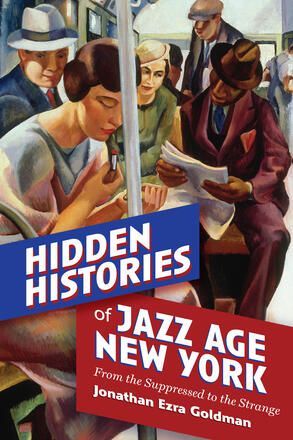
“Hidden Histories of Jazz Age New York, From the Suppressed to the Strange,” by Jonathan Ezra Goldman.
“Be careful in New York, Katie, the streets are filled with gangsters and tommy guns shooting up the streets.” Katie Connelly, my grandmother, was warned before she departed Sligo in 1924.
Flappers, the soaring stock market, speakeasies and, yes, gangsters shooting up the streets with their tommy guns are just one of the many images that come to mind when we ponder New York in the 1920s. However, as Dr. Jonathan Ezra Goldman reveals in “Hidden Histories of Jazz age New York, From the Suppressed to the Strange,” there is always more to the story.
Goldman, recently named Distinguished Professor of Humanities at New York Institute of Technology, has exhaustively researched this Jazz Age era account that informs additionally with illustrations, newspaper clippings and photographs.
Truly, there is so much history to delve into this seminal work, but the review will focus inevitably on the Irish-American highlights. And what would my grandmother, Katie Connelly, have encountered in 1924 in New York’s bustling, hectic, multiethnic, rebellious, cultural mélange?
Depending on the neighborhood, an immigrant could’ve been welcomed or reviled. Irish-American police of this era would either find room for a fellow from the “old country” on the force; or just as easily billy-club him if deemed a troublemaking anarchist.

Readers can ascend with the skyscraper construction workers as New York’s skyline rises ever upward; as well as muck in the trenches with the “sandhogs,” the tunnel workers expanding the subways outwards to the boroughs. Goldman specifically cites F. Scott Fitzgerald’s “The Great Gatsby,” as the zeitgeist for this era, where the narrator, Nick Carraway hob-nobs with the upper crust of society amidst spectacle and opulence, yet deep down knows that despite the host’s generosity, the Irish American was still an outsider.
The chapter about the Irish in New York City is brimming with vignettes from Eamon de Valera in the 920 St. Patrick’s Day Parade to Zelda and F. Scott Fitzgerald’s wedding. Fascinating details of William Butler Yeats and James Joyce visits to the city swelling Irish American pride and their influence on Irish American Pulitzer Prize-winning playwright Eugene O’Neill.
Goldman skillfully covers broad movements — such as the Harlem Renaissance, immigration reform and Prohibition — to the minutiae, and with his compelling hidden histories manages to strike a personal chord with the reader In the chapter “Assimilation.” The author enlightens us about unique holidays that ethnic groups celebrated, such as one from my mother’s childhood, an odd custom, “ragamuffins,” whereby children dressed as paupers begging for coins on Thanksgiving.
As James Joyce’s work is a tribute to his beloved Dublin, Goldman’s “Hidden Histories of Jazz Age New York” pays homage to the unsung heroes, the radical influencers and characters less than heroic of the early 1920s in this scholarly yet assessible work. (Goldman is, incidentally, the current president of the New York James Joyce Society.)
Did my grandmother, Katie Connelly ever hear the rat-tat-tat of the infamous tommy guns? The story goes: One early summer afternoon in1924, she exited the subway on East 86th street, she heard the gun shots and hid in every building vestibule she could find. Arriving at her cousin Lucy’s apartment shaking and exclaiming, “The gangsters are out and they’re shooting up the streets with their tommy guns!” To which Lucy replied, “You greenhorn, there’s no tommy guns! It’s fireworks — today is the Fourth of July!”
“Hidden Histories of Jazz Age New York” is chock full of fascinating tidbits and it both celebrates and questions the Jazz Age in New York City; and also enables me to see the New York City streets that Katie Connelly once walked.