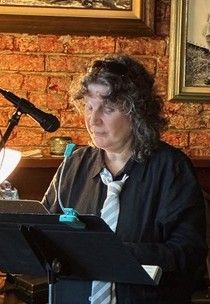
On Wednesday, May 13, Éanlai graced the Irish American salon at Sláinte Bar in Oakland with her amazing writer’s group, a tight knit group of seven who have met every Wednesday for the last 10 years. Filled with remarkable insights of heart, brilliance, humor and especially courage, the writers held the whole pub captive, reading after reading. For to write about life with all its waves of hope and love and despair and still manage to keep writing is the definition of bravery. And brave they were.
Amid the bookshelves, bodhráns, fiddles and portraits of Irish writers adorning the pub walls, we stationed the writers under a bemused photograph of Samuel Beckett.
Beckett once said, “Dance first. Think later. It’s the natural order.”
And dance we first did, as Barry O'Connell (accordion) & Vinny Cronin (flute) kicked off the salon with reels and polkas from County Kerry. Indeed, audience members took to the floor for a few jigs and swings.
Lori shared a bit about the Irish American Writers & Artists Association, with a mention of IAW&A panels at the American Literature Association conference, (which took place a week later in Chicago with the West Coast and East Coast IAW&A groups in participating together). Next, she introduced the host for the evening, writer, poet an teacher Éanlai who with profound insight and grace shared her own journey to writing. How the act of putting pen to paper, beginning with one word, then another, brings us into existence, indeed restores the broken within us and heals the soul. In the words of Margaret Atwood, “a word after a word after a word is power.”

Each of Éanlaí’s writers then stepped up to the lectern to share their stories.
Nirmy Kang kicked off the night with “The Story That Should Have Been Mine,” a wonderful reflection on the writing process and which muse to follow. Nirmy tried her hand at many writing forms before deciding to have some fun and write a detective story. Her main character—Romi Rai, a British Punjabi woman of a certain age sleuthing in Birmingham, England. Detail by detail, she filled in her character’s world—love interests, parents, sidekicks, home. When her story was almost complete, a friend called and told Nirmy about a PBS Masterpiece show called, interestingly, “DI Ray.” About a British-Punjabi detective in Birmingham, England. The similarities to Nirmy’s story uncanny, as if the universe was trying to tell her something!
Next, Nancy Philips read a poignant and humorous coming-of-age piece set in 1950s New York, entitled “Mexican Hat Dance.” As Nancy’s story begins, she vigorously performs at an elementary school dance to warnings from her mother: “Stop, you’ll rip your arms out.” Now, in later life, Nancy ponders what her ever-watchful mother’s reaction to her being a lesbian might have been, had she lived long enough. How tenderly Nancy’s father reacts to her news, wondering if it was “anything that they, as parents, had done wrong.” An homage to mothers and daughters, Nancy’s mother, a true force, was right about one thing, 70 years later, Nancy did need inverted shoulder replacements in both arms.
Gigi Gamble, dressed in her BART train’s station uniform, describes leaving her job at Trader Joe’s to become a BART Station Agent for Bay Area Rapid Transit. Beating out a field of 3,000 applicants to secure her spot, Gigi’s details one of her first nights of on-the-job training at Macarthur BART station. With a one-pound set of keys to nearly every room in the railway line hanging from her brand-new belt, she dodges unwanted hugs, learns to accept "Fuck off bitch I'm sleeping here" as a sign of health under late-stage capitalism, and gratefully accepts a ride home in private transportation. Gigi’s piece was a poignant reflection on public transit workers as truly unsung heroes.
In her wonderful piece titled “Call Me Beti,” Vibha Akkaraju returns for a visit to her childhood home country of India. During her stay, she describes her longing for India to call her “beti” meaning “daughter” and welcome her home with a loving caress on her head. Instead, India calls her “ma’am.” In her absence, Vibha realizes India has changed in many ways – and so has she. The home she is looking for—her childhood home with her mother and father—no longer exists, nor maybe does the India she remembers. But what remains is her longing to be called beti, beloved daughter.
“195 Countries” explores Sheila Chandrasekhar’s sudden late-onset craze for world geography. Medical challenges have made her doubt her normal mental acuity. As she is humbled by the mysteries of her own body—and simultaneously wants to test her ability to memorize—she sees a reel about Americans’ execrable knowledge of geography. She mocks people who can’t find, say, Azerbaijan, on a map—but does she herself know *every* nation? A couple of apps help her gamify (re)learning the current canon of countries. Always an addict, more is never enough, as Sheila deepens her geographical pursuit to include flags, areas, and populations.
In his piece titled “Dionysus and Me,” Russell Kaltschmidt details how he was adopted early by the Greek God of wine and theater, who offered him solace and comfort in his early journey toward coming out. How both theatre and wine became entwined in his life, how the former led to a few ‘theater widows’ and the latter to some broken relationships, both theater and wine leading him on the eventual path to becoming sober. Ultimately, a tale of triumph, Dionysus continues to nourish Russell’s current playwriting life.
Before Éanlai reads her own coming-of-age piece titled “To Live and Die in Ireland,” she shares her admiration for, and encouragement of, her Wednesday writers to persevere in writing through the hard bits of personal narrative, that they might arrive at what Joyce famously called a moment of epiphany or change. Leading by example, Éanlaí’s story recounts her childhood in Ireland and her love of one man—her father, a devout Catholic, and her hatred for another—a neighbor who abused her, in the church. How her journey to maintain her faith was deeply influenced by her father’s nightly ritual of blessing each of his children with holy water and repeating his much beloved old Irish prayer— “Good night, sleep sound, God’s love all around, and may we all live and die in Ireland.”
It is hard to put into words how moving this reading was.
The Wednesday Morning Writers proved Margaret Atwood correct: “A word after a word is indeed power.” This was a powerful night of words. The pub abuzz with laughter and cheers, everyone eventually saying their goodbyes like old, old friends.