The historian John Lukacs was no leftist. Indeed, he labeled himself a “reactionary” and his positions, if sometimes heterodox, were reliably right of center and traditionalist.
But the long-time resident of the Philadelphia area and admiring biographer of Winston Churchill once revealed to a rising star in the National Review that he didn’t trust American conservatives.
It’s an interesting point of view in the context of Jan. 6, the greatest political scandal in U.S. history.
“In the first hours of his second administration, President Trump sought to wipe away all trace of the attack on the Capitol by granting amnesty to nearly 1,600 people implicated in the riot stoked by his lies about a stolen election.”
How’s that for an opening line for a New York Times news feature? The report, “For Many Jan. 6 Rioters, a Pardon From Trump Wasn’t Enough,” carried in the print edition on the fifth anniversary of the attack, was written by Alan Feuer, who covers extremism and political violence for the Times, and Dan Barry, one of the paper’s most celebrated writers, who’s known among things for his interviews with regular Joes and Joannes in his long-time columns About New York and This Land.
The amnesty, Feuer and Barry wrote, “gave a presidential stamp of approval to their inverted vision of Jan. 6, 2021,” and “if the rioters are martyrs to a righteous cause, as the president and his allies have often said, then why [their advocates ask] haven’t they been made whole through financial reparations?”

The House Republicans’ ambivalence about all of this, as demonstrated by the controversy over the plaque honoring police officers’ sacrifice on Jan. 6 that the Democrats wanted displayed, brings us back to Lukacs, who was born in Hungary in 1924 and fled that country for the U.S. in 1946.
Richard Brookhiser in “Right Time, Right Place," his excellent 2009 memoir about life at the National Review, to which he still contributes, said of the Hungarian-born Lukacs: “Though he knew many American conservatives, and sometimes wrote for us, he had contempt for us as a force in public life. He believed we were stupid, prone to national socialism, if not actual Nazism. Any conservative success at the polls made him flash back to the European fascist movements of his youth.”
The precise context in his memoir was the young Brookhiser, a top William F. Buckley Jr. protégé, proposing in 1985 a special issue on the East European dissidents, such as the Russian novelist Aleksandr Solzhenitsyn, who won the Nobel Prize for Literature in 1970 and was stripped of his Soviet citizenship in 1974. Brookhiser said of Lukacs, “He might have understood the dissidents, but he would have had a hard time saying anything about them to us, because he wouldn't trust us to understand them.”
And perhaps he had a point. One can’t say the National Review has taken a dissident-like stance (see also here) with regard to the president whose lies “stoked,” to use Feuer and Barry’s word, the rioters’ attack on the Capitol, and in which, the reporters say, “they not only injured about 140 police officers but also struck at a cornerstone of American democracy: the peaceful transfer of presidential power.”
And not just democracy, one might reasonably argue, but something even more foundational. They were attacking, too, the idea of rule by consent, which can be traced to the century before the American Revolution. The New York Times columnist Jamelle Bouie is a rare commentator who mentions this, with his references, for example, to the “settlement of the Glorious Revolution” of 1688.
Eleven years ago, GOP elites accepted as a primary candidate someone who questioned the birth certificate and thus the legitimacy of the sitting U.S. president. And so when the following year the newly-crowned victor of the primaries refused to say if he’d accept the result of the general election, they knew he wasn’t talking about issues that might get some form of resolution in the courts, as in the case of the “hanging chads” of 2000.
That statement alone made him unfit to serve, but GOP elites facilitated the rise to the country’s top job anyway of a failed businessman and, after being talented spotted by Roma Downey’s husband Mark Burnett, successful reality television star. And despite the golden opportunity presented by Jan. 6, 2021, those same elites gave him a pass again and he became America’s legitimately elected president a second time.
A common thread in discussions about Europe between the World Wars and our own time is that when push comes to shove some conservatives will prove themselves constitutional democracy’s fair-weather friends — that is, they’ll choose the authoritarian right over centrists, liberals, progressives, leftists and organized labor. It’s never easy to say whether it’s fear or ideological preference or mere indifference that’s involved on an individual level.
Ten years ago this month, a now former Republican policy analyst Robert Kagan suggested that with its behavior during the Obama years the party had paved the way for a candidate with an authoritarian mindset and appeal. Trump, Kagan wrote, was the GOP’s “Frankenstein’s monster, brought to life by the party, fed by the party and now made strong enough to destroy its maker.”
Two Lukacs books, “Five Days in London” (1999) and “Churchill: Visionary, Statesman, Historian” (2022), were widely read, but his pessimistic views about the state of American politics, as expressed in “Democracy and Populism: Fear and Hatred” (2005), were less well known. The former president of the American Catholic Historical Association saw populism and demagoguery as evils that led to totalitarianism.
Lukacs was witness to a lot of history in his own time. The Washington Post wrote upon his death in 2019 at age 95, “Although, Dr. Lukacs was a practicing Catholic for much of his life, the Nazis, who occupied Hungary in 1944, considered him Jewish [his mother was a convert from Judaism to Catholicism] and sent him to a labor camp.”
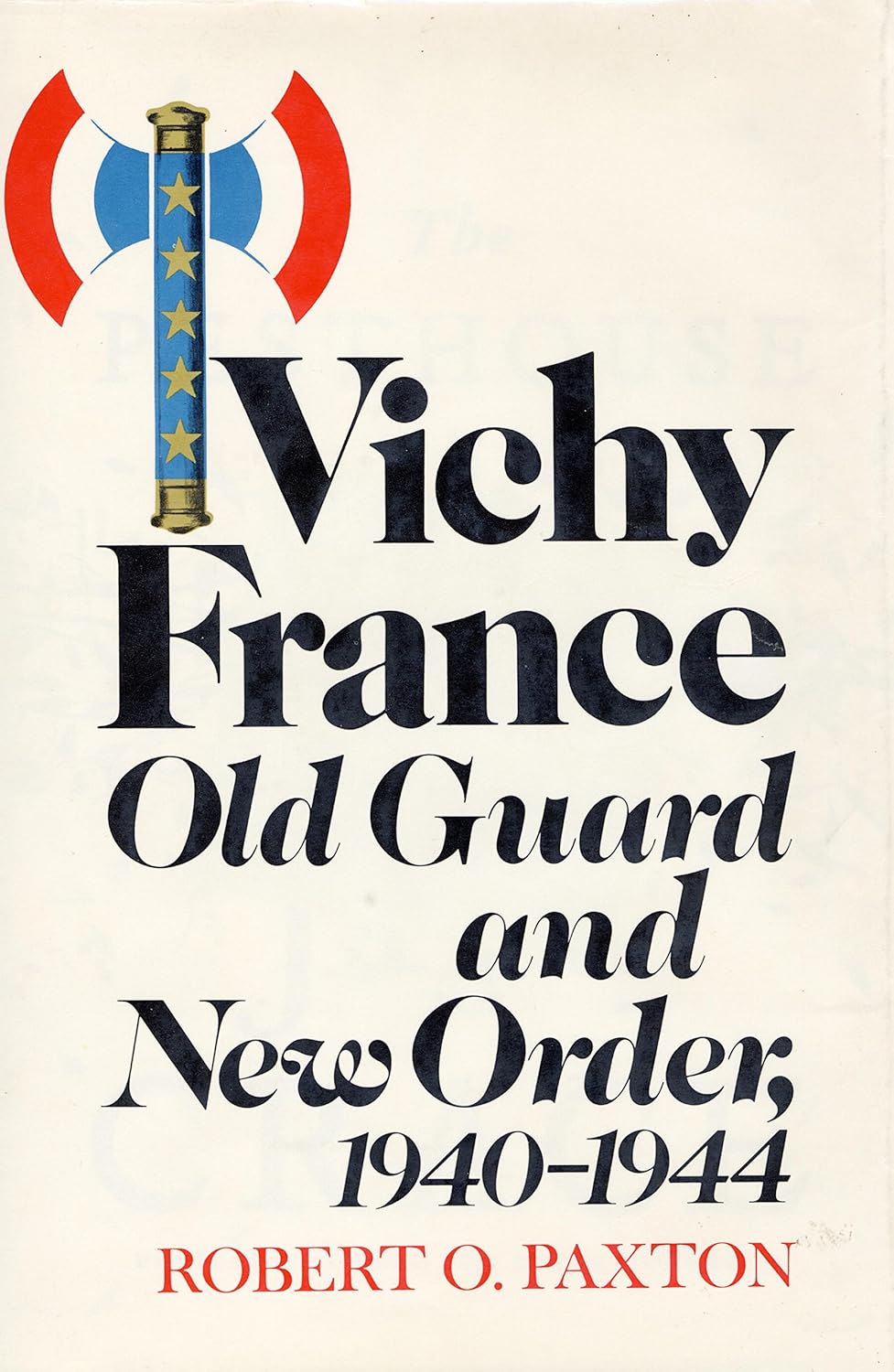
Robert Paxton is another prominent historian who has addressed these issues in his work. In 1972, the year he turned 40, his book “Vichy France, Old Guard, New Order, 1940-1944” shook intellectuals in that country to their core. France didn’t like what he had to say, but eventually forgave him, having largely come around to his point of view, and he was awarded the Légion d'honneur in 2009. According to the New York Times Magazine in October 2024, the retired professor of history at Columbia University “is still something of a household name there — his picture appears in some French high school history textbooks.”
Paxton, wrote the Times’ writer Elisabeth Zerofsky after she visited him at his Hudson Valley home, was “raised in Lexington, a small town in the Appalachian hills of western Virginia.” The lawyer’s son said his family was liberal, though it was of Confederate Army stock — one great-grandfather, for instance, was killed at the battle of Chancellorsville. He was sent up North for the final years of high school at Exeter, but instead of going on to Yale or Princeton, he opted to study at Washington and Lee University, like generations of Paxtons before him. A Rhodes scholarship to Merton College, Oxford, was followed by two years of navy service in Washington DC. He next chose European over American history, which, especially of his native South, “felt rather stultifying,” and visited France for the first time in 1960 when a doctoral student at Harvard.
At that time, the nation was attempting to exit its Algerian quagmire and also transitioning from the Fourth to the Fifth Republic, the first president of which was also its architect, Charles de Gaulle. The state preferred the view that de Gaulle’s singular act of defiance 20 years earlier, when he escaped to London by airplane to form the Free French movement, represented the true national spirit. The makeshift government headquartered at Vichy following military defeat was an aberration.
Paxton, however, helped force the country to confront its past. The regime, led by the elderly World War I hero General Philippe Pétain, was a willing collaborator with the Nazis, and it was accepted for a time by the population in the area it governed, despite the harsh terms of the armistice. Its “national revolution” was supported by conservatives, particularly the far right, which, Jan. 6-like, had rioted in the streets of Paris back on Feb. 6, 1934. Many who’d been fanatically anti-German before the war rallied to the Pétainist banner. The right had a ready-made target responsible for defeat, national decline brought about by liberals and the left, not least the Popular Front government of 1936-38, which allowed for workers’ right to strike, collective bargaining and two weeks’ paid vacation.
Some of Paxton’s political-science work, his book “The Anatomy of Fascism” for instance, has been concerned with defining fascism. When asked about Trumpism in 2017, though, he said he preferred not to use that “most toxic of labels.” There were similarities, but also differences.
After Jan. 6, 2021, a reporter from Newsweek reached out and discovered he’d changed his mind. Paxton quickly followed up with an essay in a French publication that was translated for an American outlet. The assault on the Capitol “removes my objection to the fascism label,” he declared, adding that Trump’s “open encouragement of civic violence to overturn an election crosses a red line.”
He added, “The label now seems not just acceptable but necessary.”
In her magazine piece published 15 months ago, the Times’ Zerofsky wrote that the historian “told me that he doesn’t believe using the word is politically helpful in any way, but he confirmed the diagnosis.”
Paxton said, “It’s bubbling up from below in very worrisome ways, and that’s very much like the original fascisms. It’s the real thing. It really is.”