This column was published in the Nov. 26-Dec. 2, 2025, edition of the Irish Echo.
The word “Never” being used before someone’s name is a practice that’s been slow to take off since being applied in the Trump context.
But we had a recent example from Dan McLaughlin in the conservative National Review, a piece that ran with the intro subhead, “Where Is the Never Mamdani Movement?”
“There have been plenty of opportunities for Democrats to show the voters of the city, the state, and the nation that this man’s [Zohran Mamdani] views are intolerable to their party,” he wrote in late September.
McLaughlin’s terminology was an allusion to the movement of Republicans opposing the current president that first appeared when he emerged as a serious contender for their party’s nomination a decade ago. Although he didn’t explicitly mention that “Never Trump” movement, he was keen to make the general point that the Democratic Party can’t claim any moral superiority over Republicans on the issue of flawed candidates.
There’s an obvious weakness in McLaughlin’s position, which I’ll get to; but he does show the potential adaptability of a word that suggests someone’s views are beyond the pale, politically speaking, or should be, from his or her party’s perspective.

“Never” brings to mind two other words, or at least suffixes, that are used widely in the media about politics. One of them, “-gate,” is not at all descriptive, while the second, -skeptic, aims to be, initially at least.
The origins of the first can be traced to the incident at the Watergate complex of buildings in Washington DC during the early hours of June 17, 1972. The arrests of burglars at the office of Democratic National Committee Chairman Lawrence O’Brien would eventually uncover a campaign of espionage and sabotage against his party by top Republican aides in their efforts to reelect the president. Richard Nixon, it turned out, easily won a second term, but 22 months after those Watergate arrests he became the first and still only U.S. president to resign from office.
Ex-Nixon speechwriter and New York Times columnist William Safire would claim credit for popularizing -gate with the ironic attaching of it to various other words as the 1970s rolled on.
In the decades since, -gate has been used not just for major scandals, but also as a label for relatively minor controversies and short-term media storms in a teacup. Wikipedia has a long list of such “-gates” — which even includes two gategates.
As for “skeptic,” according to the online definition that pops up first, that is a “person inclined to question or doubt accepted opinions.” One well-known use politically is “Euroskeptic” — and it has set the pattern, whereby the “inclined” becomes militant opposition to and the “accepted opinions” opposed often refer to ones that are based upon reason and/or science.
Some Democrats might disagree with the New York mayor-elect’s policies, but other than his electoral opponents, there are no overt Mandami-skeptics, in the political sense just described. Nor do they see any credible -gate type scandal connected to him, and more generally, they’d consider it absurd to attach “Never” to a 34-year-old politician who’s been elected to run a city.
A few years back the New York Times had a feature that explained corruption and why it was a problem for America doing business with certain nation-states. It posed a rhetorical question: didn’t the U.S. itself have Tammany Hall and other corrupt political machines at one time? Yes, this explainer piece conceded, but that was at the local level.
Clearly, then, there was and always is a difference between a city mayor and the person we refer to as the “leader of the free world.” Of course, someone like New York City’s former Mayor Rudolph Giuliani or Mayor Pete Buttigieg of Sound Bend, Ind., could emerge as presidential candidates without folks saying they were beyond the pale.
Certainly in the past there have been mayors whose authoritarian behavior or personal corruption or toleration of corruption among allies and underlings, would’ve made any of them unsuitable as a national candidate. Then again, local mayors and machine bosses like Tom Pendergast of Kansas City or Jersey City’s Frank Hague or, a little later on, Richard J. Daley in Chicago, tended not to have national ambitions. Even arguably the most controversial viable candidate with regard to corruption and an authoritarian style, Huey Long, had been Louisiana’s governor and was a U.S. senator at the time of his assassination in 1935.
So while we might welcome the expansion of the use of “Never,” the linking of Mandami and Trump is pure whataboutism from the National Review’s writer.
Mandami has caught the imagination, but he’s not close to being a viable state-wide candidate; meanwhile we have a president who combines some of the worst traits of the Pendergasts and the Hagues of the past, without exhibiting any of their basic competence. Too often, though, the message from right-of-center intellectuals is, “Move along folks, nothing to see here.”
On last Wednesday, the New York Times columnist Jamelle Bouie wrote: “Here is a small selection of stories concerning either the president, a member of his family or a member of his cabinet.
“This week, President Trump welcomed Crown Prince Mohammed bin Salman of Saudi Arabia with a lavish reception at the White House. Part of the president’s relationship with Prince Mohammed includes lucrative ties between the Trump Organization and Saudi firms, to the tune of tens of millions of dollars. It is for this reason, perhaps, that the president angrily dismissed the idea, evidence of which U.S. intelligence long ago gathered, that Prince Mohammed ordered the killing and dismemberment of a Washington Post columnist, Jamal Khashoggi, in 2018. The crown prince denies it. ‘Things happen, Trump said.”
Bouie continued, “Earlier this month, top Swiss business leaders arrived at the White House bearing lavish gifts fit for a king.” After detailing what they were, he wrote, “A week later, the president rewarded Switzerland with a favorable break on tariffs, reducing them from 39 percent to 15 percent.”
The columnist continued his list: “This summer, The New Yorker reported that the Trump family had earned $3.4 billion through deals it had arranged since Trump entered the White House in 2017. The Trump Organization is also expanding its operations around the world, developing more than 22 properties in at least 10 countries, whose leaders have every incentive to flatter the president with gifts and handouts.
“And ProPublica reports that Kristi Noem, secretary of the Department of Homeland Security, directed more than $220 million worth of funding for an ad campaign to a consulting firm with ‘longstanding personal and business ties to Noem and her senior aides at D.H.S.’
“In any other administration, at any other time in American history,” Bouie commented, “this level of corruption would be a political disaster — a scandal that could bring down the administration. For the Trump administration, it is a Tuesday.
“If Trump’s first term was marked by a level of graft and self-dealing that would have embarrassed a Tammany stalwart, then his second term seems to be an explicit effort to outpace his previous record and set a new high-water mark for political corruption in the United States.”
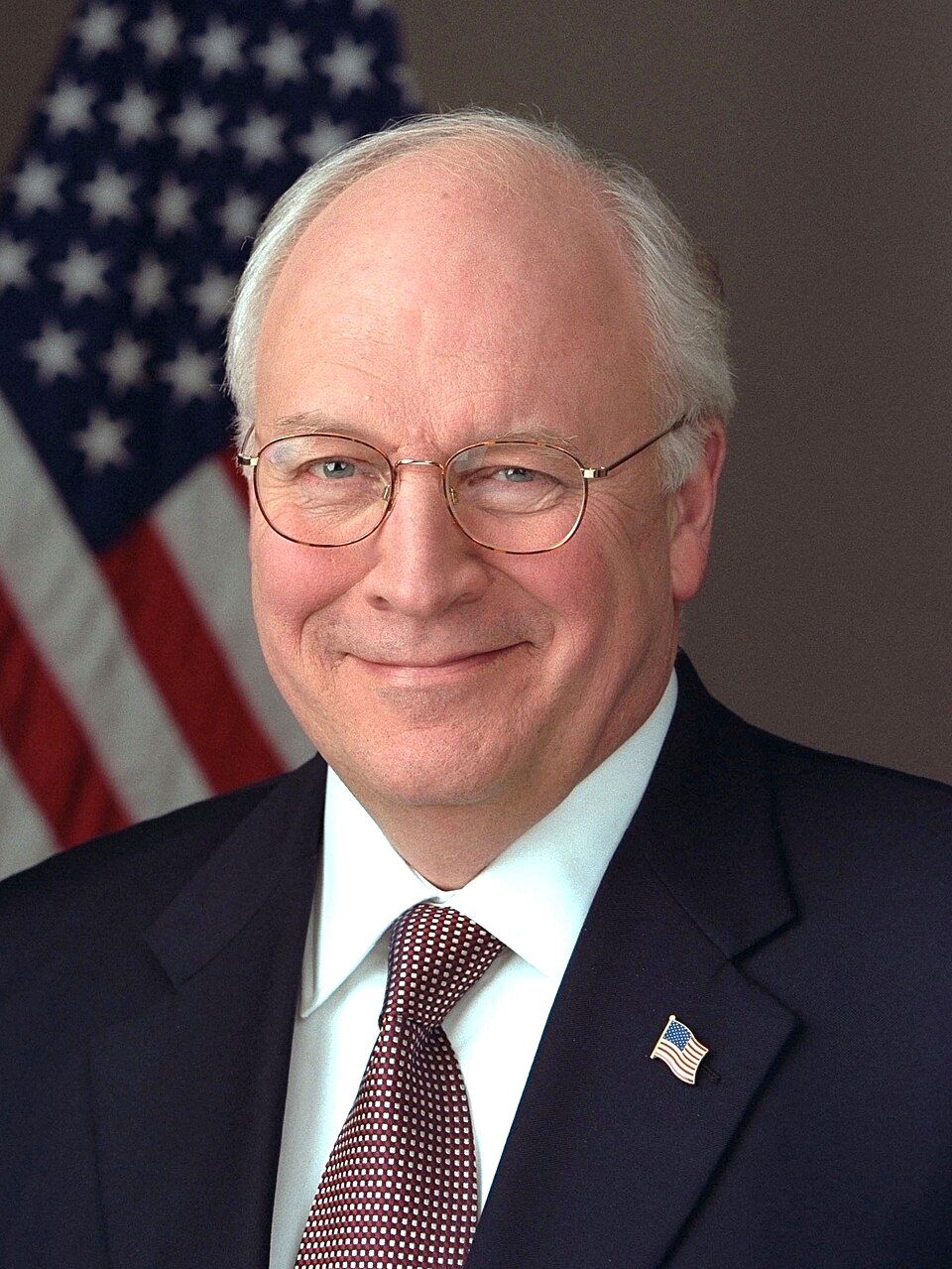
U.S. Vice-President Dick Cheney in 2003.
The lack of an impassioned stand against the rampant corruption and authoritarianism of the Trump administration is what distinguishes the conservatives who refuse to break with the Republican mainstream and the Never-Trump camp.
“Trump’s many and well-known vices should not leave us unable to see that the man also has his virtues,” ran a summary introduction to a Dan McLaughlin piece at the National Review’s website on Oct. 31.
The Never-Trumpers would not likely agree with him.
Three days later, on Nov. 3, former Vice-President Dick Cheney died, and we were reminded by media outlets that he was the only former president or vice-president to back Trump in 2016, but he’d flipped by 2024 to become a Never-Trumper, like his daughter Liz Cheney.
Cheney said last year, “In our nation’s 248-year history, there has never been an individual who is a greater threat to our republic than Donald Trump. He tried to steal the last election using lies and violence to keep himself in power after the voters had rejected him. He can never be trusted with power again.”
The former vice president continued, “As citizens, we each have a duty to put country above partisanship to defend our Constitution. That is why I will be casting my vote for Vice President Kamala Harris.”