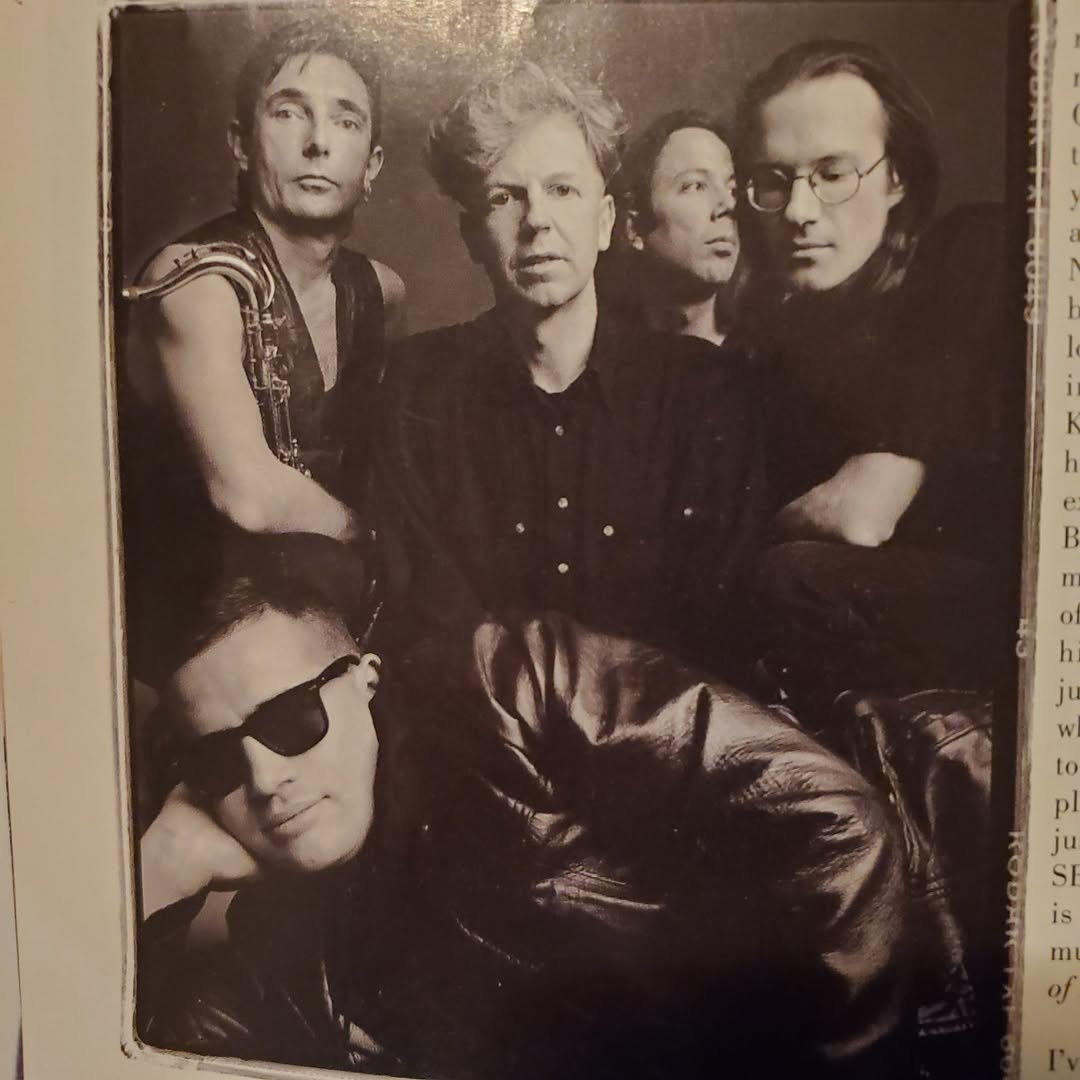
Larry Kirwan is a man to admire on many fronts. Anyone who chances to meet him knows they are in the midst of a living, American urban legend.
For over forty years, he has been a voice for the unspoken, and a contender against the unjust. By the cause of his noble soul—in his iron-clad words and thrashing rhythms—Kirwan has given rise to the underrepresented in America and worldwide.
Even unto his success, Kirwan has led the charge for the marginalized, the uncounted, the downtrodden and the unseen. Like Springsteen, Larry never lost the roots of his humanity, has never lost sight of the underdog in the fight, and holds steadfast to his vision in hope of a deserving, even-handed, and rightfully won America.
By way of Wexford, Kirwan made his name in New York on the Lower East Side as the playwright of “Liverpool Fantasy” and co-leader of Major Thinkers alongside Pierce Turner. From the demonic days at CBGB into the 80s, Kirwan continued writing plays with a punk approach, among them “Requiem for a Rocker,” “Mister Parnell,” “Blood,” and “Night in the Garden,” until he began making songs about labor leaders and the immigrant experience, and played them in The Bronx with a little band called Black 47.

The rebel heritage of Kirwan’s music is a dream of stuff as the American dream is made on.
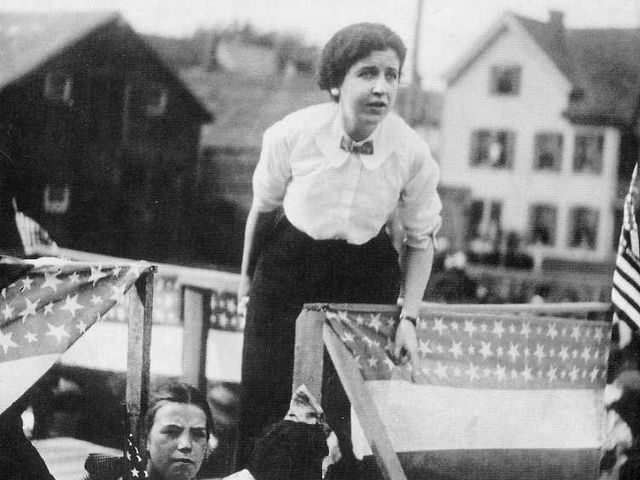
Elizabeth Gurley Flynn.
In the cold sun of a January day, I spoke with Larry over cups of mellowed Barry’s about his latest musical, “Rebel Girl,” whose staged readings were performed last fall at the New Brunswick Performing Arts Center, produced by Michael Londra, directed by Peter Flynn with musical direction by Mark Fifer. Following his Tony-nominated musical “Paradise Square,” Kirwan reprises the search for America’s essence in peril with “Rebel Girl,” the life of 20th century labor activist Elizabeth Gurley Flynn, as we interpret the familiar tune of her times, when social mores and politics revolt in the syncopation of a modern world.
KP: “Rebel Girl,” much like “Paradise Square,” is enmeshed in the untold stories of the Irish in America, often involving complicated alliances and imperfect cooperations made in the pursuit of freedom and fairness. Sounds like the music industry, or the theater industry.
LK: Like life.
Has collaboration been integral to your pursuit of art?
Yeah, that was one of the things I liked about theater, that you're meeting new people all the time. You have a different cast for each play. So you're sussing out the actor's strengths and maybe adapting the part a little more for them. Because I come from the improv world, the word is not sacred to me. Even if I've written it in a nice way and an actor does it and I feel that's better, I'll go with that. If the actor does something that's totally different, I'll halt them and say, “consider it this way.” But you don't in general do it...the only thing I insist upon is that whatever the initial truth of the thing was in my mind, that we stayed true to that.
Musically, “Rebel Girl” is a union of genres, and an anthology of America’s revolutionary music: rock, blues, jazz, punk. The same can be said about Black 47. Many characters in “Rebel Girl” are analogous to America’s greatest (and notorious) musical figures: Ben Fletcher to Paul Robeson, Margaret Sanger to Bessie Smith, Joe Hill to Woody Guthrie, and J. Edgar Hoover to Al Jolson. Who were your influences and who did you correlate to which characters?
Every one of the ones you mentioned there is an influence. And, say for instance, with Ben Fletcher, I would also throw in Otis Redding. But one of the reasons I chose 1912 to 1922, the time span of the play, was because these different styles of music were coming out from different areas of the country. New Orleans and folk, hillbilly, opera. They were all coming together to create American music for the first time. So I thought, there’s so many different styles to choose, including Irish and Jewish from the immigrants coming in, Italian from the opera, and of course the glory of African American music. It’s the glory of American culture, I think.
I think it’s so important that music takes center stage in the story the way that it does.
There’s a rule in musical theatre that the song leads you into the next scene...And I had been wondering for so long, when is musical theatre going to grow up and catch what we always got in the rock world? It’s not so much what you’re saying; it’s the overall feel... What I’m talking about is having waves of sound that will create a feeling that the actor can tune into.
How do you write for history? Do you have a narrative in mind that the history follows?
I like to find watershed periods when something is changing. I knew that between 1912 and 1922, so much went on in American history. Everything was changing...And the “Rebel Girl” characters were world-changers, you couldn’t make them up... Not only that, but when Queen Victoria died, sexual mores changed almost overnight. So the women in this musical were the first generation of American women defining their own sexuality. So it’s not just political change, it’s societal change. I always look for those periods when something is happening, you can’t put your finger on it. The music you can use without hammering a point over the head. If it’s a straight play you really have to bring that out and talk about it. With a musical, you can have people dancing and singing about freedom…and in the abandonment of the dancing, you can get your point across.
Many of the Irish were unsung leaders of workers’ rights, yet rarely remembered the world over. How did Elizabeth Gurley Flynn’s story reach you, what does it mean to tell her story now?
I’m from Wexford, and Wexford was an industrial town in the early 1900s, with three big foundries. There was a lockout in 1911, led by Big Jim Larkin and James Connolly, both of whom had been in the U.S. at different times, and had been in league with the Wobblies and with Elizabeth. I was always going to write about Elizabeth, because she’s just kind of amazing. At 15, she gives her first speech on a Bronx street corner, and James Connolly, who is staying at her house because her mother is a real Fenian, can’t get over this young woman; that she’s so advanced. And by the time she’s 20, she’s a national figure. James Connolly, by the way, taught Elizabeth how to burp her baby! One of the things with Elizabeth, and with Tresca in ways, is that they came from a pre-confessional time. She wrote some amazing, fine poems. She was a deep thinker and feeler, and I wanted to bring her back to life.
Elizabeth Gurley Flynn, the hero of “Rebel Girl,” along with Carlo Tresca, Ben Fletcher, and Joe Hill are portrayed as folk heroes in the music, reminiscent of the anti-Crown rebel songs of Irish trad. Do your Irish musical roots have a part to play?
Yeah, because the Irish know how to tell a story. Writing was taken away from us through the Penal Laws…but we never lost the facility of being able to tell a story. I always think, and again it’s going back to musical theatre, usually the root of the piece comes from a movie, or a book. So where are the storytellers? You have to come up with new stories. And it always strikes me when I go into an Irish bar that there are better storytellers in there than you’ll find on Broadway.
In your music—in the studio, on the road, and on the stage—you are so keenly aware of local history and the ordinary people who have the power to change the world. Is it your purpose to keep their stories alive in song?
Yeah, and the good they did. That it shouldn’t just dissipate into TikTok.
The Irish have both championed workers’ rights around the world as well as suppressed them. How do you hope the Irish will be remembered in America’s labor history?
I think the Irish are the foundation of American Labor. There’s always that need to find the radical heart of the Irish in America, because otherwise, conservative forces can take over so easily, and I’m not saying that’s always wrong, in ways, but there’s got to be a balance between radicalism and conservatism.
The struggles of “Rebel Girl” are as critical today as they were over a century ago. But the story, while complex in its politics, sometimes conflates the tropes of its conflicts with its characters. Do you worry that audiences might miss history’s complexities for its archetypes?
I see that one character’s faults can lead to the problems they are having. Like for instance, Elizabeth’s big fault—if it is a fault—is that she didn’t want to have another baby, and Tresca wanted a son. So, who’s right and who’s wrong in that?... I did villainize [J. Edgar Hoover] a bit but, he seems to me somewhat of a sympathetic character in his own way. He thinks he knows what he’s doing but he’s being used by Big Money too...They’re just a complex bunch of people.
Elizabeth Gurley Flynn’s life has been left untold for many biases—for the gender bias in history and the repression of worker’s rights that go on to this day. What do you hope Flynn’s story will remind audiences about the women of America’s past?
Their sheer courage. Now there are rights. Women didn’t have rights back in 1912. Women just got pregnant over and over, and the women of “Rebel Girl” were the first of a new generation after Victorianism who just said, “No. I’m not putting up with it.” So it’s to show that it can happen once, it can happen again...because we have the exact same problems today as back then: income inequality, immigration, the rights of women, the rights of everyone. It just shows that if you stand up and say something, and do something, you can change things. I learned that from Bobby Sands. “No one can do everything, but everyone has their part to play,” then everything fell into place! If you influence the people around you, you can’t do much more than that, but if everyone does that, it will be a better world.
It’s hard to know how to hold your own in such a chaotic period of history and still keep your direction. And I think that’s what people are going to be, I hope, really fascinated with in these characters. And most identifiable with these characters, is “How do I maintain my integrity in a time where it’s hard to see the beacon...” One last question: Can music still rebel?
Yeah. It’s just that it isn’t set up to do so anymore. Rock music has become like society in general. Only the top 1% can make it. But now that middle ground is not there. Since people stopped buying music, bands like Black 47, who were in the top 10%, can no longer exist. That’s why I’m back in theatre: I can control the narrative as well as the music. “Rebel Girl,” in many ways, tells my story and many others.