Dear Editor:
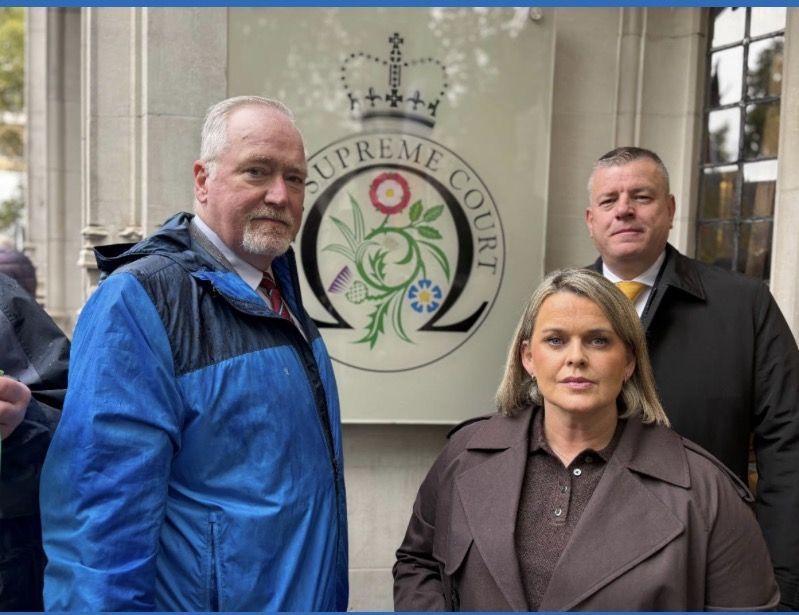
The Irish Echo’s recent report on the Sean Brown murder case highlighted the family’s resolute pursuit of truth, acknowledgement, and justice. (“AOH National President Attends London Sean Brown Court Hearing,” Irish Echo - Nov. 4, 2026). A hearing before the UK Supreme Court marked the Brown family’s 60th trip to court on this journey.
The family spent years fighting to have the police produce information in their files. They spent additional time fighting the UK government to disclose information covered by a blanket national security claim. Decades passed with the family’s questions going unanswered - a typical outcome in cases involving collusion. At present, the family still has been denied the truth about the killing.
It was heartening to read that AOH National President Sean Pender attended the hearing in support of the Brown family, They, like all Troubles-murder victims’ families, deserve Irish-America’s support and praise for their courage and determination.
Brown was chairperson of the Wolfe Tones GAA club in Bellaghy, County Derry. While locking the gates one evening in May 1997, he was kidnapped, placed in the boot of his car, driven away, and shot 6 times by members of the Loyalist Volunteer Force. He was murdered during that year’s Drumcree violence. His killing was yet another sectarian crime involving government collusion. Over time it became clear that 25 people, including state security agents, were involved.
A focus on the law can often eliminate the human element from court hearings, giving the hearing an aura of legal sterility. It can also lead a court to entirely miss the human element in its decision-making. That appears to be likely in the Brown case.
Last May, the UK Supreme Court unanimously decided In the Matter of Dillon, et al. The court held that the Independent Commission for Reconciliation and Information Recovery (ICRIR) process was able to produce human rights compliant investigations. Therefore, the court said, the time to challenge whether compliance was achieved is after completion of the investigation not before. The court did note that in a rare and exceptional case, it may be possible - based upon the facts - to show the ICRIR process cannot fulfill the state’s human rights obligation prior to an investigation. A key issue in the Brown case was whether the salient facts established “exceptionality.”
Sean Brown’s 89-year-old widow Bridie filed this action ((In the Matter of Bridie Brown) after Northern Ireland (NI) courts recommended that “a public inquiry be established into the death of Sean Brown,” because the public inquiry process permitted the examination of national security files in a closed hearing. Then NI Secretary of State (SOSNI) Hilary Benn rejected that recommendation and called upon the Brown family to utilize the ICRIR. The Brown family stated they did not trust the ICRIR and lacked faith it could deliver them the truth and justice which they deserve. So, they appealed the SOSNI’s rejection of the NI courts’ recommendation to the UK Supreme Court.
In court, the SOSNI’s barrister cited Dillon again, and again, and over again. Bridie Brown’s barrister argued that the facts presented in Sean Brown’s case satisfied the rare and exceptional grounds contemplated in Dillon, and he admirably argued why the NI courts’ recommendation to hold a statutory public hearing should be followed.
The murder MI5 wants to hide.
Almost 30 years after Sean Brown was kidnapped from a football club, British intelligence is still censoring files that could help solve his murder👇https://t.co/xoQdvSKfK3
— Declassified UK (@declassifiedUK) November 8, 2026
He pointed out that the NI Police Ombudsman’s Office found the original police investigation of the murder was flawed; that the failures were egregious and deliberate to protect state agents; that the Police Service NI Chief Constable apologized to the Brown family for its failure to conduct a proper investigation; that 25 people, including several state agents, were involved in the killing and cover-up; that the coroner concluded the national security veto prevented him from doing his job; that Bridie Brown has been to court 60 times seeking truth and justice; and that only a statutory public hearing - as recommended by the NI courts - would result in uncovering all of the facts surrounding the crime and answer the family’s questions.
He made, in short, a compelling exceptionality case on why the ICRIR process would be incapable of delivering the truth to the Brown family. The court reserved judgment.
It is always dangerous to predict an outcome based upon the Justices’ reactions to arguments presented in court. From my perspective, however, the questions they posed to the barristers exhibited a disinclination to find exceptionality as contemplated in their Dillon decision.
I’ve listened to a few UK Supreme Court arguments on legacy cases. My overall sense is that, while UK Justices may understand the level of devastation the murder of a family member inflicts upon a family, they appear unable to appreciate the deep pain families suffer in having to spend decades fighting to find out what happened to a loved one. Like the Brown family, hundreds of Troubles-murder victims’ families are still waiting for answers. This is the human element in collusion matters. Additionally, the Justices don’t seem to comprehend the depth and breadth of the collusion that took place during the Troubles or grasp the enormity of the indelible societal scars it caused.
I fear the UK Supreme Court’s Brown decision will mark another example - like the NI Troubles Bill moving through the British Parliament - of London missing the mark on delivering Troubles legacy justice to victims’ families. If the facts in Brown do not meet Dillon’s exceptionality standard, no case will.