In 1602, Red Hugh O’Donnell, Lord of Tyrconell (Donegal) and leader of the Irish in the Nine Years’ War, entered the city of Valladolid in defeat. He, along with his Irish confederates and 3,500 Spanish allies, had lost the siege of Kinsale, the catastrophic battle that crushed the Gaelic order and ravaged Irish culture. As darkness was falling on Aodh Ruadh Ó Domhnail’s world, the city of Valladolid’s sun was rising to its zenith. Spanish renaissance buildings lined its streets along with older gothic structures. The birthplace of Castilian Spanish, Valladolid boasted one of the oldest universities in Spain and indeed in the world. King Phillip III had recently moved his court to the city from Madrid, boosting the local economy, population, and construction. In a couple of years, tax collector Cervantes followed him to see the first edition of “Don Quixote.”
Red Hugh’s strong relationship with King Phillip III and the Franciscans offered him hope. He would ask the king for troops and ships with which he could sail back to Ireland to wrest from the English invaders the green land spied by his Milesian ancestor, Ith. Sadly, while Red Hugh O’Donnell awaited the Spanish reinforcements promised by Phillip III, he fell ill and died at nearby Simancas fortress at the age of 29. The king honored Red Hugh with a royal funeral.

Organized by Carlos Burgos, president of the Hispano-Irish Society and Eddie Crawford, chair of the Red Hugh Association of Donegal, a reenactment of the funeral took place during “O’Donnell Weekend” in Valladolid Sept. 25-27.
O’Donnell Weekend began Friday morning in the baroque Valladolid University Auditorium with welcomes from Ireland’s Ambassador to Spain, D. Brian Glynn, Donegal Cathaoirleach Gary Doherty, Valladolid University Rector Paz Altes, Valladolid Vice Mayor Dr. Irene Carvajal and Carlos Burgos.
Eddie Crawford announced plans to place a plaque at Dublin Castle at the spot where Red Hugh and his comrades escaped from prison and the twinning of the towns of Lifford, Donegal, birthplace of Red Hugh, and Simancas, Spain, where he died.
Representatives from Spanish organizations promoting Irish culture offered updates: David Alegria from Asociacion de Amigos de Irlanda de Navarra spoke about his organization’s busy year of Saint Brigid’s and Saint Patrick’s Day celebrations. Ful García from Asociacion de Amigo de Irlanda Canarias told the story of Irishman Dionisio O’Daly who led a rebellion against nobles and started Spain’s first democracy in Santa Cruz de la Palma in the Canary Islands. Luis Blanco of the Hibernian Iberia Association highlighted Salamanca’s Irish College, which gave refuge to Irish Catholics for centuries. Jorge Mackey from Asociacion Irlandeso-Argentina presented via video.
Academic presentations followed. Dr Eduardo de Mesa gave a talk on “The Irish in the Spanish Tercios” about the Irish who have served in the Spanish military over the centuries. Franciscan Brother Francisco Javier Rojo provided the history of “The O’Donnell Clan and the Franciscans,” outlining the O’Donnell clan’s long history with and strong devotion to the order. Hugo O’Donnell from the Royal Academy of History discussed “Prince Red Hugh O’Donnell,” exploring the mythical and poetic underpinnings to the history of the Spanish Celts migrating to Ireland. Actor Denis Rafter inspired the audience, describing his goal of feeling what Red High O’Donnell felt as he walked the streets of Valladolid in the days before his sickness. “Communication is not sound only, but emotion,” he said, and illustrated his point with a love poem in Irish.
Irish dancers from Madrid-based company Luna Celta, “a space where Ireland and Spain can meet in Madrid,” stepdanced to jigs and reels played by Mark Blackwell on the uilleann pipes and Brian Clince on bodhran.
On Friday evening the Museum of Contemporary Spanish Art hosted a screening of “The Camino Voyage,” a touching and humorous documentary about four Irishmen who rowed in a “naomhog” from Ireland to Santiago de Compostella to recreate sea pilgrimages made by the Irish centuries before. Brian Clince sang, “The Parting Glass” in honor of Danny Sheehy who drowned on a subsequent journey. In memory of substitute rower Glen Hansard who died in a recent motorcycle accident, we watched the video of “Falling Slowly,” the Oscar winning song he wrote with Markéta Irglová.
Next morning we headed to Simancas Castle, the royal residence where Red Hugh spent his final days. For the first time in the history of O’Donnell Weekend, there was a ceremonial raising of the Irish flag at the castle. The dignitaries from Ireland and Spain held meetings and exchanged gifts. Brian Clince read Mangan’s “Dark Rosaleen,” accompanied by Mark Blackwell on tin whistle. We had a tour of the archives housed in the former castle, which date back to the 17th century and include Aodh Ruadh Ó Domhnail’s will in Irish.
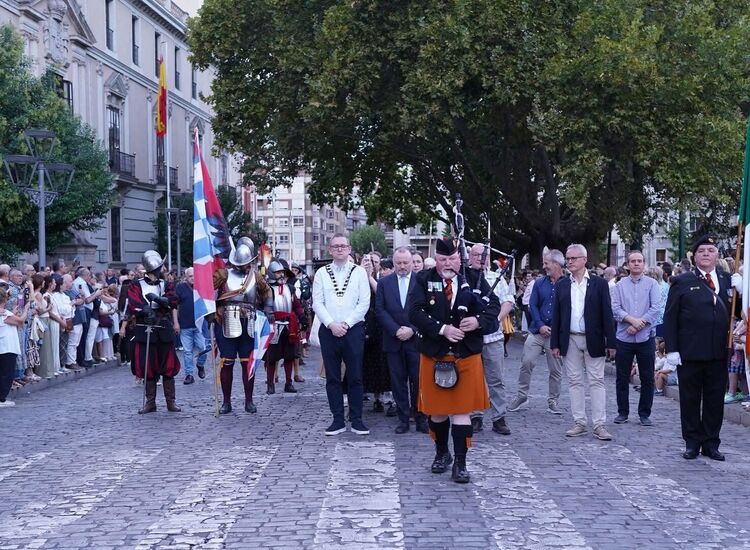
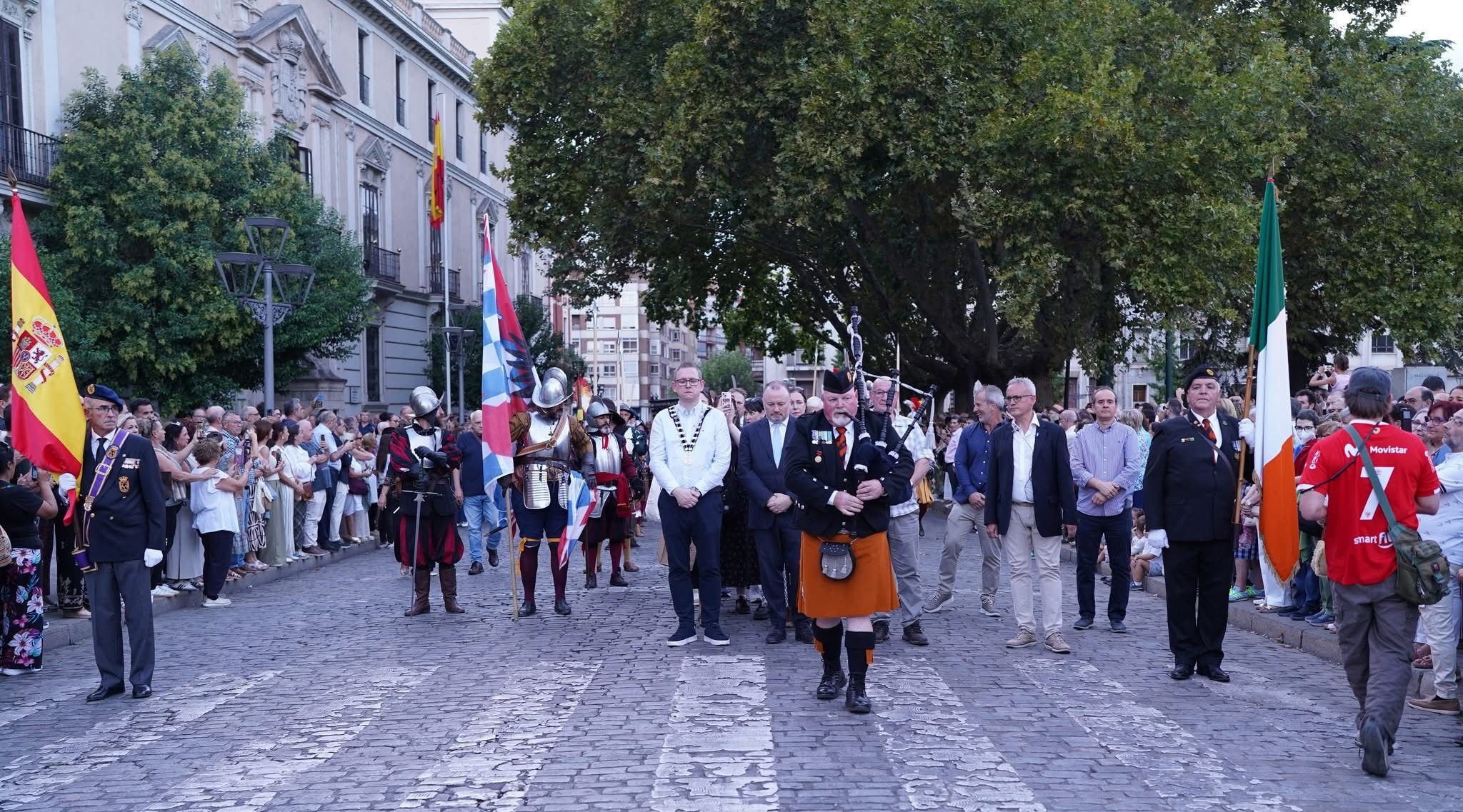
Saturday evening marked the main event: the reenactment of O’Donnell’s funeral. Participants dressed in period costumes as soldiers, torch bearers, Franciscans, and the king and queen. Traditional Spanish musicians and Irish bagpiper Jim O’Hagan led the way with marching tunes. A flag-draped coffin waited in a horse-drawn hearse as dignitaries gave dramatic readings in Spanish and in English of Red Hugh’s will, which specified that he be buried in the San Francisco Convent. The procession wound from the Royal Palace Courtyard to Constitution Street, where a plaque commemorating the location of the “chapel of wonders” where Red Hugh was buried. Echoing with bagpipe music and the clipcop of hooves, the streets were thronged with a record-breaking number of people lined up to see the procession and curious onlookers who left their outdoor café tables. The Spanish and Irish dignitaries gave speeches and hung wreaths bearing the colors of the two countries.
Of course, as with most Irish events the craic and real bonding took place at the pub afterwards. The Seamrog Bar near the university hosted three nights of sessions until the wee hours with Mark Blackwell, Jim O’Hagan, Brian Clince and local Spanish musicians on bodhrans, Irish bouzouki, fiddle, and guitar. Donegal Cathaoirleach Gary Doherty contributed songs a capella and accompanied by guitar. The Spanish musicians were well versed in Irish tunes and rebel songs.
Toward the end of the final seisiun of the weekend, all of the Spanish and Irish voices joined in chorus after chorus of, “A Nation Once Again,” which shook the walls and rafters of the Seamrog and echoed down the centuries-old street. Red Hugh O’Donnell must have smiled down on that.
The weekend concluded with a Sunday Franciscan mass at the San Isabel Convent Church. Mark Blackwell played the uilleann pipes and a choir of local women sang with shamrocks on their lapels. Jim O’Hagen led the offertory procession with his bagpipes.
The mass ended with a surprise song from the choir in English: “May the Road Rise to Meet You” whose conclusion “Until we meet again, may God hold you in the palm of his hand” brought tears to the eyes of the congregation.
Plans for the 2027 event were already discussed on Sunday night as the group brainstormed about getting some Irish-American groups and visitors involved next year.
For more information, visit hispano-irish.com and Facebook’s Red Hugh O’Donnell The Fighting Prince of Donegal.
_____________________________________________________________________
John Kearns is the Arts and Culture Chair of the Irish Business Organization of New York. The launch for his novel, “Abaton,” will take place at the New York Irish Center on Nov.18.