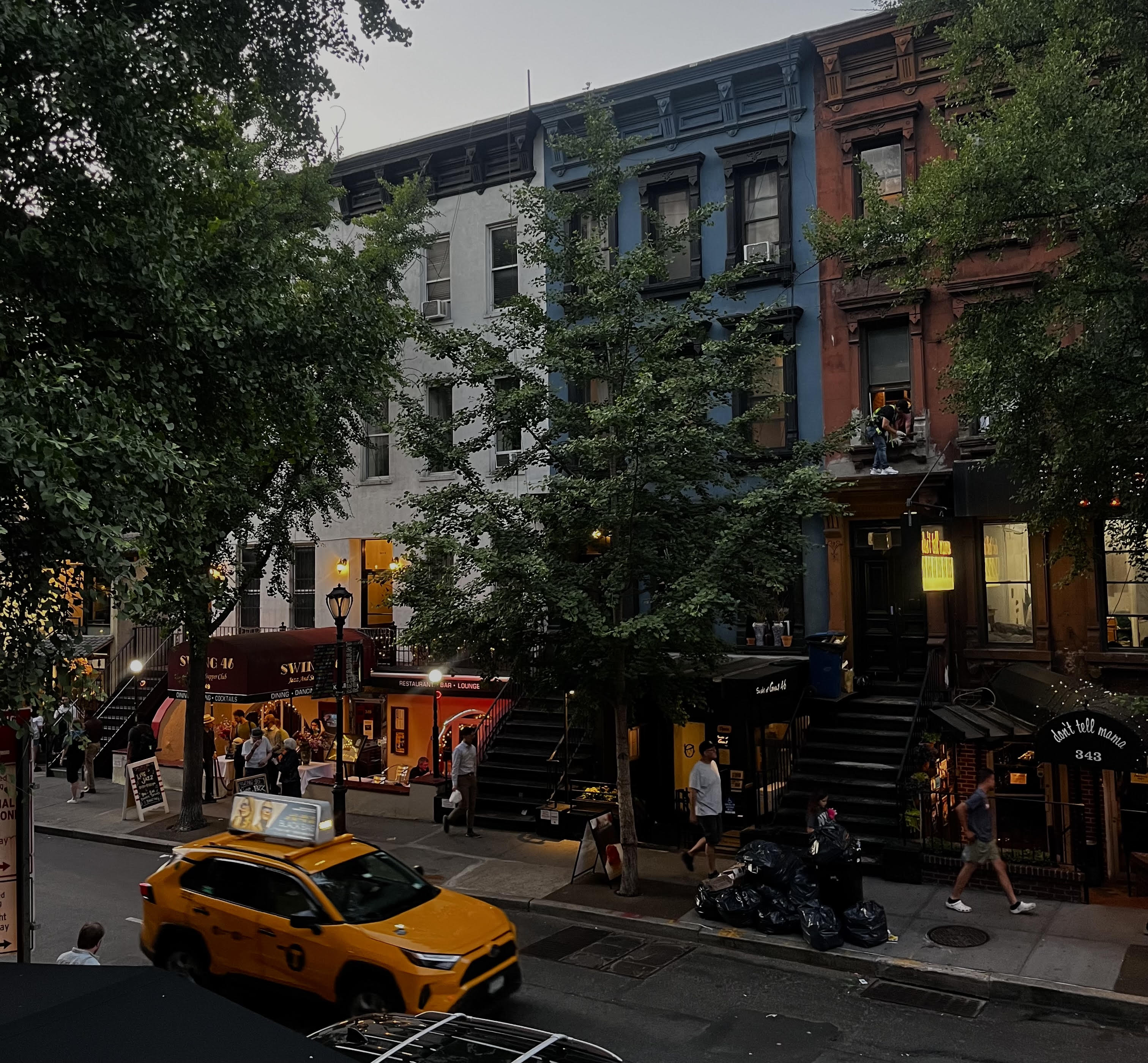
The first time I saw a rat in New York City, I screamed. It was a midsummer evening in Brooklyn, I was passing stoop after stoop in a scenic brownstone neighborhood, when a hideous creature skittered past my feet. My mother has always had a phobia of rodents. Spiders have been my aversion, perhaps a factor in choosing to move to New York over Australia, in contrast to my brothers before me. The rat had merely caught me off guard that night.
They say you start to see something everywhere you go after you encounter it once. It’s called the “frequency illusion” or, in my case, you might counter that there really are that many rats in New York City. Approximately 3 million, I’ve heard. Rats became a staple of my everyday life when I lived in New York. I’d count them on the subway tracks. I’d anticipate the sight of the same three rats that would scurry out from the same black fence as I approached my apartment building. I grew quite fond of them, I thought.
In 1977, sociologist Graham M.S. Dann posed the question, “What makes tourists travel?” It’s one that most people would probably have an answer to -- escapism, curiosity, a good tan. Dann mulled on the thought somewhat longer, however, and explored the idea of a push-and-pull mentality. A person is pushed out of their jaded routine and pulled towards the prospects of shiny new terrain, whether it be for a weekend or the rest of their lives. A man who grew a thick skin in a shivering Siberian village might have developed a fervor for the sticky heat of Singapore. A woman who staked her claim in the splashy boulevards of Los Angeles might book a one-way ticket to a humble town in Ireland. Look at Rosie O’Donnell, who recently returned to the spotlight on “Jimmy Kimmel Live!” narrating her enchantment with lollipop ladies (crossing guards in U.S. parlance) and friendly pharmacists after relocating to Dublin.

Sydney, Boston, Liverpool, wherever you go around the world you’ll find an Irish pub. New York City is no different. Historically, we migrated to New York to escape the Famine, British policy, instability. Ireland was a rat trap, as The Boomtown Rats once claimed. Nowadays, an Irish person could have any reason to give it a try. They might be seeking a bigger city, better opportunities or simply an authentic bagel. I myself could never quite articulate why I wanted to move there. “It’s New York.” That’s about all I could muster when asked, as if the city speaks for itself. What I do recall, however, was a latent craving to toughen up. At 22 years old, I had never lived away from home. I had never bought my own toilet paper. It may have been subconscious, but that was my push-and-pull.
During my 14 months away from Dublin, I screamed at rats, I called my parents at every inconvenience, and I cried on the subway. I remember a conversation I had with a friend where she remarked on a moment she started crying in the middle of the street. Pedestrians aplenty, no one batted an eye. “I could never do that back in Longford,” she said. She was right, that doesn’t happen back home. It’s as liberating as it is discomforting. In other words, it’s New York. I was braving the big city, yet I didn’t feel any braver.
There’s more to Dann’s theory than the push-and-pull effect. Anomie refers to the destruction of societal norms and the subsequent dissonance between the individual and the community they belong to. It bears roots in the drastic cultural transformation of 19th-century Europe when everyone was forced to fend for themselves after the French and Industrial Revolutions. In contemporary times, inflation, housing crises, recession, to name a few, are undeniable factors of diaspora. Post-Celtic Tiger Ireland, in all its anomie and ghost estates that still haunt us, has no doubt left people restless for a sense of identity. New York is a minefield of identities. From Bushwick to Tribeca to the Bronx, there’s a city-wide thrift shop to try on personas and see what fits. We move to New York to find out who we can be.
Park Slope, Brooklyn.
I moved back to Dublin with no greater sense of myself. Walking through Dún Laoghaire harbor the next day, I looked back at the year I had lived with a distant haziness when I bumped into a girl I had met in New York. “The whole thing feels like a dream,” she said. I knew exactly what she meant. Suddenly I was back in my childhood bedroom as if I’d never left it. It was smaller than I remembered.
I suppose that’s the part that surprised me. There’s no mystical moment living abroad where you suddenly mature. The feeling dawns slowly. It blossoms in the mundane. You find yourself more comfortable talking to strangers. You start to doubt your competence less. You have to swim from the ocean back to the fishbowl you came from to know that you’ve grown.
A few months ago my house had a mouse infestation. My poor mother was in her own personalized Hell. The mousetraps were useless; the invaders were far too intelligent for them. They seemed to be multiplying at an impossible rate. Dominance asserted, it became apparent they were taking over. I took it upon myself one evening to put an end to their tyranny. I cornered them in rooms, I set up traps, and I lured them outside one by one. I had become the rodent hunter. I think about that first rat I saw in Brooklyn. He hadn’t caught me off guard that night. In full honesty, I was repulsed by him.
It’s spider season in Ireland right now. I think it might be time to give Sydney a go.
Since leaving New York, Cal Dillon has completed his master’s in screenwriting at Trinity College Dublin and looks forward to the next step in his career.