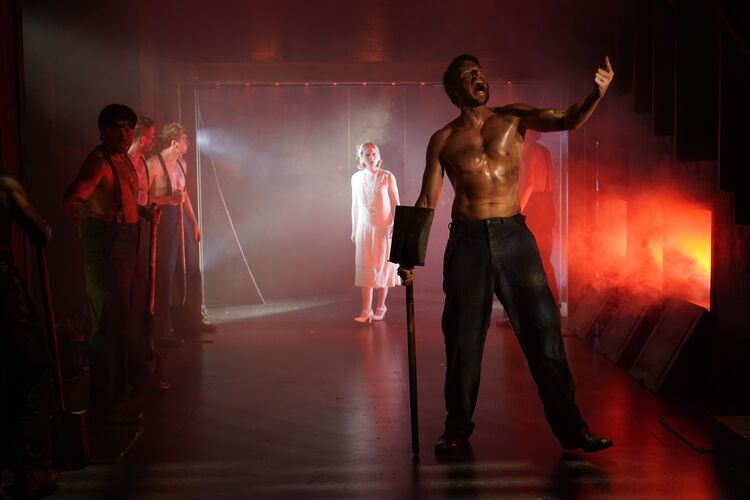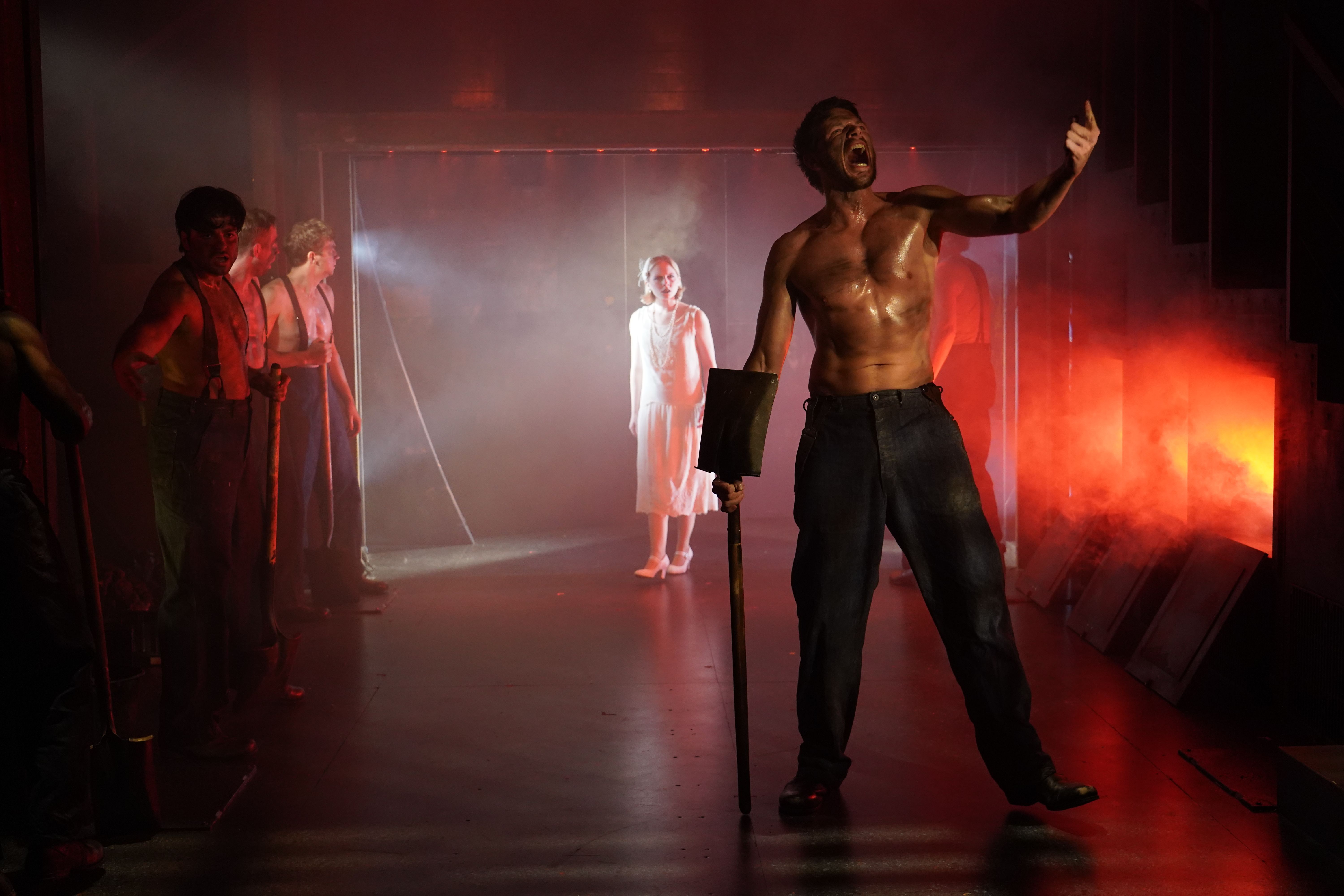
"The Hairy Ape” is a spectacular show. Never can I recall such a lavish production at the Irish Repertory Theatre. The set, especially, plus the costumes, the stylized movements, and the effects all hit the viewer. (Indeed, “Playbill” warns: “Please be advised that this production uses theatrical haze, fog, and flashing lights.”)
These, plus a 10-person cast make for a Hollywood-worthy production.
Set designer Charlie Corcoran has created many wonderful settings at the Rep over the years. (Could anyone that saw it forget the pulley system bringing beer bottles to an eccentric farmer in his bath in “The Quare Land” back in 2015?) His range goes from minimalist, as with last season’s “The Honey Trap,” to maximalist, in the case of this production of Eugene O’Neill’s 1922 play.
It's fitting for an expressionist work since expressionism boldly prioritized subjective emotional states over objective realism. (Think of the screaming emoji, derived from Edvard Munch’s painting, “The Scream”.)
Roaring fires, gushing water, and an angry gorilla are well simulated across some half-dozen locations depicted. But it is the sudden appearance of first-class passengers on deck, who are lowered on a platform from the rafters towards the alternate universe below-deck, that elicits a gasp of surprise.

This is how we are introduced to Mildred Douglas (Elizabeth Teeter) whose father owns the steamship on which she and her aunt (Joanna Glushak) are sailing to Europe from New York.
Far removed from them, in every sense, are workers in the boiler room feeding coal to the fires that keep the engines moving. Historically, these cogs in the machine were known as stokers and were frequently immigrants from Ireland or Italy. Many reportedly jumped overboard to escape their hellish existence.
So, seemingly did Driscoll, a drinking acquaintance of playwright O’Neill who was the inspiration for the “Ape” in the play’s title.
Like the central character, Yank, Driscoll once prided himself on his physical strength. His role in propelling the ocean liner made him feel part of the so-called “second industrial revolution” as the 20th century began.
This towering man is sent reeling into an identity crisis, sending him from being a pro-progress modernist to an expressionist fearing alienation. (Think of the movie “Metropolis” where man is devoured by the machine). Not that Yank would use such words. In his quest to belong—a word used 47 times in the script—Yank can’t find common ground with the intellectual Marxists, represented by his fellow stoker Long (Ariyan Kassam) any more than he can go back to the pre-locomotive past evoked by another, Paddy.
John Keating is inimitably wistful in a standout monologue as Paddy.
Jon Beavers, who carries most of the action, is a tour-de-force as Yank. This was the California-based actor’s first time on the New York stage, but it’s unlikely to be his last.
Yank’s crisis starts when Mildred comes into the boiler room. He thereby sees how others perceive him and his self-perception can no longer coexist with that. “Oh, the filthy beast!” Mildred cries, horrified and, fainting, is carried away. She just lost all interest in how “the other half” lives.
Our first glance at Mildred sets up the tension of the times, with her drop-waisted dress fitting the Jazz Age, whereas her aunt, in a bustle, seems Victorian. (The striking costume design is by Orla Long.) Sexually provocative, Mildred also heralds the femme fatale to come in 1930s culture: another expression of anxiety about the erosion of men’s power.
Despite current-day concerns that somewhat echo those of O’Neill when he wrote this play in 1921, the script feels dated. Yes, populist political movements globally have been partly attributed to the displacement felt by blue-collar men. And there is greater concern today that technology, in the form of artificial intelligence, will displace humans, but plumbers are better positioned than lawyers, so the parallels only go so far.
Under a less skilled director than Ciarán O’Reilly the play might have felt quite didactic and the characters more like representatives than individuals. (Ensemble members not yet mentioned are: Jonathan Crimeni; Nayib Felix; Hassiem Muhammad; Adam Petherbridge; and Harrison Tipping.)
Just days after the Oct. 4 opening, the theatre was full—in part showing continued interest in O’Neill, a Pulitzer-Prize winner known as “The Father of American Drama.”
Eugene O'Neill’s “The Hairy Ape” runs through Nov. 15. Performances are 90 minutes without intermission. Tickets at www.Irish Rep.org.