St. Finbarr’s Boys Club took out an ad in Cork’s Evening Echo for a dance that was due to take place on Wednesday night, Oct. 31, 1951. That saint’s name is associated with both track & field and Gaelic games in Cork, and so perhaps it was a fundraiser of some sort. It was on from 8 p.m. to 12 in the Arcadia, a venue that seemed to have dances most nights, and so it was likely an event catering to adults. There were to be spot prizes: barm brack, nuts, chocolates, nylons, cigarettes.
What was interesting is that it cited Halloween, a rare use of the word in the week coming up to it. The only other mention was in a bakery ad and a second such ad alluded to it with its own barm-brack reference. The most notable and interesting aspect of the Irish Halloween for decades was someone being lucky enough to chomp down on a circular piece of metal, i.e. a ring, baked into said barm brack.
I made a rather speculative tour of the wonderful Irish Newspaper Archives recently knowing that I’d find lots of fascinating stuff that I couldn’t report back on, but little on Halloween, or All Hallow’s Eve.
Ten years on, in the week leading up to Oct. 31, 1961, the Cork Examiner, the Evening Echo’s sister paper, also had two bakeries advertising their barm bracks, and again just one referenced the day itself, i.e. Hallowe’en, as it was sometimes written.

And that was it. I know Americans think we helped invent it, and it is certainly derived from Samhain, but the Irish still weren’t in party mode Halloween-wise two years after Seán Lemass had taken over as Taoiseach, and had opened up the Irish economy to the winds of change, and three years after the election of John XXIII, who began in the process of bringing the Catholic Church into the modern world.
The Examiner was as clericalist and almost as obsessed with the Reds as it was back in 1951. Of course, Nikita Khrushchev didn’t help matters by allowing an Oct. 30, 1961, test that detonated a hydrogen bomb, the most powerful nuclear weapon ever built to that point.
Back in those times, the telling of ghost stories was a year-round activity in Ireland, and one was expected to be spiritual at all times. And there were plenty of events anyway to go to, as listed in the classified category entitled “Meeting, Fairs and Fixtures” in the Evening Echo in 1951, though few were child-friendly.
There was fun in Fianna Fáil’s rooms, via more dancing (not necessarily crossroads-related); Fine Gael had whist nights and socials around the fire in their rooms; meanwhile, whist was also a big thing with the AOH; the Blackrock Labour Party branch didn’t have their own space but met in the Northern Harriers’ club rooms.
The city’s GAA and soccer authorities took out adverts for the big upcoming games, which some kids no doubt got to see, although a few would have liked the event hosted by the Cork Caged Bird Society, which had its Annual Bird Show at Gregg Hall, South Mall, open Wednesday, 31st Oct., (2 p.m to 10 p.m.) and Thursday, 1st Nov. (10 a.m. to 9 p.m.). “A grand display of canaries, native and foreign birds” was promised.
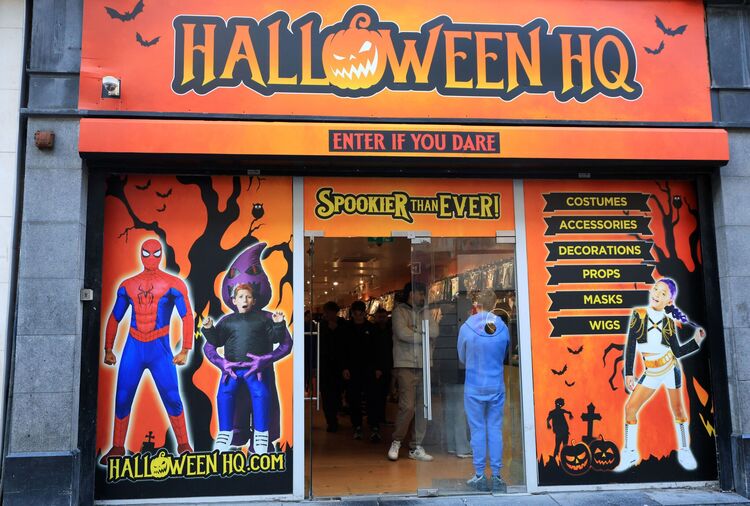
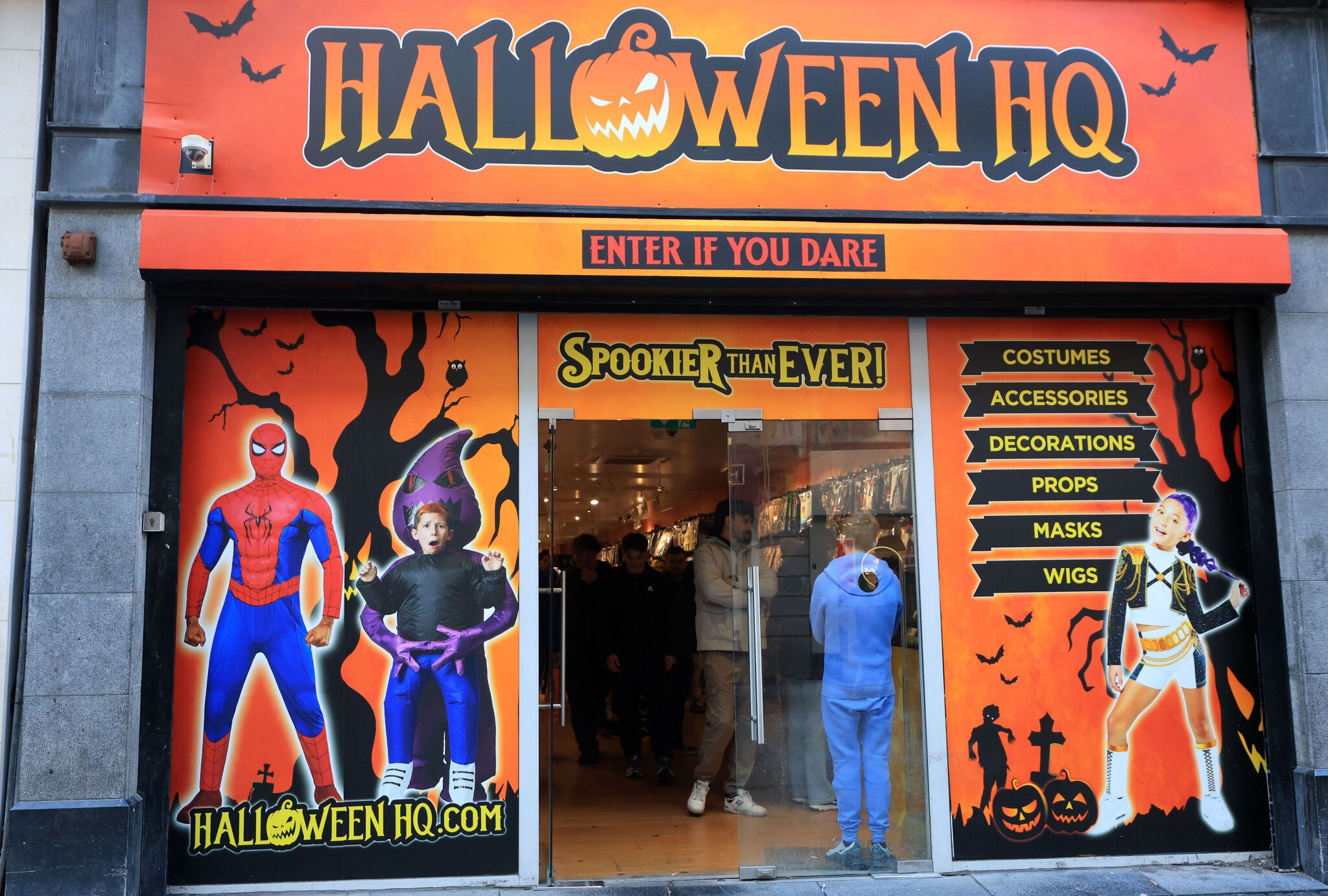
Perhaps that wouldn’t quite compete with an outlet of Spirit Halloween, of which there are 1,500 in America, four of them in Queens with lines around the block. But still, not bad.
Back in 1951, it’s clear that St. Finbarr’s dance mentioned Halloween only because their event took place on Oct. 31. Twenty years on, in 1971, there was a clear shift, at least if we’re to judge by a few showbands and other musical acts advertising Halloween events due to take place on Friday night, Oct. 29. The old land of the Celtic festival Samhain was now getting a first glimpse of the new Halloween.