The biggest obstacle to a New Ireland may not be opposition to it, but the absence of a compelling reason to change.
For those without firm constitutional loyalties, familiarity can outweigh the promise of change. The challenge is not simply to explain how a united Ireland would be designed, but to demonstrate how life would improve.
Unionism offers continuity and the reassurance of remaining in the UK amid global uncertainty. Constitutional change raises questions about jobs, public services and daily life, alongside concerns about how elements within loyalism might respond.
Nationalism faces challenges in its own ranks. As Newton Emerson recently observed, a unity debate could expose divisions over identity and national symbols, including resistance to changing its flag and anthem. Uncertainty favours the familiar.
The crucial audience may be those identifying as neither unionist nor nationalist. The Northern Ireland Life and Times Survey 2024 put this group at 35 per cent. University of Liverpool polling in December 2025 found that 41 per cent favoured remaining in the UK, against 23 per cent supporting unity.
The figures underline a simple point: the absence of traditional political loyalties does not necessarily mean an appetite for change.

Communication therefore matters.
Trump's Make America Great Again and Brexit's Take Back Control distilled complex arguments into memorable promises. Macron's En Marche! offered an optimistic vision beyond France's traditional left-right divide.
FARAGE: Compelling power of a slogan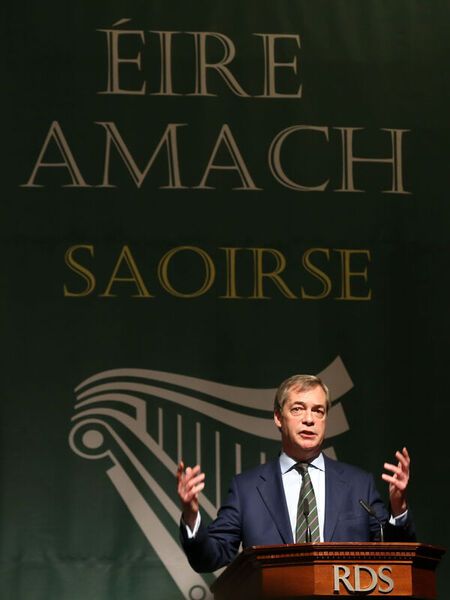
Brexit also showed the power of a single statistic: £350 million a week for the NHS. Misleading, but memorable, tangible and relentlessly repeated.
Whatever one's politics, these campaigns understood the value of a simple, emotionally-resonant message.
Where is the equivalent clarity in the debate about a New Ireland?
The argument needs to move beyond constitutional structures to everyday outcomes. What happens to wages, pensions, taxes and healthcare? Would families be better off, patients treated sooner, young people offered greater opportunities?
Ulster University research recently highlighted public demand for practical answers on healthcare, education, pensions, employment and living standards.
Imagine propositions such as “Shorter Waiting Lists”, “A Healthier Life”, “Better Jobs”, “More Money in Your Pocket”. Their meaning is immediate. So is their personal relevance.
But slogans need substance: independent evidence, credible assumptions and realistic delivery plans.
The formula is simple: the promise, the proof and the plan. A memorable claim, evidence to support it and a credible route to delivery. Yet a coordinated effort to develop and communicate such a proposition across Northern Ireland remains conspicuously absent. And the messengers matter as much as the message.
Trump, Farage and Macron, despite their differences, illustrate the influence of communicators who command attention, simplify complexity and frame debate.
Comparable figures have yet to emerge prominently on the nationalist side. Moreover, a campaign led solely by familiar nationalist politicians risks reaching only the already convinced. Voices from business, healthcare, education and civic society, including those outside traditional nationalism, could broaden the conversation. All will need the 60-second elevator pitch.
The question is not simply what a New Ireland would look like. It is why ordinary people would want to live in it.