We have just marked another Columbus Day. Also Indigenous Peoples' Day - though only the Columbus part of the day is an official federal holiday.
And, as is the case just about every year, there is attention paid to the matter of who from Europe first discovered what would become known as The New World.
The Washington Post and the BBC, to name but two, carried Columbus Day stories focused on Leif Erikson, the Norwegian Viking who, in the Post account, voyaged to present-day Canada.
And this grand exploit was "known to Europeans in Christopher Columbus’s time."
Erikson named his landfall as "Vinland."
As per the Post story: "Today, it’s called Newfoundland, in eastern Canada. The Vikings arrived in the year 1000, give or take a decade — half a millennium before a certain other European explorer first landed in the Bahamas. So why, on Monday, does the United States observe Columbus Day?"
The report opines that Columbus, quite simply, had better PR. And this is according to
John Steinberg, an archeologist at the University of Massachusetts Boston.
And remember, Columbus never set foot in what would be known as North America. Nothing like good PR indeed.
The report continued: "Much of what’s understood about the Norse presence in North America comes from the Vinland Sagas, a pair of 13th-century Icelandic works of genealogy, stories and navigational data that was uncorroborated until the discovery of Norse artifacts in Newfoundland in the 1960s."

Ah, the written word; always an effective way of nailing down a tale of extraordinary courage and discovery.
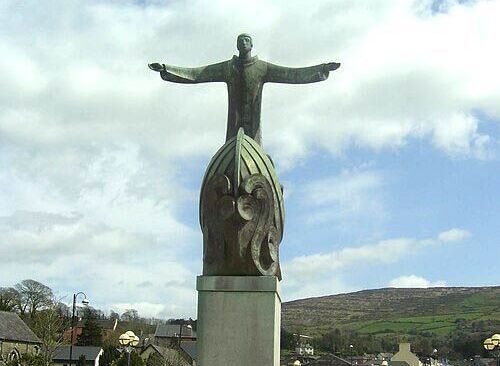
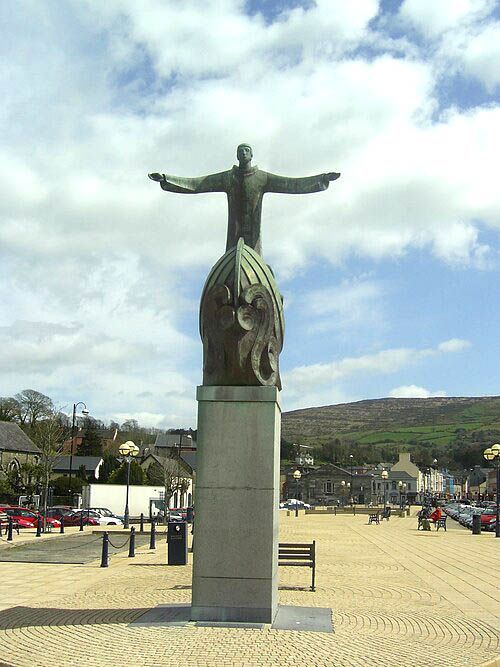
But wait a minute. Move over Christopher and Leif. We cannot forget Saint Brendan of Clonfert who, according to a written work attributed to the man himself, set foot in what is believed to be present day Labrador. The sixth century voyage of Saint Brendan across the Atlantic is recorded in the Navigatio Sancti Brendani Abbatis, or the Voyage of Saint Brendan the Abbot.
Back in the 1970s, explorer Tim Severin recreated a cowhide boat in the manner of one described in Brendan's time. The "Saint Brendan" made it across the North Atlantic, proving that it had been certainly possible for Brendan and his fellow monks to make it to the likes of Iceland, Greenland, Labrador and Newfoundland back in those early medieval times.
But if Leif is getting short shrift in the shadow of Columbus, Brendan isn't even in the shadow. Something has to be done.
During his recent visit to Ireland, President Trump was presented with a trio of gifts by President Catherine Connolly. One of them was a copy of the Navigatio Sancti.
We're not sure how up to speed President Trump is on Latin, but we know he is a fan of Christopher Columbus. He has a statue of the great explorer in the grounds of the White House.
Trump loves constructing stuff. He could broaden his view with a statue depicting Columbus, Eriksen, and Brendan.
He could even add in a depiction of an indigenous person. Well, that might be a stretch.
But if there is an annual holiday saluting Columbus, and now also indigenous people, there is for sure room for an elevated annual salute to Leif Erikson, whose "Leif Erikson Day" falls on October 9, and Saint Brendan, whose feast day is May 16.