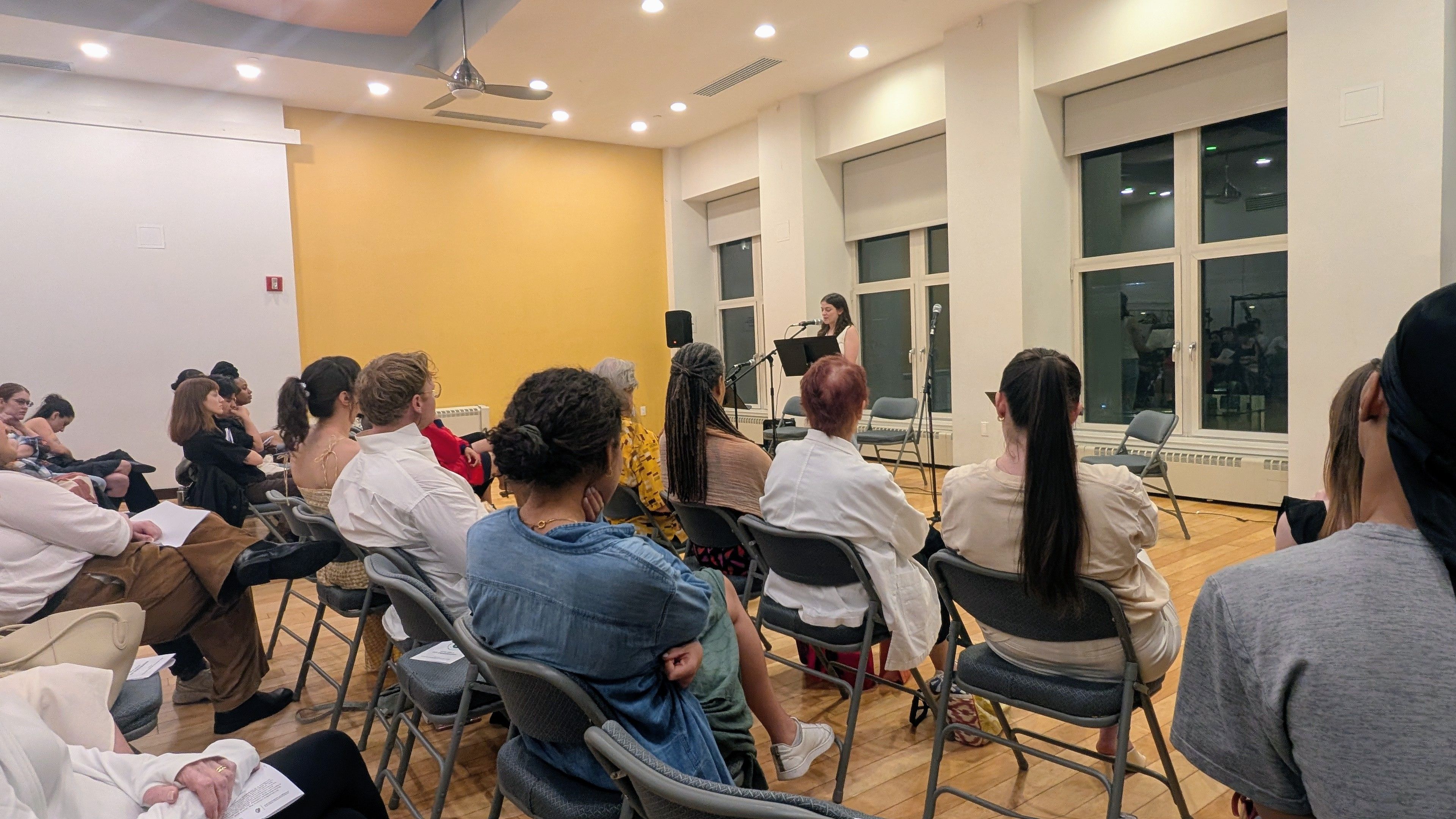
On a balmy June night -- June 17 to be precise -- Irish American Writers & Artists presented “Irrepressible Joy/A Pride Salon” at Houghton Hall Arts Community on Manhattan’s East Side. The salon featured a rainbow of readings tucked inside an evening dedicated to a joy not to be repressed. Shelley Ann Quilty, an IAWA Board member, County Wexford native and New York-based attorney, began the festivities by welcoming everyone into an evening of joy and her co-host S.J. de Matteo seconded that motion by affirming that even in a time of conflict, there is still room for celebration.
Newly-appointed Vice Consul General Deniz Ozturk told her listeners of the Irish government’s immigrant support programs, of her visit to a New Orleans psychic and of her recent relocation to New York, which tonight gave her the opportunity to attend a Pride Salon with a New York accent.
Halle Charlton, screen/stage actor, playwright/film writer (her film “Dummies” won Best Short at the New Faces New Voices Festival), presented a “collection” of scenes from “International Space Lesbians,” her work-in-progress which, incidentally, features soap actors leaving the tv screen to take up residence in the hero’s bedroom. Halle and fellow actor Sarah Larkin played scenes centered on a young woman and her best friend, with whom she is secretly in love. “It is a coming-of-age story,” Halle said, “It is finding community in the most surprising of places.”

Next was Ashton Weber, a New York hospital chaplain, who spoke of being a lesbian working with lesbians; and of exploring queer approaches to death, dying and grief; and then read what had happened on one of her chaplain rounds. She scanned the hospital notes on Lillian, an elderly patient; and sometime later, she met Lillian’s partner and discovered their relationship was longer than she has been alive! And then she began to know them. She concluded with: “On a Sunday morning, at 3 a.m., Lillian died”. And, in a memoriam for Lillian, Ashton said Lillian’s death had changed how she now lives her life.
Labhaoise Magee, a multi-hypenate theatre artist from Derry and director of the 25th anniversary production of Enda Walsh’s “Misterman” (currently running at Theatre Row through July 5), read two works by Irish playwright, novelist and a host of other laudatory appellations, Honor Molloy. The first work,“Behold! the Lesbian,” glances back to the 1990s, when lesbians “were everywhere’; then further back to an aunt with a lesbian past; over to Robert Emmet everywhere; and then love shared, love lost.
Labhaoise’s reading of Honor’s soliquoy “and in my heart” stilled the room. The work is a memory of lost love — with that grief laid like a wreath across Ireland’s long twisted painful history of British oppression. And yet, “and in my heart” celebrates love, the way Bloom celebrates his Molly:
Then we see it: light on the water. Our whole life in light
on that water. Light shifting-shifting. Fishing poles taut
on the lift of the waves. Sudden flap of wings. Two gulls rising.
Labhaoise Magee’s pitch-perfect reading was followed by S.J. de Matteo, who defines herself as a transsexual wit and accidental performer (and, it should be noted, holding degrees from Yale, Sarah Lawrence, and Trinity College). S.J. recounted an event that had happened the night before she was to speak at a conference in Ireland, when she left her hotel for a walk to the nearby River Foyle. Near the swiftly flowing river, she happened upon a boy, curled up on a bench, soaking wet, and badly bruised. He told her he had been beaten up and thrown into the Foyle by a crowd of boys demanding to know: “Are you a faggot?” And then they had talked some more, and S.J. told him she had two mothers, and he told her: “How can you have two mothers, you’re so old!” (and S.J.’s wink to her listeners: “this happened when I was 24!”). Then the boy said he was from Belfast, he was gay, and he could not tell his family. Then the police arrived in response to a report that a man was harassing an American tourist. Then he was gone, and S.J. was left holding the price of love when it cannot flow free, and the Foyle, mouth wide open, pulling the stars all the way down.
The evening’s last reader was Rachel Karp, multimedia writer and producer, who read from the preface of her debut nonfiction book Lesbian Bar Chronicles (Beacon Press), currently #1 on Amazon’s bestseller list in Lesbian Studies. Rachel recounted how she and a friend went on the road to visit 20 lesbian bars in 30 days to understand how lesbian bars survived (the first lesbian bar in New York opened in 1925). And followed that road trip with an excerpt from chapter 4 of her book, which narrates the history of Gingers, a lesbian bar in Park Slope, Brooklyn, founded in 2006 by Shelia, a native of Ireland. She concluded by affirming lesbian bars remain a vital part of the community’s social fabric.
Over the course of the evening, Shelley read two poems. The first: “Signs of the Times” by Oscar Wilde’s mother, Lady Jane Wilde, an outspoken critic of the British occupation of her country. The poem laments a famine made more brutal by an indifferent and callous English landlord. The second poem was Oscar Wilde’s “We are made one with what we touch and see”, a meditation on human connection and the cosmos and the idea that human emotion and physical existence are deeply intertwined with the natural world.
And then the clock struck 10.
And then Shelley celebrated everyone out into a soft June night, and a moon almost full, and a love that had dared speak its name ringing in their ears before slipping all the way down into their hearts.