County Tyrone is sometimes referred to as "the hard country."
This not in the context of scenery, but in the county's role over the centuries in Ireland's struggle for freedom.
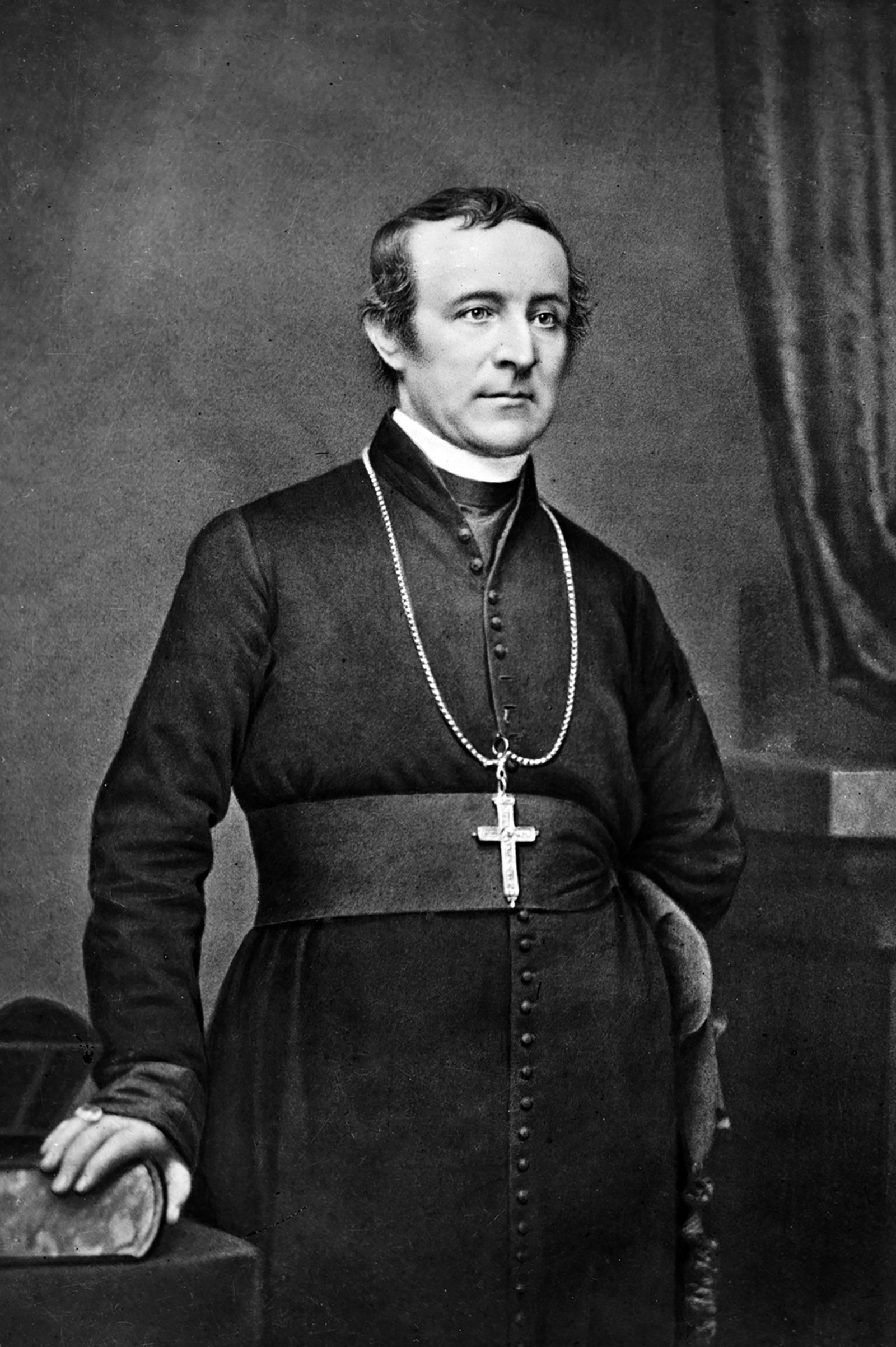
John Joseph Hughes was born into this hard soil but in later years found himself standing on even harder ground in the fast growing and rambunctious city of New York.
The New York of the 1830s was not a place overly friendly towards Catholics, most especially those freshly arrived from Ireland.
Bishop, and later Archbishop, Hughes was painfully aware of this. Doubtless he prayed for better days but the man from Tyrone had a strong worldly streak in him.
Prayer could only go so far. In a hostile world you needed to stand your ground with sharp elbows. And Hughes, who would earn the sobriquet "Dagger John" because he would sign his name along with an adjoining symbol of the cross, had sharp elbows under his clerical robes.
Dagger John was a fitting title for a man who was not averse to physically defending Catholic life, limb and property at a time when violent nativism was a grim fact of life for all too many Irish immigrants.
Hughes would not stand alone. Those Irish immigrants would band together and become what would become known as the Ancient Order of Hibernians.

The Hibernians trace their origin to both Pennsylvania and New York and the year 1836 is the one recognized as the official starting point. 190 years on the AOH will record its latest chapter this week at the order's biennial National Convention in Omaha, Nebraska.
The founding Hibernians found it necessary at times to wield weapons to defend themselves, their clergy and sacred places, their very lives.
Today's Hibernians are not required to wield more than the pen in its various technical forms.
But that is something they do wield. The modern AOH has its traditions and links to the past. But it is very much a voice for the Irish of America, Catholic and otherwise.
It has been, and remains, a voice for those in Ireland who have, in recent years, come through hard and troubled times. The AOH is a voice for peace and reconciliation, for civil and religious rights, the Good Friday Agreement, and, critically, for the cause of sensible immigration policy in Washington, the kind that does not close doors in the face of Irish people wanting to follow in the footsteps of their immigrant antecedents.
There will be much work to do in Omaha. There will be much discussion, perhaps vigorous at times. There will be socializing and a chance to reconnect with fellow Hibernians from around the United States.
All this will take place without a horde of nativists howling outside the convention venue.
And yet, sadly and tragically, the spirit of nativism is again abroad in America. It does not specifically target the Irish; rather it marginalizes and denigrates new arrivals from an array of lands around the world.
The Irish who stood alongside their bishop in the 1830s would recognize this nativist plague for what it is. Dagger John would for sure recognize it and he would have ideas about how to face into it.
His spirit lingers. In New Yo/rk. In Omaha. Everywhere.