It is not surprising when a man born of Irish parents in England becomes a folk musician, but it is when he becomes a revered Greek traditional musician and the foremost living expert on traditional Cretan music.
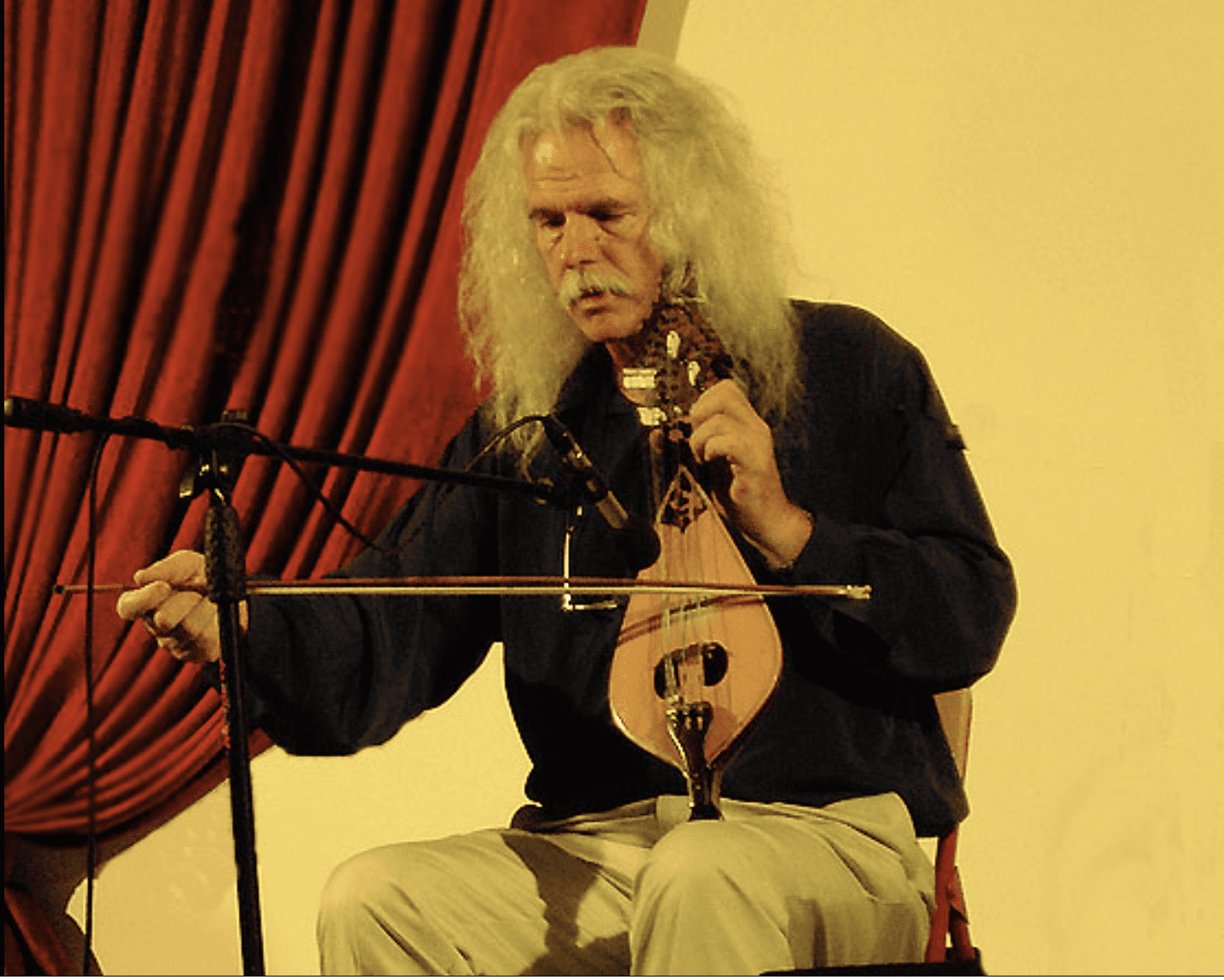
Seventy-four-year-old Ross Daly is considered a living legend on the island of Crete, where he has been living for the past fifty-one years. The acknowledged master of the Cretan lyra, Daly has transformed Crete into an international hub for musical cross-pollination.
Born in Norfolk, England, the son of one of the world’s foremost experts in computer science, Daly experienced an amazing mix of cultures as a boy, also living in the United States, Canada and Japan. In California, he began with the cello. By age 11, he was studying classical guitar in Japan. Before reaching adulthood, Daly had become skilled in an amazing variety of instruments — and experimented with all kinds of music.
Deciding to dedicate his life to music, Ross studied the sitar in India and rabab in Afghanistan in his youth. Living in so many different countries around the world ignited a burning love for world music that still animates him today. Ross summed up his experiences saying, “There’s a way to belong but not to be a native... I live outside a national identity and that’s always been a great advantage... I can feel at home anywhere.”

Arriving in Crete in the early 1970s, Daly became enraptured by the Cretan lyra. He decided to settle there and became the devoted student of the legendary lyra master Kostas Mountakis. Beyond teaching, the two musicians formed a deep friendship and actively performed and recorded together, preserving and sharing Crete’s rich musical heritage. He explained, "Some things in life grab you; Crete and its music did that for me.” Thanks to his strong background in classical stringed instruments, Daly mastered the lyra by immersing himself in the island's traditional music and culture.
Daly, however, extended his learning far beyond mere technical lessons; he traveled extensively around the Mediterranean to understand the broader context of Cretan traditional music. In 1982, he established the Labyrinth Musical Workshop in the Cretan village of Houdetsi as a loosely structured collective exploring the modal music of different cultures. Modal music is based on tones or modes rather than Western scales.
Over the years, the award-winning Labyrinth has become deeply respected by musicians because it provides a rare, immersive sanctuary for preserving and evolving global modal musical traditions. Daly’s workshop brings together master musicians from around the globe, where they learn techniques that are disappearing and share threatened lineages. Instead of a strict academic setting, it operates on the Greek concept of parea (a company of friends). Teachers and students live together, eat together, and jam informally, fostering deep, cross-cultural bonds. Every summer the Labyrinth Workshops draw students from around the world to seminars and masterclasses taught by celebrated musicians from a variety of modal traditions.
Daly is not just a master of the Cretan Lyra; he is also an innovator. Daly revolutionized the Cretan lyra in 1990 by adapting it to include 18 to 22 sympathetic (resonating) strings alongside the traditional three playing strings. This design, crafted by luthier Stelios Petrakis, added Indian style jawari bridges to create deeper harmonic resonance, allowing Daly to create formerly impossible modal compositions. Thanks in part to his new Cretan lyra, Daly has released more than thirty-eight albums of his own compositions, as well as his own arrangements of traditional melodies that he has garnered during his extensive travels.
Few people in the world have a deeper appreciation of world music than Daly, who has delved into the common roots of musical traditions from the Middle East, Central Asia, India, and the Mediterranean. For decades, Daly has headlined music festivals on three continents. In 2004, he was named the artistic director for the cultural program of the Olympic Games in the city of Heraklion, Crete, during the Summer Olympics. In 2012, his workshop won the European Citizen's Prize, which The European Parliament initiated to recognize outstanding achievements by European citizens and organizations that promote cross-border cooperation, mutual understanding, and closer integration between citizens and member states.
In his 70s, Daly shows no signs of slowing down. Explaining his deep love of music he once said, “Music is the language of my dialogue with that which I perceive to be sacred.”