Stories matter.
For Irish Americans, they are a way to celebrate identity and ensure that we and the next generation know who we are and where we come from.
We tell stories of famine and emigration, of overcoming prejudice in cities like Chicago, Boston, and New York, and of Irish success that reaches from the White House to Silicon Valley.
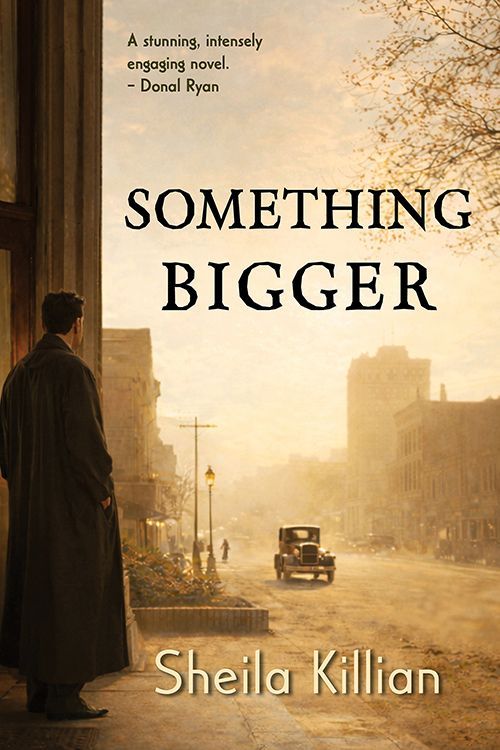
My novel, "Something Bigger," tells a less familiar story: that of a real-life Irish priest who travelled from Roscommon to Alabama just over a hundred years ago and challenged the Ku Klux Klan.
The novel is based on a story passed down to me by my grandaunt, Marcella. She immigrated to Birmingham, Alabama at the age of fourteen and lived through extraordinary events before returning to Ireland late in life to live with my family when I was a child.
I am very glad that our lives overlapped.
Marcella was an exciting presence in rural Roscommon, an elderly Southern belle with a slow drawl and a great set of memories to pass on.
She taught me to read using books about Brer Rabbit and the tales of the American South. But the story that mattered most to her, and the one I really learned properly in writing "Something Bigger," was about her brother, Father Jimmy Coyle.

As a child, I didn’t really take in the details. In our house, Jimmy was seen as a hero, but the reasons why were not clear to me.
Marcella kept a sea trunk filled with mementos from Alabama: a mirror, a letter-opener, and a chocolate box of newspaper clippings and photographs. If we were good, we could open it and leaf through them. In all the photos, Jimmy looked straight to camera and his serious, pale eyes seemed to demand attention. It was only later, when I began to research his life, that I realized how unusual and important his story was.
Jimmy came to Birmingham around the turn of the twentieth century and at a young age became the rector of St. Paul’s, a busy city-center church. He brought Marcella over to complete her education there and after school she lived with him in the small rectory beside the church, working as a bookkeeper and helping with parish life.
Birmingham was a booming city, and Irish emigrants were becoming part of the fabric of American industrial society, working in mines and mills while negotiating their place in a city divided by race, class, and religion.
Jimmy spoke out against those divisions. He believed passionately in his faith, in Irish freedom, and in the United States. He saw no contradiction in holding all three commitments, and in insisting on a simple principle: that all people were equal in the sight of God.
Birmingham, however, had other ideas. The city was riding high after the First World War on the fortunes that were made on coal and steel to feed the war.
After the war, the idea of Irish independence from Britain began to emerge. Britain, however, had been a key ally of the USA, so the idea of an Irish state and everyone who supported it aroused suspicion. Catholics, too, were facing a wave of hostility at the time.
They were accused of all manner of things, including storing munitions in the basements of their churches for a coming revolution, of worshipping statues, of being forbidden to read the Bible, and of owing their allegiance only to the Pope in Rome rather than to the USA. Jimmy, who was quick and articulate, and a prolific writer, challenged these claims publicly from the pulpit and in local newspapers.
Between this outspoken opposition to bigotry, and his hosting of Eamon de Valera on his visit to Birmingham, he found himself in the crosshairs.
He was not a political organizer, but as an Irish Catholic, he recognized injustice when he saw it and had the courage to confront it. The Ku Klux Klan was growing more and more powerful, more visible, and more feared.
The city’s booming industry brought more immigration, fueling racial tensions. In that context, Jimmy’s speaking out was not a costless exercise. It was an act of almost reckless courage and carried very real consequences. At the heart of the novel, however, is not just one man’s courage but the human cost of such conviction and of the small decisions made by him, his sister and people around them.
The story is largely told through Marcella’s voice, capturing her experience as a young immigrant navigating a strange and changing world. While she tries to build a life in ordinary ways, she is oblivious to the way in which her brother is trying to change the world.
Meanwhile, he is drawn ever deeper into conflict with forces far beyond his control and they both make small but fatal choices that affect the ones they love. Writing historical fiction based on real events brings its own challenges.
At first, my academic training kept me too closely focused on the dry facts of history. That all changed when I travelled to Birmingham for research.
One the first sunlit evening, standing outside the old rectory on Third Avenue, I could suddenly see the story unfold around me. The city became a film set in which characters came and went, and there was no distinction between those based on real people and those fully imagined.
The book became alive from that point on, and became not a history, but fiction. When novelist Donal Ryan launched the republished edition of "Something Bigger" he said the story was compelling, that he could feel the world in which Marcella and Jimmy lived.
I knew then the story had escaped the origins in the chocolate box of newspaper clippings in Marcella’s old sea trunk and become a real novel. For Irish American readers in particular, this story offers something both familiar and new. Marcella’s journey reflects a well-known experience of emigration and adaptation.
But "Something Bigger" also explores how Irish immigrants engaged with some of the most difficult and contested issues in American life. The story has a contemporary resonance I did not fully anticipate when I began writing.
Questions of migration, identity, division, and public speech remain with us. What does it mean to speak out against injustice? What is the cost of doing so, and the cost of remaining silent? Jimmy and Marcella’s story endures because it confronts those questions directly. The title reflects the idea that there are forces beyond the individual that come from history, patterns of power, institutions and faith.
It points to the way people want to belong, maybe to a church, or an Irish community or a Klan, and what the consequences of belonging might be. It also refers to the idea that even within a larger movement, choices are made by individuals, and whether big or small, those choices matter. The characters in the novel can’t control everything in their worlds or change the course of history, but the actions they make or avoid still matter.
At its core, "Something Bigger" is a story about courage under pressure and the cost of speaking out or staying silent. It is also about how Irish lives in America were shaped by the places where they settled, and how, in turn, they helped shape those societies. The history of the Irish in the American South is an important and often overlooked part of our shared story. In writing the novel, I wanted to take the fragments passed down to me from Marcella and give them shape, grounded in history, but alive as fiction.
I hope it contributes, in some small way, to a broader understanding of the Irish-American experience. Because, in the end, our stories are not just family stories.
They are part of something bigger.
Sheila Killian is an award-winning Limerick author whose novel, "Something Bigger" (2021) has just been published in a second edition. It is available from online retailers, Barnes and Noble, and to order at local bookstores. Her short stories have been published in Ireland and the UK, and her poetry in Ireland and South Africa. Sheila has had creative non-fiction broadcast on RTE and has been published in the national press. She has also published two non-fiction books and a wide range of peer-reviewed research articles. Sheila lives in Limerick with her family, and spends as much time as she can by the sea. More at www.sheilakillian.com.