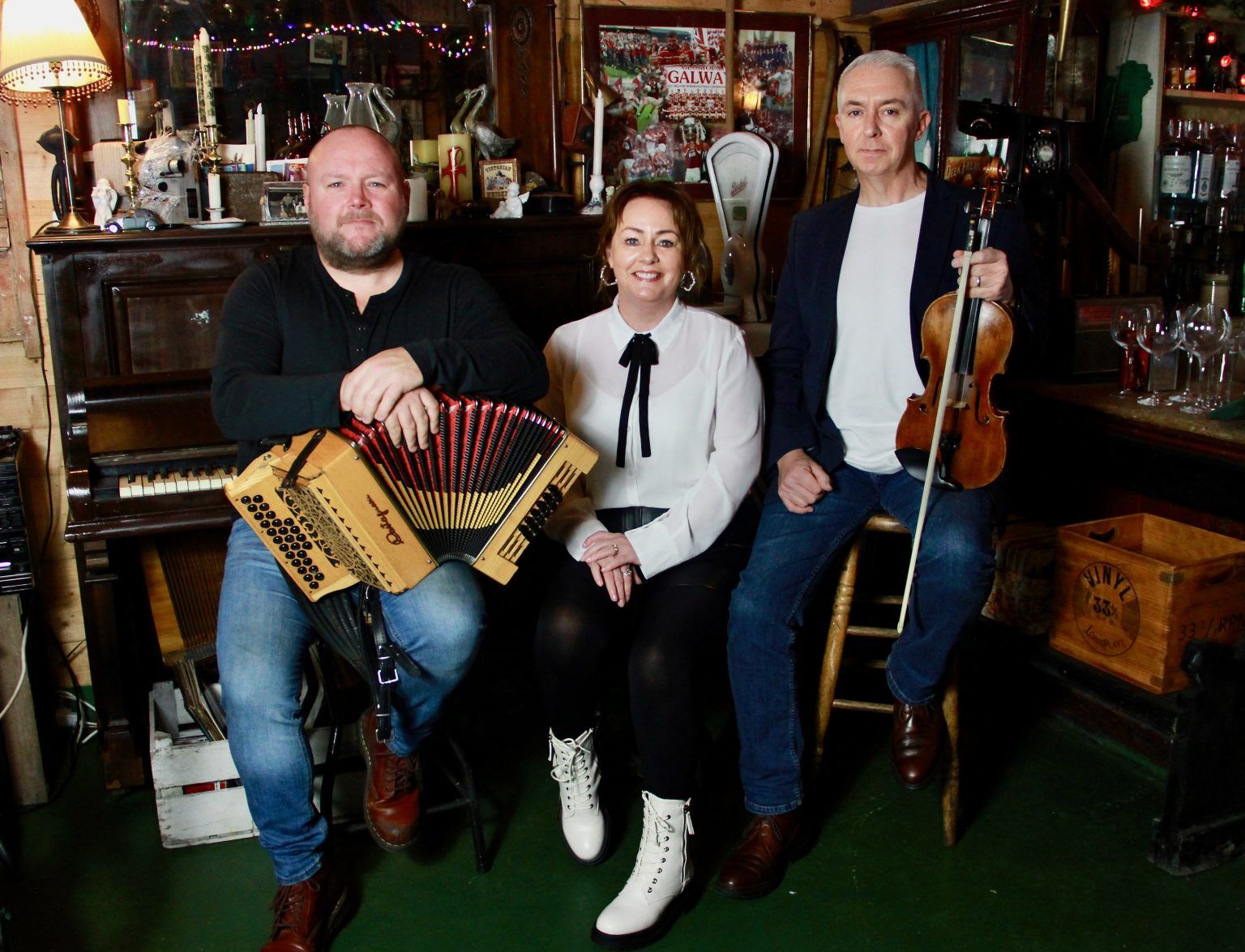
Shortly after I started on this column in 2012, I wrote about Mick Conneely and David Munnelly’s then-new album “‘Tis What It Is.” It was high energy, and I loved it, the things I said basically echoing the blurb that they’d gotten from comedian Tommy Tiernan, who pithily described the album as “a raucous encounter between chaos and melody.” They’ve done all sorts of stuff since then and it’s always great when these two kindred players get together and with “Old School,” their newest release, they’re at it again, this time with singer Caitríona Ní Cheannabháin as part of the mix. While the retro-modern sensibility I heard in 2012 is still apparent, the music here results feel different. There’s still the boundless energy, but there’s also an enhanced refinement in their music that I love and that I think fans of traditional will find very appealing.
So we’re all on the same page, the album features Mick Conneely on the fiddle, viola, and Greek bouzouki, David Munnelly on the button accordion, and Caitríona Ní Cheannabháin on vocals. Fans of traditional music will recognize each as a top performer and together the three are a very formidable musical unit.
Conneely is one of today’s great fiddle players and a highly respected bouzouki accompanist. Now based in Galway, he and his musical sisters grew up in London, immersed in the tradition by his Irish-born parents and developing under the guidance of renowned teacher Brendan Mulkere. In addition to his earlier work with Munnelly, he’s recorded several critically acclaimed albums over the years, including his solo debut “Selkie” (2001). Conneely is also a distinguished performer, having been a full time member of De Danann from 2010 to 2013.

Munnelly grew up in a musical home in Belmullet, Co. Mayo. An extraordinary player with an inventive, complex style, he led his own David Munnelly Band for thirteen years starting in 1999 and since then has been part of several top bands, including Niamh Parsons’s, The Chieftains, and De Danann. In addition, he’s worked on several notable projects that have extended his own musical vision, including “Accordion Samurai,” which features some of Europe’s top accordion players, and “Aonair,” a non-traditional solo accordion project for which he wrote new music.
Ní Cheannabháin is a third generation sean-nós singer from Aird Thoir, Carna, Co. Galway. She’s released two albums, contributes regularly to Raidió na Gaeltachta and TG4, appeared in the Joe Heaney biopic “Song of Granite,” and has won numerous competitions, including the women’s competition at Oireachtas na Gaeilge three times. In addition, she’s the chair of Éigse Mhichael Mháire Ghabha, an annual festival held in her father's memory.
The playing on this album is tight and full of depth and refinement. Conneely and Munnelly have developed their musical rapport and seem to be playing together better than ever. The instrumental tracks have a incredible swing to them and there’s remarkable unity in their playing, especially in the more complicated moments when it’s often Munnelly pushing the envelope. There are so many good tracks to speak of. For example, the reels “Molly From Longford / …” open the album with great energy and drive, but what I love about them is their character, as they really gives a sense of the state of Munnelly and Conneely’s music together these days. It’s great stuff. A similar flavor can be had with “Bonaparte Crossing the Rhine / ….” Again, the character is is great, and I love how they drag the notes at the end of the B-section and shift from hornpipe to reel time. The jig track “Geese in the Bog / …,” which pays tribute to Ma McNulty and John Kimmel, is great, too – it feels simultaneously old and new. And Munnelly absolutely shines on his own in his interpretation of the air “The Banks of the Moy.” His playing there is spectacular.
Speaking of Munnelly, he’s composed a few tunes here that deserve mention. The first is “Ringo McDonagh’s,” written for the great bodhrán from De Danann. Paired with “The Tailor Small,” a tune associated with De Danann, it’s a lovely tune that sounds old and perfectly in place in the set. The other Munnelly-penned tunes are a pair of
flings, “Mick Conneely’s Fling / The Piper Barry. ” The first dedicated to Conneely, the second to the Kerry uilleann piper Leonard Barry, and they’re both fabulous, the kind of tunes that’ll have the musicians out there asking “what do you call those?”
Alongside these instrumentals are a number of wonderful vocal tracks that feature Ní Cheannabháin’s immense talent. Her take on “Eileanór a Rún” is simply gorgeous, with Munnelly’s backing a picture of understated sophistication. Her phrasing and expression on “Fear an Bháta” is very moving and communicates the song’s meaning well. Munnelly and Conneely’s backing on this one enhances the quality of her performance and help make it one of the album’s finest tracks. Their approach on “If I Was A Blackbird” gives Ní Cheannabháin voice – whose performance subtly echoes that of someone like Margaret Barry’s – a real throwback feel. I also love “Someone To Love Me.” Here, her voice is powerful, reedy, and fully of experience, which gives the track it’s special charm. That it closes with a 1975 field recording of her grandmother Máire Ghabha Uí Cheannabháin singing it, is a nice touch and draws an impressive and enriching multi-generational parallel. It’s a lovely way to end the album.
Made in “tribute to those who came before [them],” “Old School” is a deeply satisfying and brilliantly executed collection that draws straight from the well, but does so in a way that builds based on the trio’s personality and musical backgrounds. Conneely and Munnelly are in superb form, the riotous musical volatility of their 2012 effort maturing into something that’s more thoughtful and but no less rewarding or intense, while Ní Cheannabháin wonderful singing gives the album a distinctive touch. Trad fans will thoroughly enjoy this one – highly recommended! To learn more and to purchase, visit here.