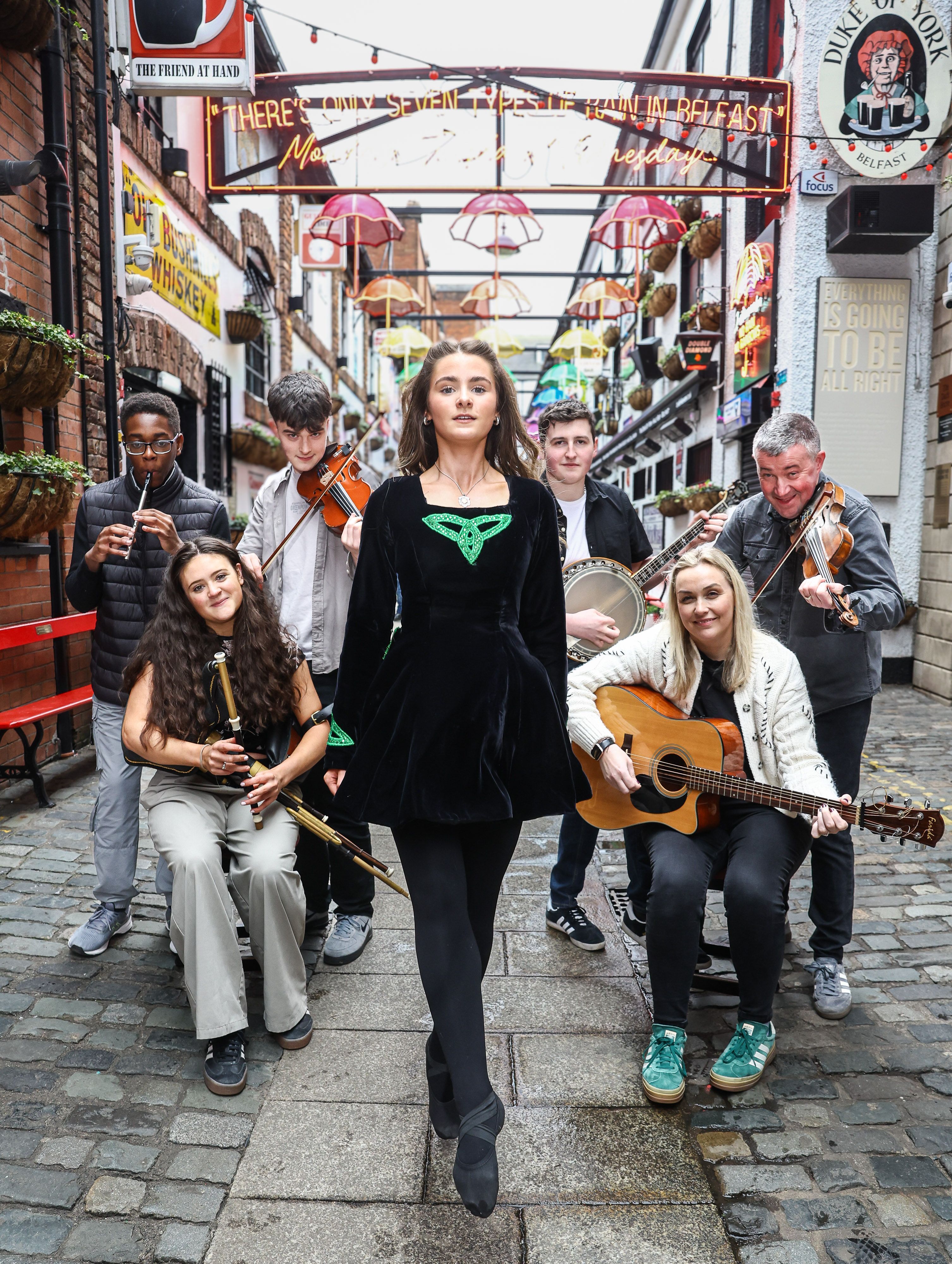
With our two regional fleadhanna done and dusted, North America’s All-Ireland hopefuls are making plans to head over to Belfast from Aug. 2-9, to compete at the 2026 Fleadh Cheoil na hÉireann. It promises to be an important moment: Belfast hosts the Fleadh for the next two years, giving folks a once in a generation opportunity to experience traditional music at its very best, and to get to know a city whose story, shaped by nearly 30 years of peace and reconciliation, is one well worth knowing.
Many don’t realize how rich and special Belfast’s musical heritage really is. Traditional music fans might recall it as the location of the Belfast Harpers Assembly in 1792, or as the place folks like the great fiddle player Sean Maguire, the Chieftains harpist Derek Bell, the McPeake Family of musicians, the McNiff family of dancers, uilleann piper John McSherry, and the band Réalta come from. Belfast is also where the Belfast Tradfest happens each year, a brilliant event that started as a summer school in 2017 and became a fully blown festival in 2019.
But to understand why Belfast is the right home for this event, it helps to know just how deep the music there runs. In November 2021, UNESCO named it one of its prestigious “Cities of Music” and it wasn’t for its traditional music alone. Belfast is an city that’s produced a range of diverse and important artists over the years, including Ruby Murray, Van Morrison and his band Them, Stiff Little Fingers, many of the members of Thin Lizzy, Sweet Savage, James Galway and nowadays, Kneecap, and others. The city is also home to 80 music venues and hosts scores of festivals of various sorts each year. It’s truly become one of the world’s great centers for music.

It makes sense, then, that world's biggest celebration of traditional Irish music and culture should take place there. The city will be ready for the Fleadh’s eight days of music, song, dance, and craic, and that not only means there’ll be something for everyone, but it’ll likely be something that’ll stop you in your tracks.
As with every Fleadh Cheoil, the competitions are what matter most. Whether it be in U-12 Fiddle, the Senior Céilí Band, or any other of the myriad competitions in between, the young people who come from all over the world, who have spent months preparing for their moment in the spotlight and give it their all in front of a judge, are what gives the Fleadh its life. Their courage and commitment stand as testaments to the power of traditional Irish music and at the end of the week, they're what the Fleadh is really all about.
But the Fleadh is more than just competitions and the “Gig Rig,” a free outdoor stage at Belfast City Hall, is a perfect example. It runs from 11 a.m. to 11 p.m. every day and over the course of the week will feature some superb acts, including Goitse, Blackwater Céilí Band, Sharon Shannon, Tempest Ceol, NxNW, Sí Fiddlers, Lúnasa, the composer Neil Martin (who will direct a special multicultural music experience called “Connections”), Peter Street, the Breen, Rynne, Murray Trio, Foy Vance, and many, many others.
Among the other things that will happen will be a series of flagship events that honor the inclusive spirit that keeps the tradition alive. One of the most important are the Gradam Inclusion Awards will celebrate traditional musicians with additional needs, reminding us that the Fleadh is a place for everyone. Cathal Hayden will be honored at the ninth annual Michael A. Flanagan Traditional Irish Music Banjo Award ceremony. The Flanagan Award pays tribute to the great banjo players of the traditional Irish music world who represent the very best of Michael Flanagan’s music and spirit. Other nights will feature Ceol na Cruinne, Comhaltas’s international showcase, the 60-member Comhaltas National Folk Orchestra, and a special Ards CCÉ celebrating both their 50th anniversary and the 75th anniversary of Comhaltas.
The Fleadh has never been hosted by a city quite like Belfast, and one of the things that makes this year’s program so special is its willingness to reflect that. At the Titanic Slipways, Belfast Bands Forum will lead an exploration of Unionist and Ulster-Scots culture, tracing the deep roots of traditional flute bands through Lambeg drumming, pipe bands and traditional Scottish dancing. It's a strand of Belfast's musical life that has strong roots and important that it be included and celebrated on its own terms. The Fleadh is all the richer for making room for it.
And as if all this weren’t enough, there’ll be a fringe festival as well. With over 50 official events that involve more than 300 artists and 60 organizations, there will be a range of offerings, including an exploration of the relationship between the human brain and the harp, a trad disco, an Irish language hub, an examination of Ulster Scots language and tradition, pop up storytelling events, nature walks, community cinema, street food, and way, way more.
This August, you’ll want to go to Belfast for the music, but you'll find yourself especially interested in staying for the craic. There are stories and a spirit to that city that you simply won't find anywhere else. The Fleadh Cheoil na hÉireann is one of the most important events in the traditional music calendar, and it’s worthwhile learning more about its storied history. I recommend books like “Heading to the Fleadh” by Méabh Ní Fhuartháin [see here] and “On The Night” by Philip Duffy [see here] – both are great. But there’s no replacement for actually being there, and the upcoming Belfast Fleadh is a great way to experience it. To learn more, visit the Fleadh Cheoil na hÉireann’s website at https://fleadhcheoil.ie/.