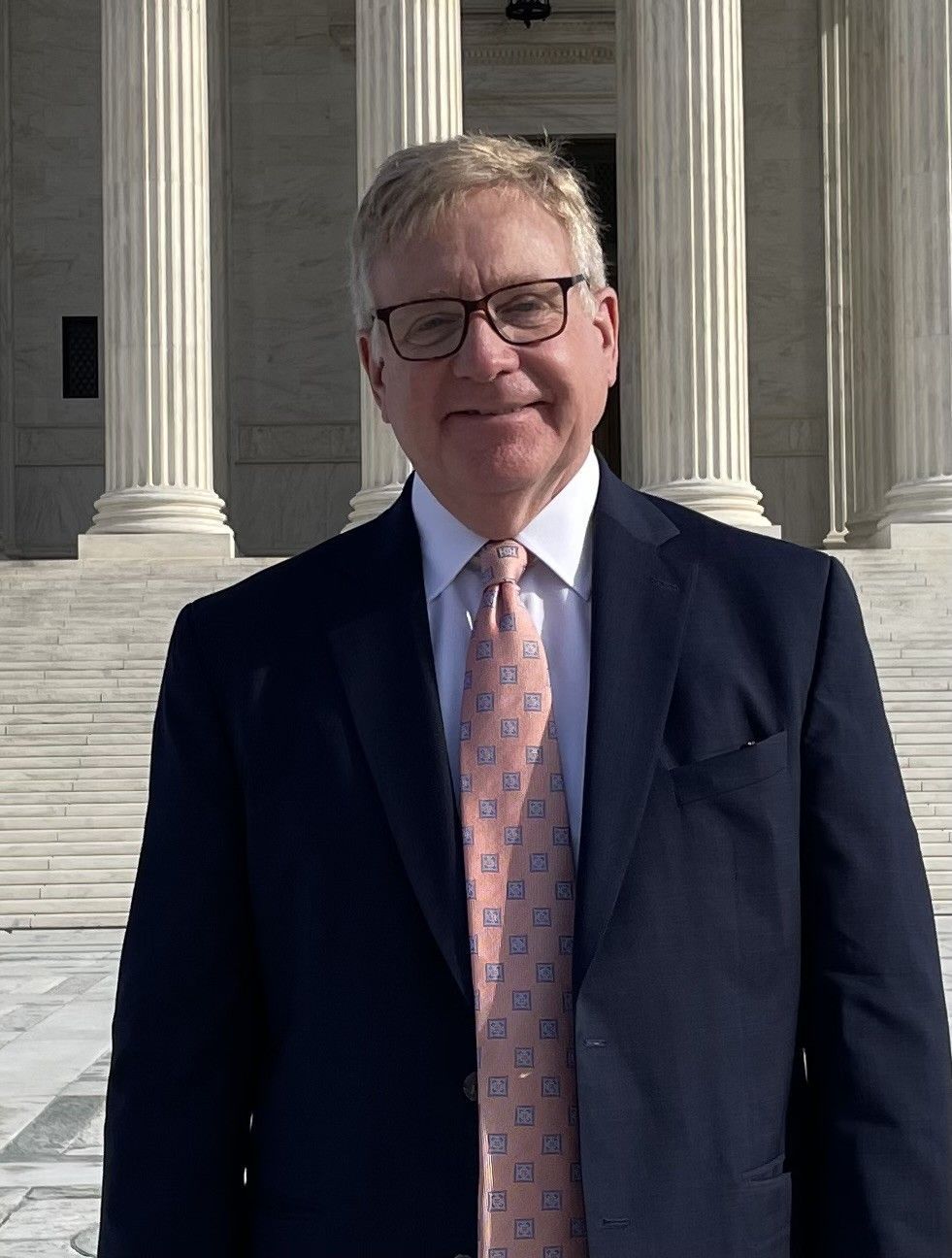
At its 289th Anniversary Dinner in Boston on St. Patrick’s Day, the Charitable Irish Society announced it had submitted an amicus brief to the United States Supreme Court in support of automatic birthright citizenship amidst the Trump administration’s ongoing effort to restrict birthright citizenship.
Former Charitable Irish Society President Christopher A. Duggan and the Hon. Frank J. Bailey, a retired federal judge and president of the Pioneer New England Legal Foundation, authored the brief.
Duggan, a lawyer who attended the Supreme Court’s oral arguments on April 1, has Irish roots in Counties Cork, Kilkenny and Waterford. His ancestors immigrated to Newfoundland and moved south to Maine and Massachusetts around 1870 or 1880 for work after Amory Maynard founded the Assabet Woolen Mill company. Duggan’s interest in immigration, as well as the constitutional significance of the Trump v. Barbara case, fueled his decision to write the brief.
“People come here, and we don’t share a common language,” said Duggan. “We don’t share a common race. We don’t share a common background or a common religion, but we share a common belief in the Declaration of Independence. And so, I’ve been fascinated by that for basically my entire career. And on top of that, many of my friends who are constitutional scholars thought that this would be the biggest case of the 21st century to date.”

Duggan’s brief examines the text and meaning of the 14th Amendment’s Citizenship Clause. It delves into the debates leading up to the amendment’s adoption in 1868, particularly the congressional debate between Senator John Conness of California, an immigrant from County Galway and a supporter of the amendment, and Senator Edgar Cowan of Pennsylvania, who opposed the amendment.
“The key to that argument (between Conness and Cowan) is not whether birthright citizenship was good, bad or indifferent,” Duggan said.
“The key is that everybody knew. The proponents and the opponents knew that if the amendment was adopted as written, it would grant birthright citizenship to all but a very small segment of people who were born here in America. And rather than grasping with that reality, the government's trying to make up an alternative reality, which simply is false.”
As the brief explains, the sole exceptions to birthright citizenship were children of Native Americans living on tribal lands which were recognized by treaties as sovereign Native American nations, children of foreign diplomats, and children of invading armies occupying American land. In modern times, the relevant exception remains for children of diplomats, as all Native Americans born in the U.S. are American citizens as of the Indian Citizenship Act of 1924.
However, under President Donald Trump’s Executive Order 14160, the administration posits that the Citizenship Clause shouldn’t apply to children of undocumented immigrants, of those who overstayed visas, or of legal immigrants briefly in the U.S. for work, study or tourism. The executive order has been blocked by multiple federal judges.
Duggan argued that the administration’s interpretation deviated sharply from the historical understanding debated during the amendment’s adoption. The amendment was intended, he maintained, to apply to children born in the United States, irrespective of parental immigration statuses and “allegiance." He pointed to exchanges between Conness and Cowan about Chinese immigrants in California.
“The 14th Amendment says nothing about the parents,” said Duggan. "What does appear is born and jurisdiction. That’s it. It’s the child, not the parents, who (was) the focus of the 14th Amendment, without a doubt.”
Conness chose to stand with Chinese immigrants and their children as they faced discrimination and mistreatment in California, whereas Cowan feared and despised gypsies. Yet, despite national xenophobia, the 14th Amendment passed, and ever since the United States v. Wong Kim Ark case (1898), higher and lower courts have ruled that any child born in the United States acquires U.S. citizenship regardless of the origins or immigration statuses of the parents.
Duggan said that, at the Supreme Court oral arguments, the American Civil Liberties Union’s Cecilia Wang drew upon the Wong Kim Ark case to support her argument. In contrast, the Solicitor General, John Sauer, argued that the Citizenship Clause was adopted to rectify the wrongs of the Dred Scott case and meant only for the children of former slaves. But it was Chief Justice John Roberts, in response to Sauer’s claim that foreigners are separated by just a plane ride from coming to the United States and having children, who delivered the line that stood out to Duggan.
“The Chief Justice said, ‘It may be a new world, but it’s the same Constitution,’" Duggan said. “And that line is going to live in history. Mark my words on that.”
Justice Ketanji Brown Jackson pressed Sauer on how the executive order would work in practice if birthright citizenship were restricted. She raised concerns that parents may have to present documents in the delivery room to prove their immigration status so that their child could obtain citizenship.
Sauer denied that this would be the case, saying that every baby born in the United States gets a birth certificate (with parental information) and a computer-generated Social Security number, and that immigration databases could be used to determine whether the child qualified for citizenship. However, when asked what would happen if a baby were denied citizenship incorrectly, he acknowledged that the parents would have to challenge the denial afterward.
Should the executive order be deemed unconstitutional, there will be one other avenue to alter automatic birthright citizenship legally: constitutional amendment.
In contrast to most of North America and much of South America, many European countries, including Ireland, have placed limits on birthright citizenship that depend mostly on parental status.
While the U.S. Constitution has been amended 27 times, it’s purposefully difficult to change, with amendments requiring the support of two-thirds of both houses of Congress to be proposed, and approval from three-quarters of state legislatures to ratify them.
“Would I personally want it to be changed? No, I wouldn’t,” said Duggan.
“But that was the whole purpose of Chief Justice Roberts’ remark that we have the same Constitution. That Constitution allows you to, in Article X, to amend it, if you wish. But the people who are going to make that argument are going to have to make it pretty strongly and convince a lot of people.”
* In a ruling released on Tuesday, June 30, the Supreme Court rejected the Trump administration's attempt to end Birthright Citizenship. Editor.