Jacqueline Butler and Harry Gargan have called on the British government to apologize, both for killing their loved ones and then making them wait 54 years for truth that came with the historic inquest verdict exonerating Catholic priest Fr. Noel Fitzpatrick, parishioner Patrick Butler, Margaret Gargan 13, John Dougal 16, and David McCafferty 16, as “wholly innocent victims."
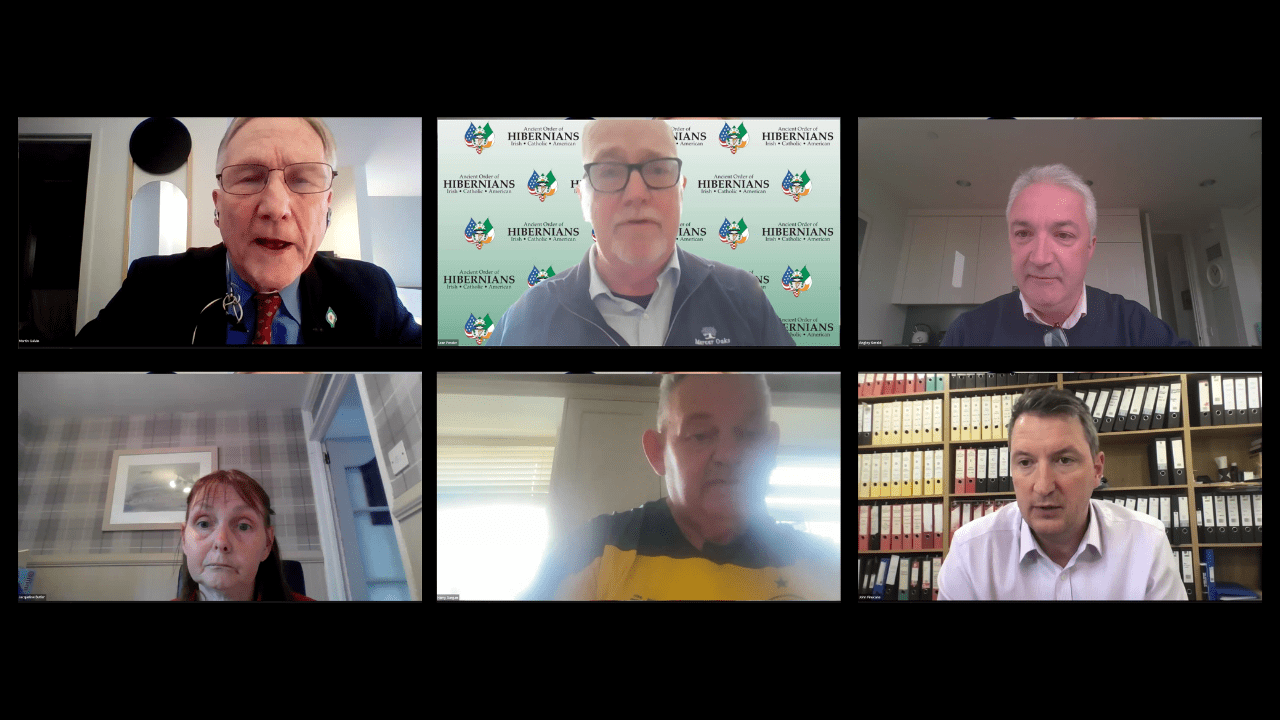
The victorious relatives spoke, along with New York Consul General Gerald Angley, representing the Irish government, and civil rights lawyer John Finucane MP, in a live webinar broadcast hosted by the Ancient Order of Hibernians on Saturday, May 9.
The prior verdict came amidst increasing demands for "Special Protections" for former British soldiers such as those who carried out the Springhill-Westrock Massacre, and days after a London Supreme Court undercut positive rulings on legacy by the Belfast Court of Appeals.
Jacqueline Butler’s father Patrick Butler was one of four killed by the same British Army sniper during the 1972 Springhill-Westrock Massacre.
There had been a ceasefire in the Troubles and a six member Republican delegation had been taken to London for negotiations with the British. However on July 9th, 1972 the ceasefire had broken down. Sometime around 9:30 p.m. that evening sixteen year old John Dougal, was shot in the back, without warning, as he ran away from British soldiers. Two other teenagers, Martin Dudley, 19, and Brian Pettigrew 17, were shot and severely wounded at the same time.

Fr. Noel Fitzpatrick was contacted to give last rights to the dying or assist the wounded. He stopped at the Butler home for help because Patrick Butler was deeply involved with the local parish. Patrick agreed to accompany Fr. Fitzpatrick, despite the danger, with shots still being fired nearby.
Fr. Fitzpatrick was dressed in clerical garb and held up a white cloth or handkerchief to show he was acting in a humanitarian capacity as he walked slowly with Patrick Butler behind him. Fr. Fitzpatrick was shot in the face and the high powered bullet passed through and hit Patrick Butler, killing both men.
David McCafferty, 16, then ran out and tried to pull Fr. Fitzpatrick to safety, but was shot in the back without warning.
Forensics confirmed that the same British soldier killed all four.
The next day news reports claimed that gunmen dressed in black had been shot as they fired on the British and that the priest was guilty of trying to retrieve weapons. No weapons, bullets fired at troopers, or forensics were found at scene.
At the 1973 inquest, written statements from soldiers were accepted into evidence and read in court. Jacqueline said “my mommy went thinking she would get answers and came away heartbroken.”
Because her father was falsely labeled as a gunman to justify his murder, British troops targeted their home for destructive house raids two or three times weekly and sometimes spit on photographs of her deceased father and Fr. Fitzpatrick. These vindictive raids continued for more than 15 years.
A new inquest was ordered in 2014, but was constantly delayed and only began in court ten years later. Under the new legacy act, the inquest would have been terminated if evidence was not completed by a final date. The British Ministry of Defense kept delaying the inquest, hoping to shut it down. The coroner said he would open the court on weekends and stay until midnight to get it concluded in time.
The British said that all records, shooting logs, radio logs etc. which would have identified the troopers were missing. Troopers who did testify denied they were present. “One laughed, held his hands up and said you got me, I must have been there when shown a photo of himself."
Jacqueline was gratified with the verdict because all she wanted was the truth. ”My father was an innocent man going to help a priest."
Harry Gargan age 12 and his sister Margaret 13 were with their father at the Whiterock Community Centre Bingo that evening. Their father sent Margaret to check on something at their home, which was only a short distance away.
Margaret Gargan was shot in the head as she stopped to talk with friends outside her home. Shocked neighbors tried to pull the wounded girl inside the house, but British troops fired shots at them.
Someone came into the Community Centre shouting that Margaret had been shot. British troops were still firing, forcing Harry and his father to crawl on their hands and knees to get back to the house, where they found Margaret had been killed.
At the 1973 inquest, Harry’s mother and father expected to get some explanation or at least be told that the British Army was sorry for killing their daughter. Instead, the court read a statement from the shooter claiming he had identified and shot a gunman approximately 20 years of age.
He said “my mother was never the same after that inquest.”
The soldier who killed Margaret, was not identified at the new inquest. The British claimed all records compiled by the Royal Military Police, who had investigated the incident, had been lost or destroyed.
Harry Gargan said: “If they wanted to find him they would have found him." The coroner held that neither Margaret nor anyone in her vicinity was posing any risk to anyone, when she was murdered. Harry’s biggest regret was that his parents, Margaret’s twin sister and other family members, did not live long enough to see the verdict.
He also paid special tribute to his solicitor Padraig Murray who represented him and most of the families. Under new British legacy laws families may not get independent legal counsel.
The Irish government was represented during the webibar by New York Consul General Gerald Angley. He began by noting the iconic image of then Fr. Daly holding a white handkerchief on Bloody Sunday in January 1972, and how Fr. Fitzpatrick was doing the same thing when shot down.
Consul General Angley said that the Irish government “are in almost daily contact with our British counterparts to make sure that the new legacy legislation complies with the Joint Framework and can deliver for victims”.
He noted that there are calls for special protections for former British troops and the recent Dillon case, in which the London Supreme Court overturned rulings by the Court of Appeals in Belfast, but that the test for the Irish government is that “all those accused of crimes must be treated equally and all witnesses treated equally."
The case against the British government remains live and is an important source of leverage which can be progressed if necessary to get justice for the victims.
John Finucane MP was introduced as a solicitor to give legal analysis, as an elected representative and member of a family which has waged its own heroic battle to get justice about the murder of civil rights lawyer Patrick Finucane. He commended the Springhill-Westrock families noting that “while no verdict can undo the decades of grief and loss they have suffered, they persisted despite being ignored, disbelieved and delayed until they got the truth entered in court findings."
He said “there cannot be one set of rules for state actors and another for everyone else. Any credible legacy process must apply equally to all, must be independent, must be human rights compliant and have the confidence of victims.”
Finucane also noted that there was a lot of fake news about witch hunts for British troops but the facts are completely different.
He gave an update on the public inquiry into his father’s murder, which will soon hold a scheduling hearing, but probably not begin evidentiary hearing until 2027.
Before closing AOH Freedom for all Ireland Chair Martin Galvin, who had moderated the discussion said: “We support your call for an apology for murdering your loved ones and also for what has been done to you over the last 54 years, merely for seeking justice.
“It is noteworthy that the British say they need special protections for former British troopers, meanwhile we see cases like this where one trooper murders a priest waving a white cloth, a father of six, and two teenagers and the British give him de facto immunity by refusing to identify him”.
AOH National President Sean Pender closed out the webinar from Ireland, speaking on a video of himself at the Springhill-Westrock Memorial Garden noting: “The Springhill-Westrock verdict was now an official finding by a court, but meanwhile there is a resolution introduced in the House and Senate, which appears to dismiss such findings as politically motivated, endorse the British legacy structures and insult you by denying you the accountability you are entitled to. The AOH will be actively opposing this Resolution”.