The title of the 2021 film “Don’t Look Up” is its best joke.
This is praise, not a put-down. The film has lots of good one-liners and funny situations, as well as brilliant comic acting from its big-star cast. It’s just that the title is perfect.
The movie may not be perfect, or not yet. Its future status as a classic is still to be decided. One good sign for “Don’t Look Up” is that it’s popular with audiences and more than four years after its release remains one of the most viewed ever on Netflix.
In contrast to that, the critics were cool towards it. So what gives? The film’s enthusiasts think they know.
At the beginning of “Don’t Look Up,” PhD candidate Kate Dibiasky, played by Jennifer Lawrence, discovers a previously unknown comet. Her delighted academic advisor at Michigan State University, Dr. Randall Mindy (Leonardo DiCaprio), names the comet “Dibiasky” and organizes a celebratory gathering with her fellow research students. There, the professor does a quick mathematical calculation about the comet’s trajectory, which reveals that it’s headed for a collision with Planet Earth in six months. His prediction, confirmed by NASA, is that unless somehow diverted or destroyed, the comet’s impact will be an “extinction-level” event along the lines of that which consigned the dinosaurs to their current super-ancient, pre-pre-history status.

Netflix and filmmaker Adam McKay, best known perhaps for “The Big Short,” have won two court cases — in 2023 and 2025 — against novelists who sued them claiming their respective concepts had been stolen. In the 2025 decision, the judge said that the alleged similarities constitute “broad uncopyrightable ideas that are typical of works that center around the Earth’s destruction.”
One might say such ideas swirl around inside many heads. More than a decade ago an Irish Times columnist argued that if a comet threatened Earth with cataclysmic destruction, the story would be on the front page every day. The writer, who’d put this hypothetical event a few years into the future, compared that scenario with how our climate catastrophe of the 21st century is covered in the media, and where — mostly below the fold or in the inside pages.
That writer’s piece was what we might call a thought experiment, and that’s what “Don’t Look Up” is also. But many reviewers could not or would not play along. When, for instance, she first heard about the idea for the McKay project the reviewer for Baltimore Magazine believed it too “far-fetched,” which, of course, is what thought experiments often are.
The piece, which is prominently displayed on the Rotten Tomatoes website, argued, “Climate change is an ongoing, diffuse disaster, not an acute one that threatens everyone instantly.”
But then the pandemic happened, which made it into a Covid-19 satire as much as about climate change in her view, and thus more realistic and relatable, but not enough — a common theme of the naysayers, whether online commenters or the mainstream professional reviewers. (The film was due to go into production in April 2020, but instead was made between November 2020 and February 2021. It was officially released on Dec. 24, 2021.)
The Baltimore Magazine reviewer appreciated the title, but felt overall it was just the one joke, and the project was in essence a “Saturday Night Live” sketch spun out over the course of a whole movie.
In the two-star (out of four) review she labeled the film “smug and mean-spirited,” adding, “Pretty much everyone is an asshole, a sucker, or a schmuck, with the exception of the astronomy student played by Jennifer Lawrence (and, to a lesser extent, a skate rat character played by Timothée Chalamet). It prompts the question: If people are so stupid and corrupt, why should we care about their fate?”
In a radically different take published two days earlier, Jan. 4, 2022, the reviewer for the Boston-based artsfuse.org, wrote “The knee-jerk, hateful reviews of ‘Don’t Look Up’ possess comments so outsized, and so beside the point, that they bear a resemblance to the oblivious thinking of the movie’s anti-science ostriches.
“Critics from all political segments of the mainstream media have joined the surprisingly ferocious attack on this expertly made comedy.
“The newspapers and websites most joined at the hip to the movie industry — from Variety to the Hollywood Reporter — were so venomous, it’s as if they believe this film is a danger to the American dynasty and their own jobs.”
He added, “To put it in terms of cinematic style: The critics cannot appreciate a star-laden, pitch-dark satire that dares to be impudently pessimistic in vision and big in execution. If this film had a slower pace, a smaller budget, and a less famous cast it likely wouldn’t have been as good, or as funny, but it might have received more positive reviews."
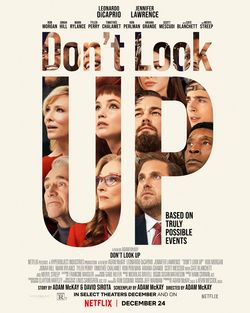
The cast also includes Rob Morgan, Jonah Hill, Mark Rylance, Tyler Perry, Ron Perlman, Ariana Grande, Kid Cudi, Cate Blanchett, and Meryl Streep as President Orlean.
The artsfuse.org writer, Daniel Gewertz, said the stars got into the spirit of the “purposeful exaggeration of reality,” noting that in particular the performance of Blanchett, who in one scene displays “a kind of subtlety that humanizes a wicked satire, but doesn’t defang it.”
Commentary in more recent times has generally taken his and the movie's side.
In an admiring piece in August 2025, an essayist at nofilmschool.com said, “Something that is often overlooked yet deserves a special mention is how the film … satirizes Hollywood storytelling conventions.”
In October 2025, a writer on cbr.com, which covers comics, film and television, argued its status as one of the most watched on Netflix, “proves that ‘Don't Look Up’ is still one of the most powerful films out there.”
The writer said, “I think the reason why many viewers disliked ‘Don't Look Up’ was that it mirrored society a bit too accurately. Satire is expected to be sleek and subtle, but this movie didn't opt for that approach.”
She added, “The tone of the movie kept oscillating, but the absurdity of the situation called for this. With the rise of social media and a detachment from reality that has occurred in the real world, almost everyone is left wondering what is real and what isn’t."
The writer said those "who disliked ‘Don't Look Up’ felt that the movie was extremely disorganized, hopping between satire, tragedy, and slapstick comedy, but to the trained eye, this was deliberate. Keeping the movie polished would have defeated its point.”
The movie, the cbr.com writer argued, “manages to be both extremely current and ahead of its time, as the version of the world it portrays has remained largely unchanged since its release. It is too loud, too obvious, and too unpolished, and perhaps that is why it is not a critic's darling.”
Movie fans like it, “but critics couldn't evaluate it beyond superficial parameters.”
More than a decade after the Irish Times columnist’s thought experiment about a comet hurtling towards Earth, his basic argument still holds. And yet, “Don’t Look Up” in its comic exaggeration forces us to contemplate the levels of denial, distraction and deflection in our culture. It’s a little unsettling that so many of the initial reviewers would not stop for a moment of reflection; or that they could not more readily identify and empathize with the film’s central character, DiCaprio’s Dr. Mindy, who, in an early moment of despair, says, “Tell me this really isn’t happening.”
“Don’t Look Up” is streaming on Netflix.