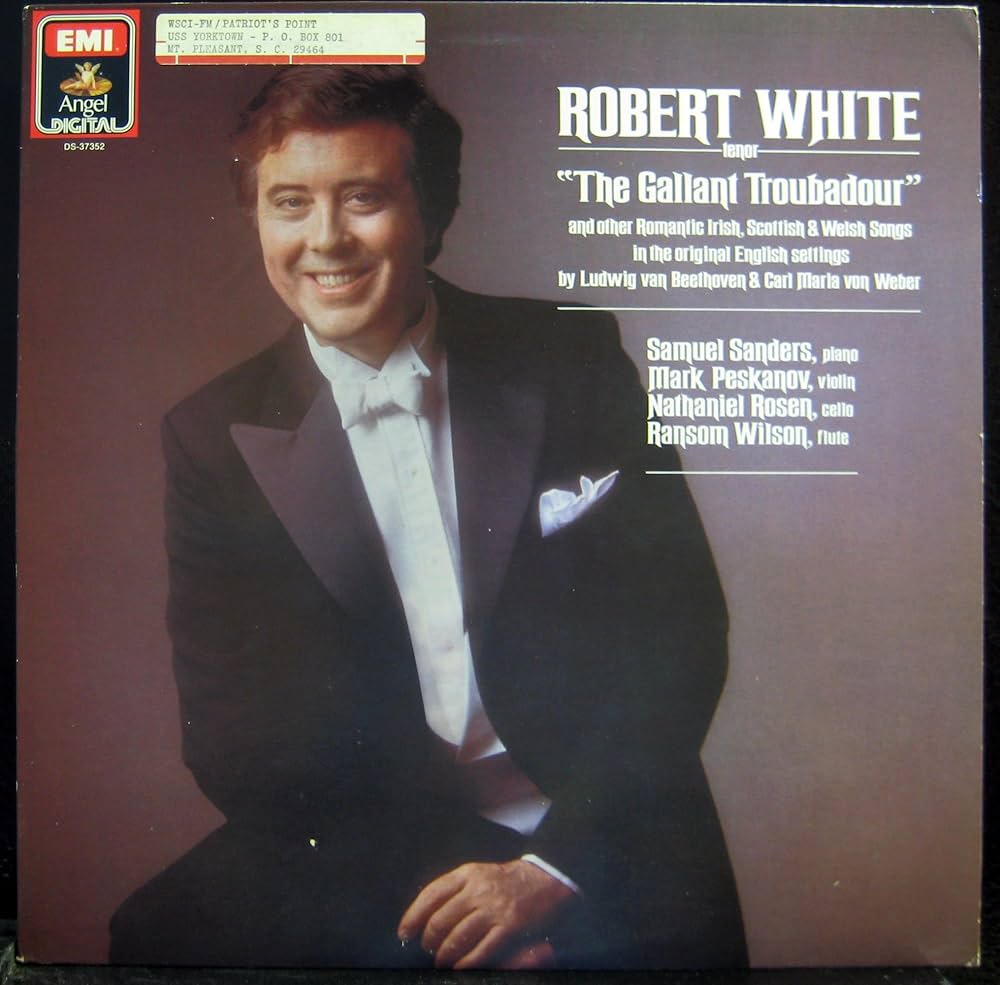
It is with deep sadness that we note the death of Robert White, the esteemed Irish-American tenor, who passed, fittingly enough, on March 17, St. Patrick’s Day. His career spanned eight decades and encompassed a vast and versatile repertoire, from early songs to contemporary works.
He was born in the Bronx, New York, on October 27, 1936. His mother was originally from Galway, Ireland, and his father was the grandson of an Irish immigrant. His father, Joseph White, was a tenor and radio actor known as “The Silver-Masked Tenor” and his mother, Maureen O'Byrne White, was a lyricist, writing many of the songs that her husband performed on radio. Robert began performing Irish songs on radio programs like “Coast to Coast on a Bus” and “The Fred Allen Show’”at the tender age of 6, earning him the affectionate nickname “our little John McCormack.” He recorded his first album, ‘Ring of Gold’ at the age of 7. After his father was unfortunately invalided, it fell to Robert to support the family and by the age of 12 he was singing with full orchestras on NBC radio.
White's initial musical training was with his father, supplemented by singing with the choir of St. Jerome's Church in the Bronx. He earned a Bachelor of Music in vocal performance from Hunter College, then pursued studies in Germany, Italy and at the American Conservatory in France. He took a Masters of Music in vocal performance from the Juilliard School in 1968.

His classical career began in 1959 when he made his Carnegie Hall debut at age 22, stepping in for an ailing Russell Oberlin as Pilate in Georg Böhm's St. John Passion with the New York Philharmonic under Leonard Bernstein. Throughout the 1960s, he was a prominent exponent of early music and toured extensively across the United States and Europe. He also premiered numerous 20th-century works by composers like Gian Carlo Menotti and Paul Hindemith. In 1970, he featured on John Corigliano's album “Caldara - A Moog Mass,” singing through an enema tube, but in the mid-70s, he refocused on his Irish heritage and in 1976 released an album of Irish ballads, “When You And I Were Young Maggie,” with the pianist Samuel Sanders. His appearance on the British national television network, the BBC, in 1977, singing Irish ballads accompanied by the renowned Irish flautist, James Galway, was so popular that the BBC asked him back in 1979 to be the featured performer in a broadcast celebrating the 95th anniversary of McCormack’s birth.
Also in 1979, White released the album “Robert White Sings Beethoven” with the cellist Yo-Yo Ma, violinist Ani Kavafian, and his long-time collaborator Samuel Sanders on piano. This album features Beethoven’s arrangement of 16 Irish, Scottish, Welsh, and English folksongs, commissioned by the Scottish song collector, George Thomson, between 1810 and 1813. In 1980, White released a third album of Irish songs, “Danny Boy and Other Irish Ballads” and in 1983 he undertook a sell-out concert tour of Ireland under the title of “I Hear You Calling Me – Robert White Remembers John McCormack.” While White definitely channeled the great McCormack and cast himself as an Irish tenor, his musical knowledge and portfolio was, like McCormack’s and Joyce’s, extensive, eclectic and global. The same year (1988) that he released the album, “Favorite Irish Songs of Princess Grace,” he performed a recital of works by Friml, Romberg, Herbert, Hindemith, Korngold, Milhaud and Grainger with Samuel Sanders at Town Hall in Manhattan; and sang Benjamin Britten's song cycle “Les Illuminations” with the New York City Symphony. In 1989, he was the tenor soloist in Britten's “Serenade for Tenor, Horn and Strings,” with the Fairfield Chamber Orchestra, and sang Beethoven's folk song settings at the Santa Fe Chamber Music Festival. He sang highbrow and lowbrow, from the White House to the music hall.
One notable omission from most obituaries though is his appearance at the international James Joyce Symposium in Monaco in 1990 where he sang Geoffrey Molyneux Palmer’s settings of Joyce’s “Chamber Music” poems. He had been approached in 1989 by Myra Russel to look at Palmer’s settings and, in his own words, he found a “virtually unknown trove of beautiful songs” Joyce believed that Palmer was the only living composer who understood the Elizabethan rhythms underlying his early poems and the only one therefore that could do his words justice. Unfortunately, Palmer was afflicted with multiple sclerosis during his last year in Oxford and depended on two sisters for his care, whose only source of income derived from the fees they earned from running a school for young ladies in Dublin. The family feared that public association with Joyce could fatally damage their reputation and livelihood, so as a result, Palmer never published his arrangements of the 32 Joycean poems he set to music in his lifetime. However, in his Musical Preface to Myra Teicher Russel’s “James Joyce’s Chamber Music” (Bloomington Indianapolis: Indiana University Press, 1993), White averred that Palmer “deserved to be celebrated in his own time for the beauty of those settings alone.” His rendition of the Chamber Music poems in Monaco is one of the few occasions that Joyce’s poetry has been delivered as Joyce himself would have wanted to hear it. The year following the Monaco symposium, White performed a recital of songs that used text by James Joyce for pupils and colleagues at the Juilliard School, whose faculty he had just joined.
Our fellow Wakean [member of the Finnegans Wake Society of New York], Enid Langbert, was privileged to meet this unique artiste in the last weeks of his life. She found him still full of songs and stories, with an irrepressible humor and a Joycean fondness for puns. Ar dhéis Dé go bheith a anam anois.
— Kevin Byrne