RTÉ’s acclaimed documentary "NORAID: IRISH AMERICA AND THE IRA" was named the Best Factual Series at the Royal Television Society Ireland Awards in Dublin on April 16th.
The two part series tells how Irish Americans, over a quarter century, defied opposition, indeed vilification by the British, Irish and American governments, to deliver vital political backing and publicity for the Irish Republican Army struggle, and millions of dollars for prisoners’ families.
Director Kevin Brannigan and Producer Jamie Goldrick of Up and Away Media won the coveted award for telling a story that had been all but hidden.
Early on in the documentary viewers see Michael Flannery, the Tipperary IRA Veteran of the Black and Tan, and Civil Wars, who fifty years later helped found Irish Northern Aid or Noraid, this at a time when money was desperately needed by the families of those arrested or interned.
Viewers glimpse the forces lined up against Noraid. British Prime Minister Margaret Thatcher shrilly condemns Noraid support. She is echoed by Irish Prime Ministers Charles Haughey, Liam Cosgrave and even American President Ronald Reagan.
Former New York Governor Hugh Carey, one of the “Four Horseman,” who along with Ted Kennedy, Daniel Patrick Moynihan and Tip O’Neill aligned with John Hume and Irish officials against Sinn Féin, bitterly attacks Michael Flannery as Grand Marshal leading the 1983 New York St. Patrick’s Day Parade - one of the largest ever held despite boycotts.

Hostile press is exemplified by a 1985 Irish Independent editorial expressing outrage that Americans would want to see the north firsthand, or hear Irish Republican leaders banned from broadcast airways, and denied visas to the United States.
News coverage termed Irish Republican Army Volunteers, “sectarian terrorists” or “mindless criminals” whose American supporters must be “misguided” or “misty-eyed." British officials even blamed Irish Americans, not British injustice, for the Irish conflict, or incidents like the brutal Internment Day 1984 attack on peaceful demonstrators, including 130 Noraid tour members, watched by millions, during American network coverage of the Los Angeles Olympics.
Top British spy Denis Donaldson would be sent to wreck Noraid from within, while an FBI official admits getting frequent demands for action from the White House at Britain’s behest.
Against this array, Irish Americans, some born in Ireland and others generations removed, joined together simply because they saw Irish men and women in a desperate struggle against British rule, and would not stand idly by.
For them, tirades by Thatcher, or her various allies, were accolades to be repeated aloud at rallies with cheers and laughter. It was truly NORAID: IRISH AMERICA AND THE IRA, because as long as Noraid members were willing to take a stand, congressmen, labor leaders, civil rights lawyers, Hibernians and other Irish organizations were willing to stand with them.
Brannigan and Goldrick tell this remarkable story by mixing historic archival film with first hand interviews of Noraid members. As the words of the 1916 Easter Proclamation, “supported by her exiled children in America” are highlighted, John McDonagh explains how Irish Americans were part of every struggle for freedom in Ireland, since the early 1800s. John himself played a major role in a Times Square display, planned as a Christmas message to Irish political prisoners, which unexpectedly became an international news story, courtesy of hysterical British tabloids.
Brigid Brannigan from South Armagh and Fr. Patrick Maloney from Limerick were two of the Irish-born members who joined Noraid when conflict broke out and carried the organization during its early years, headquartered in a small Bronx office with two phones, taking on the unlimited resources of the British.
Kathleen Savage and Michael Shanley met on the 1985 fact-finding visit, which so outraged the Irish Independent. Kathleen defied Royal Ulster Constabulary commands to surrender her camera, while Michael was arrested for shouting “British troops out of Ireland” in a chance encounter with a British royal in New York.
He describes his emotional trip to Manhattan on the day of Bobby Sands’ funeral, followed by a television news clip, “They are massing by the thousands outside the British Consulate outraged by the death of Bobby Sands.”
Chris Byrne’s song “Fenians” captured the spirit of Noraid, and the former New York City Policeman described how the New York City Emerald Society Pipe Band came to march in honor of the Hunger Strikers in Bundoran County Donegal, despite Gardai complaints, in what became “the band’s finest hour."
This documentary goes right at questions of whether Noraid monies went to finance arms for the IRA. The producers managed to get groundbreaking interviews with three men, Gabriel Megahey, John Crawley and Patrick Nee, who make no apologies for helping arm IRA Volunteers during the Troubles, and served years of imprisonment for doing so.
They each made the point, categorically, that not only were Noraid monies not used for arms purchases, but it would have been foolhardy to become involved with a public organization like Noraid.
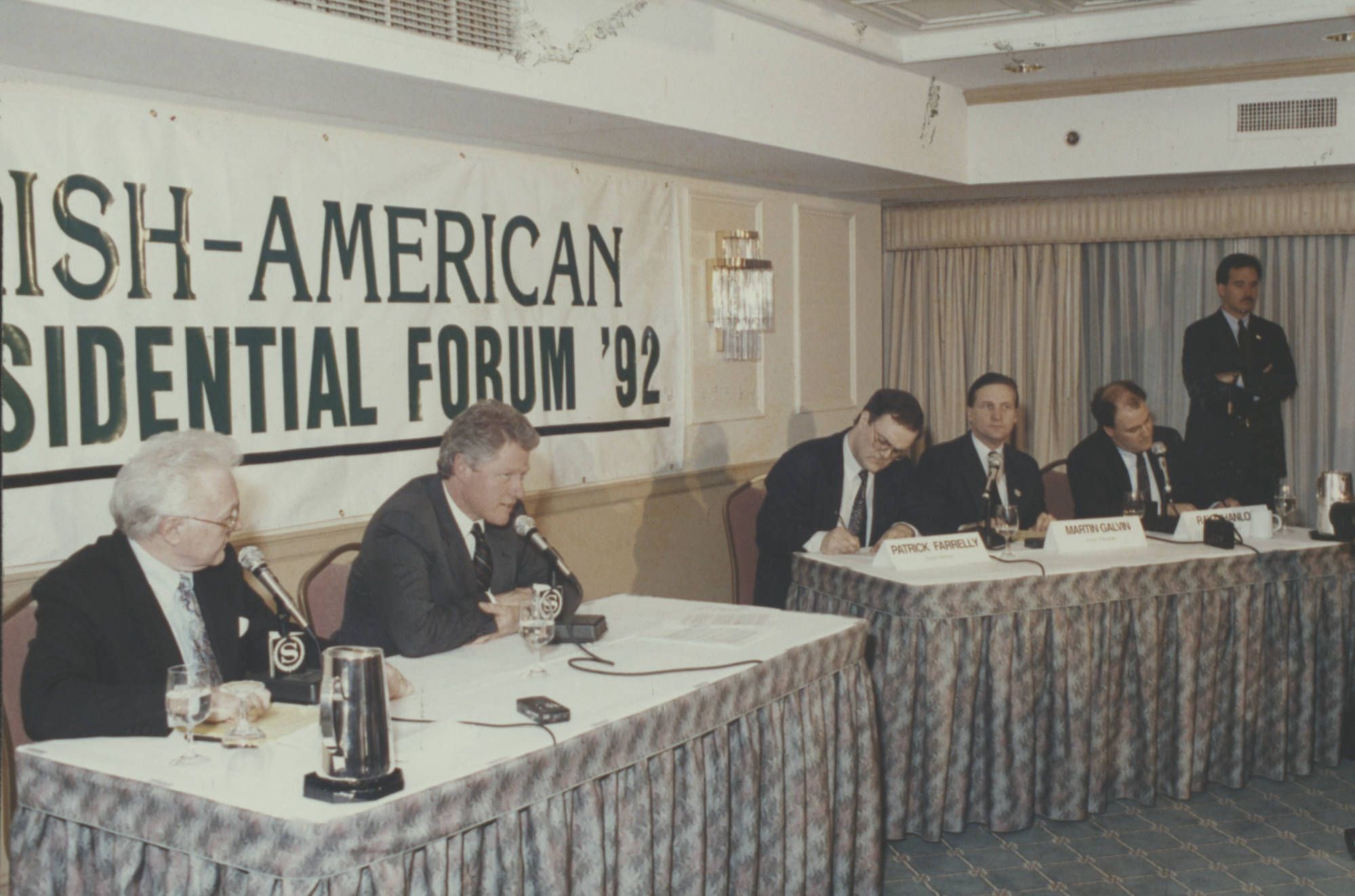
The program traces how Noraid was key to the decades-long fight to put the Irish conflict on the American presidential agenda, with a Noraid leader positioned to ask candidate Bill Clinton to pledge a visa for Sinn Féin President Gerry Adams during the historic Irish American Presidential Forum of 1992. Clinton’s Irish pledges followed by his election victory opened the door for the American involvement that followed.
That breakthrough can be traced directly to the H-Blocks and ultimately the Hunger Strikers, whose inspiration transformed Noraid. In 1978 two Irish Republicans came to New York with a message from H-Block prison leader Brendan Hughes, that the Blanketmen needed American publicity and political pressure to win their fight against brutal British attempts to break them.
A key part of the reorganization and campaign which followed were Blanketmen, Ciaran Nugent, Fra McCann, Joe Maguire and Seamus Delaney coming illegally for rallies organized by Noraid across the U.S., making the H-Blocks an American issue. Viewers see film of one Noraid rally outside New York’s Lincoln Center where 15,000 stood with siblings of Bobby Sands, Patsy O’Hara, Ray McCreesh and Joe McDonnell to humiliate Britain’s then Prince Charles.
The daily rallies across America during the 1981 Hunger Strike contributed to the victory over criminalization. They also convinced New York Assemblyman John Dearie that we could make Ireland a presidential issue using candidate forums.
The influx of new supporters led to bringing hundreds of Americans like Kathleen Savage and Michael Shanley to see the six counties for the first time. When the Thatcher government tried to quell Noraid supported by an Exclusion Order forbidding me entry to the six counties, Sinn Féin decided the ban must be challenged. The televised scenes of the murderous RUC attack on unarmed Internment Day demonstrators shocked millions by showing the true face of British rule.
There followed political battles around the MacBride Principles and Irish Political Deportees that time would not permit to be included in the two hour program. Ultimately, with Clinton’s pledges and election victory, many of those who had condemned Noraid and Sinn Féin now came around.
Noraid and its historic contributions against overwhelming opposition seemed all but whitewashed out of history.
Now Kevin Brannigan and Jamie Goldrick have told that story with a skill and authenticity that won "Noraid: Irish America and the IRA" the prestigious Royal Television Society award as Best Factual Series.
It also won them plaudits from former Noraid members, who never expected credit but are thankful to have their story told.
Martin Galvin was National Publicity Director of Noraid from 1979-1995 and for most of that period was editor of the Irish People newspaper. He has been Ancient Order of Hibernians Freedom for all Ireland Chairman since 2018.