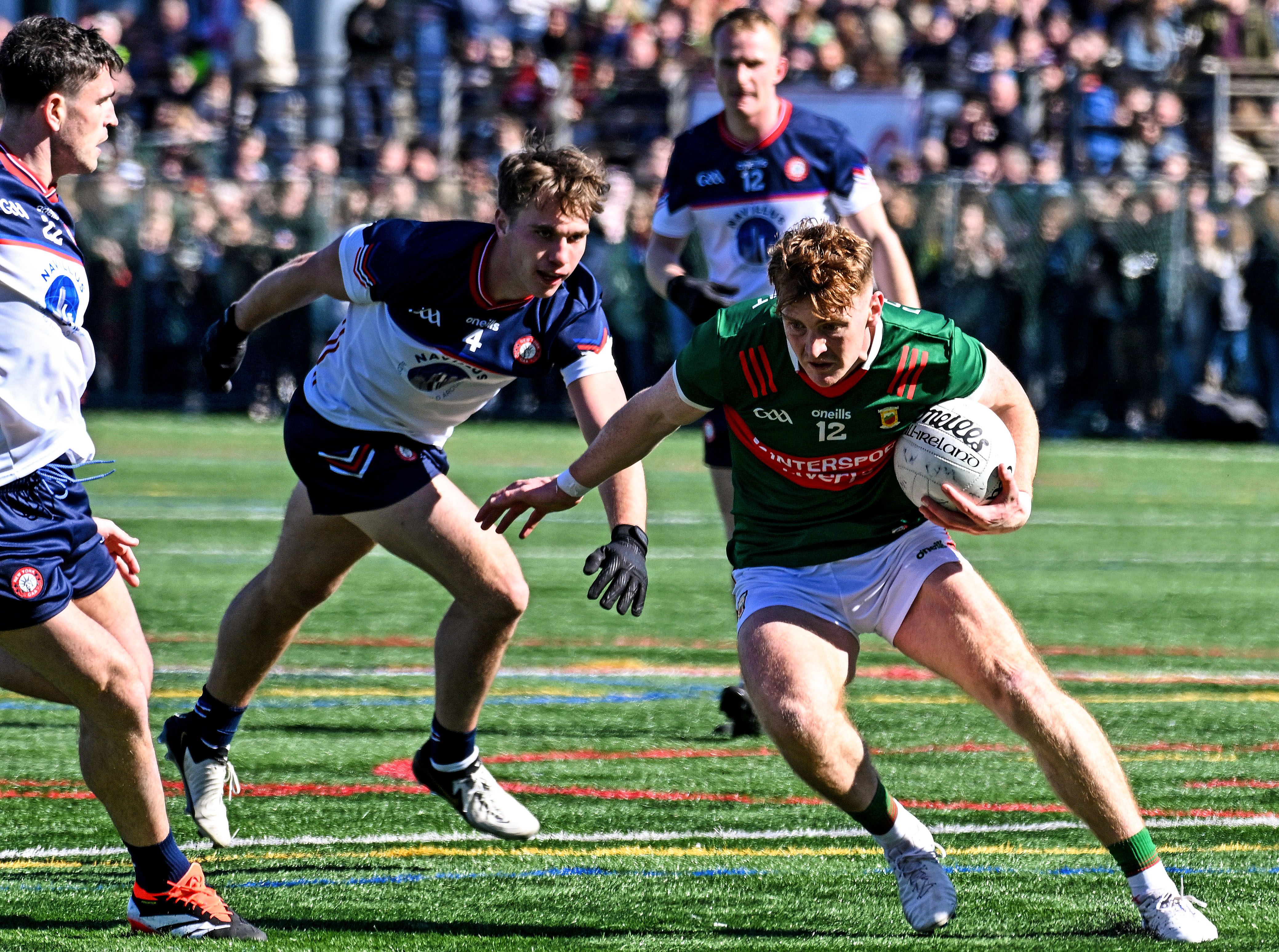
Initially, I was supposed to report on games for two weeks, well that two weeks extended to become almost two decades of reporting Gaelic games from Gaelic Park for the Irish Echo. The introduction to reporting became a very fast learning experience as I didn’t know how to type at the time. However, the ambience in the press box was very supportive with Eugene Kyne, Ciaran O’Sullivan and Chris Clarke helping out the neophyte. Once the basics were mastered, reporting firsthand the action from the playing field became quite enjoyable.
Once in a while when the heat of the battle spilled out over the sideline, I had a bird’s eye from my perched position as the warring parties exchanged unpleasantries. The unwritten rules regarding behavior in the press box would regard it as neutral territory, where vociferous support of any team was strictly sanctioned. On a few occasions, I had to strive hard to curb my enthusiasm, especially when St. Barnabas and Leitrim were playing. The usual protocol in New York is that the American and Irish anthems are played when there’s a visiting team from Ireland. A few years ago when I was in Sligo reporting on the New York versus Sligo match in the Tailteann Cup, I complained in the press box that no “Star Spangled Banner” was played. I was quickly rebuffed by the Sligo Champion reporter stating, “Do you expect us to listen to ‘God Save the Queen’ when we play London in London?”

Naturally, I have commented on referees’ performances sometimes. On one occasion I suggested the only suitable place for the referee’s report was at the bottom of a bird cage. The former referee whom I meet frequently on the golf course tells me he’s waiting for an apology. Often as a matter of courtesy when I meet a referee, I’d say, “How are you doing?” Invariably the response is, “how do you think I’m doing,” laced with enough sarcasm that you could nearly scrape it off.
Over the years we had some regular visitors to the press box and a few stand out. Among them would be the late Seamus Dooley, the Monaghan native was a former Chairman of the Board and a GAA man to the core. Evidently Seamus’s philosophy was that a well satiated press core would be quite positive with their reports. So in that vein, the Farney man arranged that the press box nearly served as a canteen with copious amounts of tea, coffee, cookies and scones supplied. Umpires and linesmen also refueled during half time in the games they were officiating. Another former Chairman, John Riordan, was a perennial visitor to the press box. The irrepressible Kerry man was always in the hunt for information about players coming and going. Truth be told the Kingdom legend was himself a mine of information about GAA affairs. Each week he avidly read the reports from the various papers, and he delighted in letting us know if there were consistencies in the respective accounts.
My reports got added interest for a few years because my son Douglas was also reporting. The late John was trying to determine who was copying from whom! Sadly, those great GAA characters, always good for a bit of craic, are no longer with us. We were also honored to have Larry McCarthy, drop in. Larry, is unique in GAA history, as he is so far the only person to have led the GAA in New York and in Ireland.
Once upon a time the leader in New York was labeled “President,” but a dictum from Croke Park deemed the term inappropriate, and hence New York’s boss is now “Chairman.” Did they fear a schism? Meanwhile Larry regularly dropped by and greeted us with the salutation, the “Fourth Estate.” I don’t know if Larry was trying to induce a notion of grandiosity that might play a role in regime change, akin to the French Revolution! Anyway, writers just drifted away as published reports became passe, and in the end I was the lone scribe standing.
I’m extremely grateful to the team managers and secretaries who supplied the team lineouts in a timely manner. Most were legible, but there were a few who would definitely challenge a handwriting expert. Of course there were a few managers who were reluctant to part with the team sheet, guarding it as if were a classified document, and then warning me “make sure the other team don’t see it.” Writers occasionally use a “nom de plume” to conceal their identity, a few Gaelic players have resorted to a “nom de peil” for perhaps similar purposes.
In recent years there are many changes in how the GAA conducts its business, and nearly all positive. However, the redesigned team sheet is one exception. Now the players are listed in longitudinal columns, where the player’s number sometimes does not match the position. It is not reporter friendly, the old format gave a quick graphic of the team lineout. I’m told the new system is better at preventing unregistered players from playing illegally. It does not make the reporter’s job any easier.
As this chapter in my life comes to an end, I want to acknowledge the great friendships I established with players, mangers and supporters. Naturally, I made a few temporary enemies, but that would be par for the course. I would be greatly amiss if I did not mention one person who was a key player in all my writing through the years, that was my late wife Helen, who passed away suddenly three years ago. Sunday was a busy evening in the Brady house, Helen had my dinner ready when I came from Gaelic Park and then I typed the reports. She was my proofreader and after I went to bed, she got her red pen and painstakingly scrutinized the draft to identify errors or omissions before submission to the paper on Monday morning. Though no longer ensconced in the press box, I’ll be quite happy to return to the stands to enjoy the action in Gaelic Park when I’m around. As my late mother told my daughter Sharon many years ago, “He’s pure daft about football.” And that hasn’t changed.