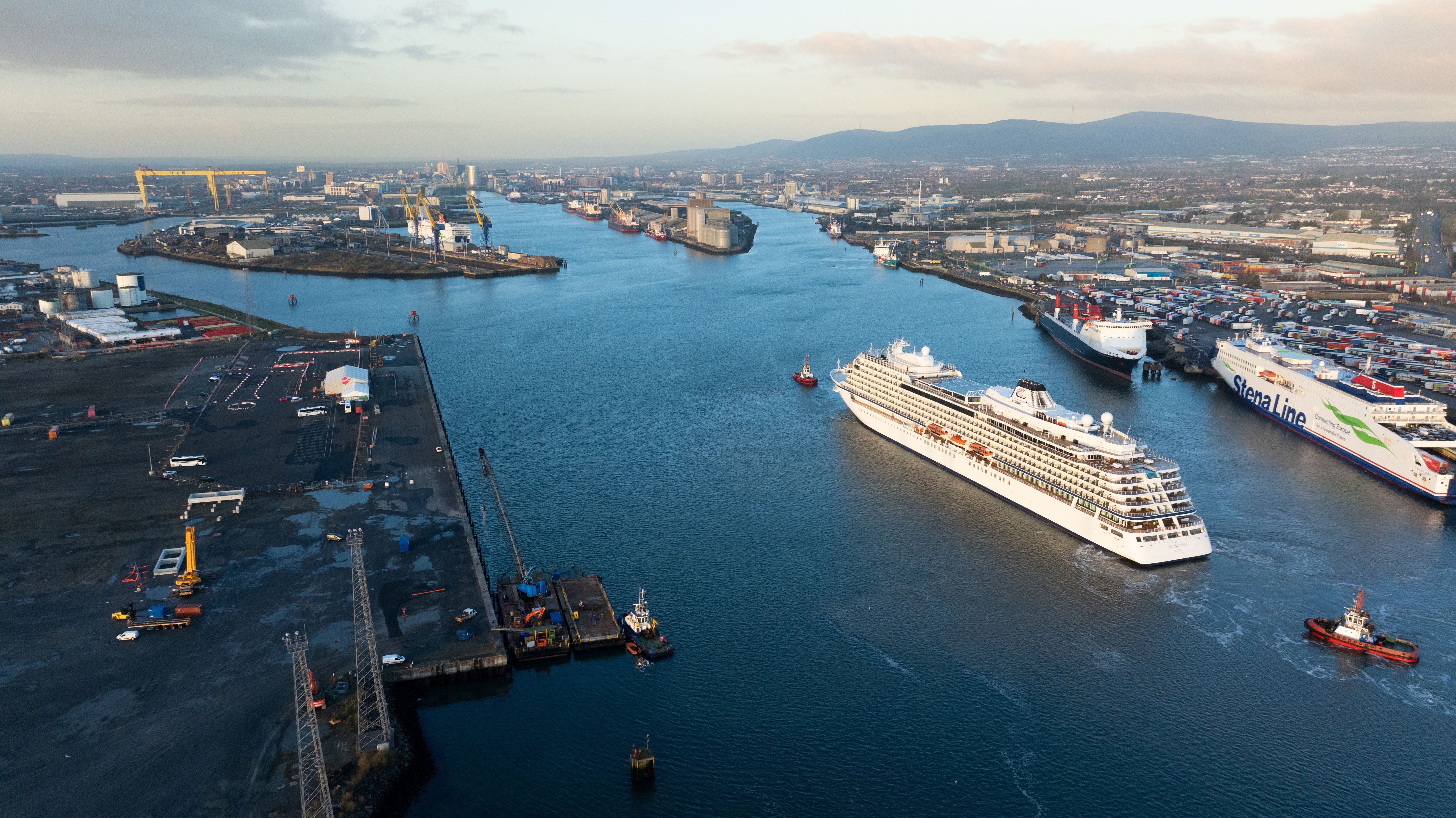
Belfast Harbour will be well known to many in the maritime sector in North America as a key gateway for trade to and from the island of Ireland, and a vital engine for Northern Ireland’s economy.
Established in 1847, Belfast Harbour Commissioners has long been a cornerstone of regional progress.
Today, it is a future-facing organisation that continues to grow by embracing new technologies and opportunities.
The port handles 70% of NI’s seaborne trade and 25% of the island’s total maritime trade.
Facilitating the steady flow of £26.7bn of goods every year, our operations generate an economic impact of almost £9bn in GVA, equivalent to 15.7% of the region’s total annual economic output and supporting almost 155,000 jobs.
It stands as the busiest cruise port on the island of Ireland and the second busiest in the UK, with a cruise business that contributes over £25m to the local economy each year.
This year we will welcome 141 cruise calls with 10 ships coming to the city for the first time.
Beyond our core port operations, Belfast Harbour Estate is a premier destination for high-quality commercial and residential real estate. It hosts a diverse community of more than 20,000 people across sectors including tourism, financial and IT services, R&D, film production, engineering and aerospace manufacturing.

As a Trust Port, Belfast Harbour reinvests all post-tax profits into the port and Harbour Estate.
RECORD TRADE LEVELS
At a time of immense change in the global economy, trade through Belfast Harbour pushed up towards record levels in 2025, driven by across the board increases in goods transported by all shipping modes.
During the year, 24.3 million tonnes of goods passed through the port, up from 24.1 million tonnes the year before.
It was a strong year for the shipping of commodities in and out of Belfast, with grain and animal feeds reaching record levels of 2.76 million tonnes, surpassing last year’s previous record figure of 2.46 million tonnes and indicating the continued strength of the region’s farming and agrifood sector.
It was also a strong year for liquid bulk commodities, with volumes of refined oils including petrol and diesel up 6% on the year before, while break bulk volumes were also robust, with steel up 11% to 200,000 tonnes.
2025 saw record Roll-On Roll-Off freight traffic delivered by Belfast Harbour’s partner, ferry operator Stena Line, with 625,000 freight equivalent units comprising of HGVs, smaller commercial vehicles and cars for the motor trade, passing through the port.
This surpassed the previous record performance of 618,000 delivered in 2024. The number of tourist coaches increased by 6% to 13,500 and ferry passengers travelling through the Port also grew by 2% to 1.73 million during the year.
Container traffic saw a positive performance, ending the year up 1% on the previous year with 124,118 units handled – a second consecutive year-on-year increase.
Trade was resilient in the face of local and global headwinds, showing that the Port community is continuing to do a great job transporting people and delivering the goods and services that we all rely on, not only in business and industry, but in all aspects of our daily lives
MASTERPLAN LAUNCH
As we look to the future, 2026 is shaping up to be a pivotal year for the future of Belfast Harbour.
Next month, we will officially launch our 2050 Masterplan, a document that sets out transformational plans to expand and reshape the port and Harbour Estate over the next 25 years.
The Masterplan sets out a bold 25-year framework designed to enhance the port’s ability to drive trade, tourism, clean growth and innovation in this region, while also shaping new places to work, visit, live and invest in.
The Masterplan is structured around three time horizons that allow it to grow sustainably, responding to demand, technology, government policy, and the needs of the community.
The first horizon reflects Belfast Harbour’s current five-year strategy, Advance Regional Prosperity with some projects already fully scoped and funded, including the development of a new £90m dual purpose deepwater terminal.
Horizon 2 from 2030 to 2040 represents will see us enhance infrastructure and maximise existing capacity, with planned projects including the proposed redevelopment of Stormont Wharf, a vital quay that already supports a range of mixed cargo uses; extending and deepening the Victoria Terminal 3 container terminal to handle a new generation of vessels; expanded logistics warehousing capacity at the Port; and the roll-out of shore power across key berths so vessels can access clean energy while docked. Horizon 3 is about long-term transformation to expand capacity, including a new terminal for freight transported by container or trailer, which will involve reclaiming land north of Victoria Terminal 4 – Belfast Harbour’s first land reclamation project for 25 years.
It will also include establishment of a Clean Energy Hub to provide for new fuels and encourage a reduction in hydrocarbon land use.
The plan contains plans for major port expansion and upgrades that will further increase our port trade capacity, including Belfast’s first land reclamation project for 25 years to build a new freight terminal, the first roll out of shore power for docked ships, wharf redevelopment for larger cargo vessels, regeneration to create residential neighbourhoods and a new clean energy hub.
GROWTH AMBITIONS
The new Masterplan is informed by independent forecasts prepared by Haskoning, a global specialist in ports and logistics, which calculated future trade volumes could grow from 24 million tonnes today to between 32 million and 40 million tonnes by 2050, meaning the port may reach its operating limits and need additional capacity.
Separate forecasts prepared by Deloitte on property and land holdings also point to lasting and growing demand for housing and commercial space that reinforces the need for Belfast Harbour to be a key driver of city regeneration between now and 2050.
Our port benefits from having a large land area with prime deepwater access, which gives us room to grow. Our plan shows how we could use that advantage to become the leading port on the Dublin–Belfast Economic Corridor while deepening trade and transport links globally and with Great Britain.
The plan puts Belfast Harbour on track to become one of the fastest-growing ports in the UK by 2050. The plan is both ambitious and practical. It reflects our track record of delivery but also raises our sights.
It shows how Belfast Harbour can continue to grow as a competitive gateway to global markets including North America and still be somewhere people are proud to live, work, study, or visit. The plan provides a coherent 25-year framework that reflects our near-term plans but also addresses essential longer-term needs.
This includes creating new capacity, replacing older infrastructure and equipment, and using new technologies to improve efficiency Our ambition is based on a proven track record.
Over the past quarter century we have completed capital projects that have reshaped not only the port, but the city itself.
Few ports in the UK or Ireland can match Belfast Harbour’s breadth of activity. The new plan shows how we can grow and compete – both on this island and beyond.
Above all, it provides clarity. It gives partners, investors, and communities a clear picture of our direction of travel and sets out how Belfast Harbour will continue to be a keystone of the economy for future generations. We believe this is a moment to plan boldly and responsibly.
To strengthen Belfast Harbour’s role as an economic engine. To invest in a cleaner, more inclusive, more connected place between the city and the sea. To create a legacy of opportunity for future generations.
Our Masterplan will be a living document that responds to changing needs over the next 25 years. We look forward to interacting with customers and maritime partners in North America as we strive to achieve our ambitions.
Michael Robinson is the Port Director for Belfast Harbour