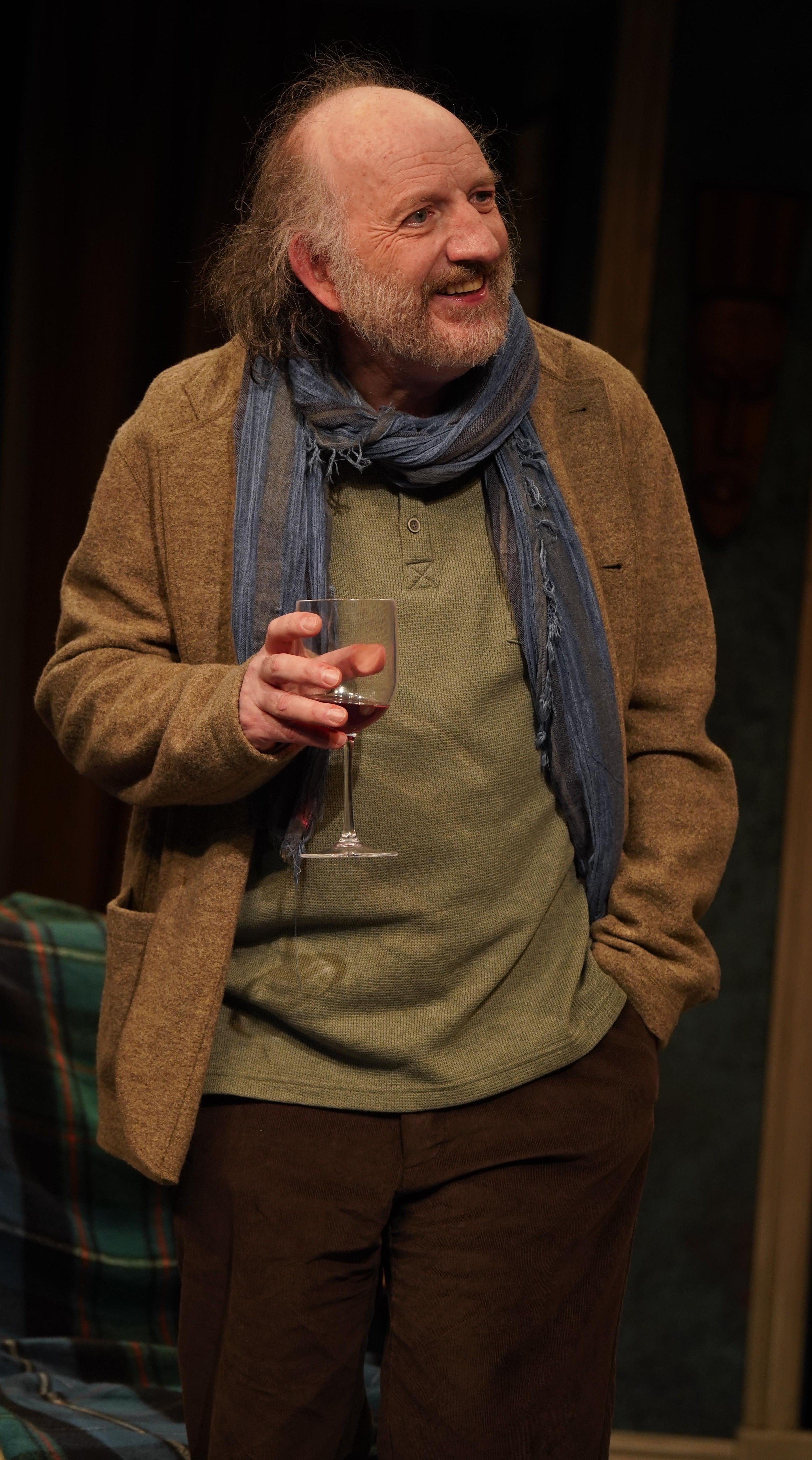
Max Baker would generally rather be painting.
Still, if he must act then he could hardly do better than perform alongside Matthew Broderick and Geraldine Hughes in “Ulster American,” which is on at the Irish Repertory Theatre, through May 10.
And if he gets to choose the director then it might be Ciarán O’Reilly every time, although this is the first time for Baker, and he’s impressed.
“The three of us have created a little sort of bond,” he said of the “Ulster American” cast. “The play will work if the three actors find a chemistry that works between the three of them. We all trust that that is going to be there now.”
Baker said that O’Reilly is the person who sets the tone. “Every other place in New York that I’ve worked — some great places, but there’s a sense of hierarchy. The Irish Rep, it’s a sense of family.
“You’re welcomed in and you’re respected and everything is opened up to you immediately and it comes from Ciarán,” said Baker, an actor, playwright and director who has in recent years been concentrating on making art daily at his studio in the Catskills.
“I’m missing it desperately, but I’m loving doing this as well,” he said. “I’m not going to not enjoy this experience.”
In David Ireland’s “Ulster American,” he plays Leigh Carver, an English theatre director; the Londoner Baker has a certain advantage here culturally, even though he departed for America a long time ago.

“The writing is so beautifully crafted, being able to tap into it is not too difficult,” he said.
“Growing up in England, you have to be polite,” the actor said. “There are norms you should obey.
“In this country, [politeness] is not the norm. It’s the opposite of that. It’s ‘be yourself.’ Because the ultimate goal of the society is for everyone to express themselves.
“It’s taken me a long while to navigate the upbringing with the culture I’m in now, and I still find that a challenge.”
In a short video at irishrep.com, O’Reilly and the cast identify some themes in “Ulster American” — female empowerment, for example, and Northern Irish identity against the backdrop of the Troubles, but also a hot topic of recent years: what is acceptable or not acceptable to say on stage or indeed in life?
“There’s a bit of a backlash now to some of the constraints that artistic endeavors were feeling — based on cultural pressures about what is acceptable or isn’t acceptable.” Baker said, “And this play certainly challenges that thinking, which I think is fantastic.
“But it does mean having to play someone who does not say the most politically correct, socially aware things — actually inherently sexist, without knowing it, sexist, but thinking that they’re not.
“I think that distinction exists and I don’t think hiding it is the answer,” the actor added, “And so to dive into a play that does explore these tricky issues, I think is vital.
“I haven’t done a lot of acting work in the last five years,” he said. “But I do know there has been a trend towards being very sensitive to language, toward being respectful to all communities.
“My experience has been that theatre has always done that. That theatre has always allowed minority voices or minority experiences to be given equal weight. More so certainly than the general society at large.”
And traditionally, it’s also about oneself as much about a concern for others. “Are you feeling respected yourself?” Baker said.
“There has been a shift toward focusing in on aspects of…certainly the language, and I feel that maybe some of the artists in the community are beginning to say, ‘Well, I don’t want to feel constricted in that way anymore.’
“But it’s always a push-pull. There isn’t any baseline right-wrong,” he said.
“And there shouldn’t be. It should be a discussion. It should be a dialogue and hopefully in a way that makes people who don’t think about these things think about them in a new way.”
One might say there were push and pull factors involved in Baker’s coming to America at age 21.
“As a young man I was looking for adventure,” he said, and the opportunity via a student visa had presented itself.
It was the Thatcher decade, the 1980s, which looking back he described, together with the 1970s before it, as “gray” and “grim.”
Baker, who grew up on a dead-end cobble-stoned street in North London not far from Karl Marx’s grave in Highgate Cemetery, was doing a course in directing before he left. But opportunities seemed limited in acting, which he described as a closed shop.
“The class system was still operational,” he said. “Nowadays the opportunities in film and on television and being seen are so different than they were in the mid-‘80s.”
He left for Durant, Okla. and then went on to Detroit and Portland, Ore. He completed an MA degree in playwriting at Washington State University.
“People here are generally very welcoming. And friendly,” he said of his new country. “And that class system isn’t imposed on you just by virtue of where you grew up or who your parents were.”
Baker has had a varied career as actor, director and playwright. He has performed on Broadway, and in major theaters in New York generally, and on the West End in London.
He’s had roles in films like “Revolutionary Road,” “Constantine” and “Hail, Caesar,” as well as parts in TV’s “The Blacklist,” “Law & Order,” “Law & Order SVU,” “NYPD Blue,” “Chicago Fire” and several other shows.
When asked the inevitable question of which he prefers, acting for the screen or the stage, Baker replied with a laugh: “I don’t know if I like any of it, to be honest.
“It really comes down to who you work with, rather than the material itself. And if you’re working with people you enjoy working with – fantastic.
“The thing with film and television is that you can get thrown into a situation where you are coming in doing two or three days on something and they’re working consistently over weeks and weeks and weeks. So you always feel like an outsider.
“And that’s a different mindset to being in a play where you’re in rehearsal every day, forging relationships as you go,” he said.
“And television especially is very results oriented. But you can also run across people who are fantastic to work with. And that makes it a great experience,” he said.
Baker has spent his time living and working in major cities: New York, Los Angeles, Chicago and London. His new departure has brought him “to the side of a mountain, surrounded by trees and deer and bears” and “a wonderful change in perspective.”
He said, “Being in nature now, I’m so much more aware of seasonal changes. The cycle of life and death is so much more present when you’re in the middle of it. Cities give a false impression of life. It’s a human construct you’re living in that denies that life and death experience. Whereas when you’re in nature, you’re part of it.
“And that change in my perspective has fed into painting.
“I’ve always enjoyed doing [painting] without giving it too much focus,” Baker said. “But in the last five years I’ve learned some skills, and tried to apply those to the work.”
As to whether the painting has shaped his other work in the arts, he said, “I think all of it does, everything feeds into each other in some way. I’m not conscious of how that happens.”
Although he has always tried to avoid labels, he allowed that his goal in painting is “to incorporate abstraction into figurative work.”
As for general influences, Baker said. “I’m a big Mike Leigh fan in terms of his work over his career. And I’ve done some Mike Leigh plays, which is its own experience.
“I think he’s a one of a kind storyteller, and I just love all of his work,” he said of the English director and screenwriter whose movies have garnered seven Oscar nominations.
“I get influenced by different things at different times. I don’t have a set idea of what speaks to me. I think I’m highly influenced all the time by other people and I kind of wish I wasn’t.
“I wish I had more sense of self — so when I’m influenced, I see that, I know how to incorporate it, rather than, ‘That isn’t me, so it must be better.’ I’m a little hard on myself about that.
“The wonderful thing about painting that I love, that is very different, is that there is no reaction at all, and you don’t have to rely on anyone else,” Baker said. “It’s only the relationship between oneself and the work.”
See also here. For tickets go to irishrep.org.