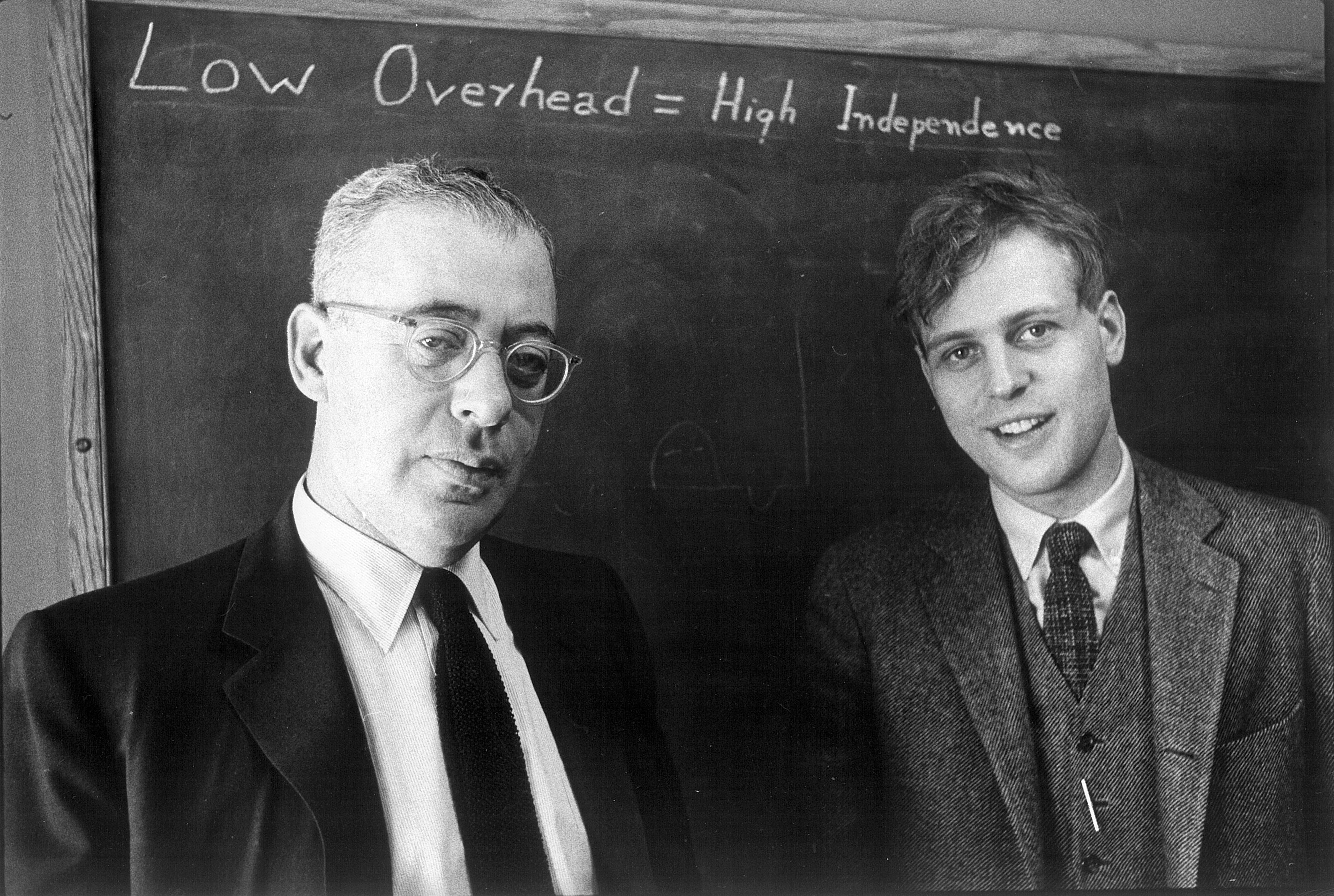
Journalist Nicholas von Hoffman recalled in his book “Radical” that he and Cesar Chavez were recruited on the same day to work for the Industrial Areas Foundation. Their Chicago-based boss told von Hoffman that the other man was the more talented organizer, but Saul Alinsky and von Hoffman would form a close bond, as revealed in his memoir subtitled “A Portrait of Saul Alinsky.” Chavez, on the other hand, would come to be distrusted.
In the New Republic in recent days, staff writer Timothy Noah commented, “There are 27 elementary and high schools named after Cesar Chavez in California, nine in Texas, and three each in Arizona and New Mexico. The New York Times put them in a quandary March 18 by reporting that Chavez sexually molested two minors, from the ages of 12 and 13, and that he raped his longtime aide-de-camp, Dolores Huerta. Now America has to figure out what to do on Cesar Chavez Day this March 31 and, more broadly, how to think about his legacy. This task is complicated by the fact that Chavez’s legacy and his life’s achievement have been out of alignment for some time.”
Despite Chavez’s achievements and his prowess at times as a labor leader, Noah wrote, it’s “widely known but seldom acknowledged that Chavez seriously botched the job of actually managing a labor union.”

Von Hoffman was one of those who did acknowledge it. He wrote in “Radical,” published in 2010 when he was 80, “By the time of his death [in 1993], Cesar had destroyed the union he had once led with such brilliance, leaving the Mexican-American farmworkers as unorganized and defenseless as they had been before his rise. As the union reached the summit of accomplishment Chavez grew autocratic and dangerously eccentric. He fell under the influence of Chuck Dederich, the boss of Synanon, a semicriminal drug-rehabilitation cult. Synanon’s central rite, which Cesar made his own, was the Game, in which a person or in this case one of the union’s staff, was put in the center of the room and surrounded by his or her colleagues who screamed epithets and accusations until the victims was reduced to human rubble.”
Von Hoffman also wrote, “Though the saintly Cesar emerged to cast a spell over men like Bobby Kennedy, women like Dorothy Day and a wide liberal public, he was not a figure Saul could trust. The leadership he admired and whose decision-making he could rely on was that of a Franklin Roosevelt or a John L. Lewis [the labor leader], men who might be devious, cynical, power loving and glory seeking but who lacked that pious tick that can make for calamity."
He continued, “Alinsky believed that Cesar didn’t have the internal dialogue that keeps one aware of the outside world and puts life in perspective. A person who did not know and understand his appetites was someone, Alinsky believed, who lacked the self-knowledge to control himself or to know what he was doing. Yet Saul helped Cesar get seed money to start the farm workers’ union, hoping that it and Cesar would end well. Neither did.”
Chavez will now be a reviled figure because of an investigation by the country’s leading daily newspaper more than 30 years after his death at age 66. The girls he abused at the center of this report, both daughters of union organizers, are now themselves 66. His former aide-de-camp Huerta wrote: “I am nearly 96 years old, and for the last 60 years have kept a secret because I believed that exposing the truth would hurt the farmworker movement I have spent my entire life fighting for.
“I have encouraged people to always use their voice. Following the New York Times’ multi-year investigation into sexual misconduct by Cesar Chavez, I can no longer stay silent and must share my own experiences.“I can no longer stay silent and must share my own experiences.”
Chavez’s former boss Alinsky’s reputation took a hit decades after his death, but in this instance the infamy was thoroughly undeserved. The Chicagoan’s problem was his well-documented influence upon the two great Democratic stars of the early 21st century, Hillary Clinton and Barack Obama. And so his 1971 book “Rules for Radicals” was examined and reviled for its “Marxist totalitarianism” -- with its neighborhood focus on enfranchising poor people and its subtitle, “A Pragmatic Primer for Realistic Radicals,” entirely ignored. Two types of people spread the story of the evil commie Alinsky who was bent upon the destruction of Western civilization: ignoramuses and professional liars. I can’t tell you which category poet Eugene Alexander Donnini falls into, but the rightwing Australian journal Quadrant republished from its archives last Friday his 2021 essay “Alinsky and the Politics of Hell”; some, though, at that publication surely must know it’s complete hogwash.
Von Hoffman wrote his memoir because he said he was one of the three or four people who loved Alinsky then still alive almost 40 years after his death. The journalist had already written about a dozen books. As a young married man with a child, he promised Alinsky he would devote a decade of his life to community organizing, which he did from 1953 to 1963, and then he’d find something else to do. That something else turned out to be a star reporter and columnist, first for the Chicago Daily News and then a few years later, before anyone ever heard the names Woodward and Bernstein, a high-profile recruit to the Washington Post under Ben Bradlee.
Von Hoffman ruffled feathers at the Post with his irreverent approach — the publisher Katherine Graham once angrily fired a shoe at him across the newsroom. “His columns routinely savaged sacred cows in Washington: military wives, whom he wasn’t afraid to call ‘sad and somewhat dumpy,’ or racial hypocrisy, or duplicity in politics,” Jeff Himmelman wrote in “Yours in Truth,” a biography of Bradlee.
The journalist’s earlier career began with some social work he’d undertaken in Chicago. Through that effort, von Hoffman, son-in-law of the church architect Barry Byrne, was introduced to Alinsky by two priests — Msgr. John O’Grady and Fr. Jack Egan. He was to discover that this community organizer was hostile to the idea of professional social work and in fact had won over O’Grady, the Catholic church’s expert on the subject, to his point of view.
The two clerics were both close personal friends of Alinsky’s, and play starring roles in von Hoffman’s “Radical,” while several other prominent Catholics also feature.
America’s most famous conservative, William F. Buckley Jr., introduced Alinsky on an episode of his TV show, “Firing Line,” broadcast on Dec. 11, 1967, as the “pet revolutionary of the church people of America.”
Buckley’s shows were often debates rather than interviews. I’ve seen two or three of them in their entirety, and, to use a boxing metaphor, he won on points each time. He had enormous home field advantage as the moderator and could put his interlocutor on the defensive from the get-go. And more generally he was a subtle interviewer who might be expected to outmaneuver his guest at any time. Little wonder that Senator Robert Kennedy was amused at the naïveté of an aide who suggested he appear on the show.
Alinsky, however, was in their meeting the clear winner on points. But, of course, it was just a TV show. What is really significant was that Buckley took Alinsky seriously, obviously did a lot a research beforehand or had his team do it, and accepted the community organizer’s bona fides as a supporter of the democratic system and commended his lack of a neatly-packaged one-sizes fits all ideology or prescription for society’s problems.
He was a good man, according to those who knew him. With O’Grady, he had a “close and rollicking” friendship. The priest “came over from Ireland the year Saul was born [1909], “a matter of mystical banter between the two of them,” von Hoffman wrote.
Someone recalled to him, “Saul just loved Egan, loved him as a priest…Saul knew what a priest was. ‘But there are so few of them around,’ he’d say.”
In the last line of “Radical,” von Hoffman wrote that Alinsky’s sudden death in 1972 at age 63, “damn near killed Egan and me and the rest of us who loved him.”