By Anthony Neeson
The Irish government is urging Irish citizens in the Middle East to register on its Citizen Registration platform.
It’s believed that as many as 22,000 Irish people are in the region, whether living there or on holiday.
Since Saturday, U.S. and Israeli forces have pounded sites in Iran killing the Supreme Leader Ayatollah Ali Khamenei and reportedly hundreds of people.
Iran has retaliated by launching rocket and drone attacks on Israel as well as the Gulf States which are home to U.S. military bases.
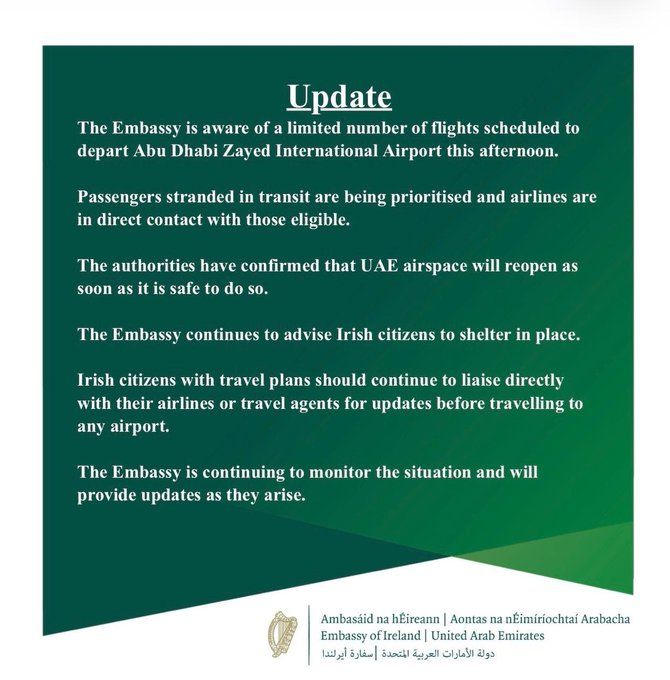
There are significant Irish populations in Bahrain, Qatar, the United Arab Emirates and Saudi Arabia especially, and with airports closed and flights grounded concern has been raised for their safety as the conflict intensifies.
As a major international transit hub, some Irish people who were travelling to, or returning from Asia and Australia are now stranded.
Minister for Foreign Affairs Helen McEntee urged Irish citizens in the region to register their presence.
“I am also aware of suggestions of consideration of land routes to neighbouring countries, such as Oman. However, I strongly urge citizens not to pursue anything other than a shelter in place strategy now,” she said.

“Following coordination across all EU member states, this remains the common approach at the moment.”
She added that as of now, “there are no evacuation routes recommended for Gulf countries and so the advice is to shelter in place.
“We are maintaining close touch with the airlines of those citizens who were in transit when the conflict began. We also remain in very close contact with EU partners as this situation evolves.”
On Saturday, as news of the conflict broke, Taoiseach Micheál Martin spoke of his deep concern for the potential risk of wider escalation of the fighting.
“Ireland has always believed that conflict should be resolved through diplomacy and negotiation, in line with the principles of the UN Charter and international law. That must apply in this situation as much as in any other,” he said.
“Our embassies and missions in the region are working to support Irish citizens affected and are coordinating closely with our international partners to ensure their safety. We will remain in close contact with our international partners, in the EU and the UN, as the situation evolves.”