Behind the veneer of every great man’s ambition is the paradox of his ideals. At the height of immense power, aloft in all his fame, is the delicate weakness which led him there—his desire for love, afraid to be shown true. Were it so easy to resolve the strife of men, could such a seamless grace of sympathy touch and cure the anguish of an inadequate world, one would tempt providence to say that two humans might do it.
If it were done, it would be seldom so sweetly conceived than The Storm Theatre’s staging of Oscar Wilde’s “An Ideal Husband,” a demure drama rapt with charming poise and effervescent tenderness, at A.R.T./New York Theatres for a limited engagement through Feb. 21.
A lesser beloved work of Wilde, “An Ideal Husband,” whose past appearance on Broadway being made three decades prior, has been well awaited in this production, as its timely themes arrive not a moment too soon, yet hopefully not too late for this intolerant American audience.
What might from first glance be mistaken as a self-pitying bourgeois melodrama, swaddled in an outpouring of Wilde’s clever witticisms, Peter Dobbins’s deceptively simple production twists our public and private anxieties into modern, human knots, and leaves us reconsidering our moral certainties.

Over its well-mannered pace, the play frames the story of Sir Robert Chiltern (Jed Peterson), a self-made man of London Society, whose unfailing honor is the epitome of virtue in the eyes of his wife Gertrude (Madelyn Monaghan). However, Gertude’s ideal of Robert exceeds his own. In an era usurped by money, Robert, who “fought the century with its weapons and won,” ascends London’s social ladder with the genius of opportunity and ambition at all costs. All is prosperity and bliss for the Chilterns, until Gertrude’s schooldays rival, the scandal-addled Mrs. Chevely (Connie Castanzo) arrives from Vienna with a suspicious proposition for Robert.
When Robert refuses to endorse her scheme, Mrs. Chevely threatens to reveal a dark secret in his past, that would forever destroy Robert’s career, wealth, reputation, and marriage. Damned both ways, Robert chooses between further tarnishing his integrity and clout, or losing the admiration of his Gertrude, whose love he cannot live without. On the verge of ruin, Lord Goring (Chase Bishop) intervenes as confidant and counselor, whose contradicting youthful wisdom just might save everyone from themselves.
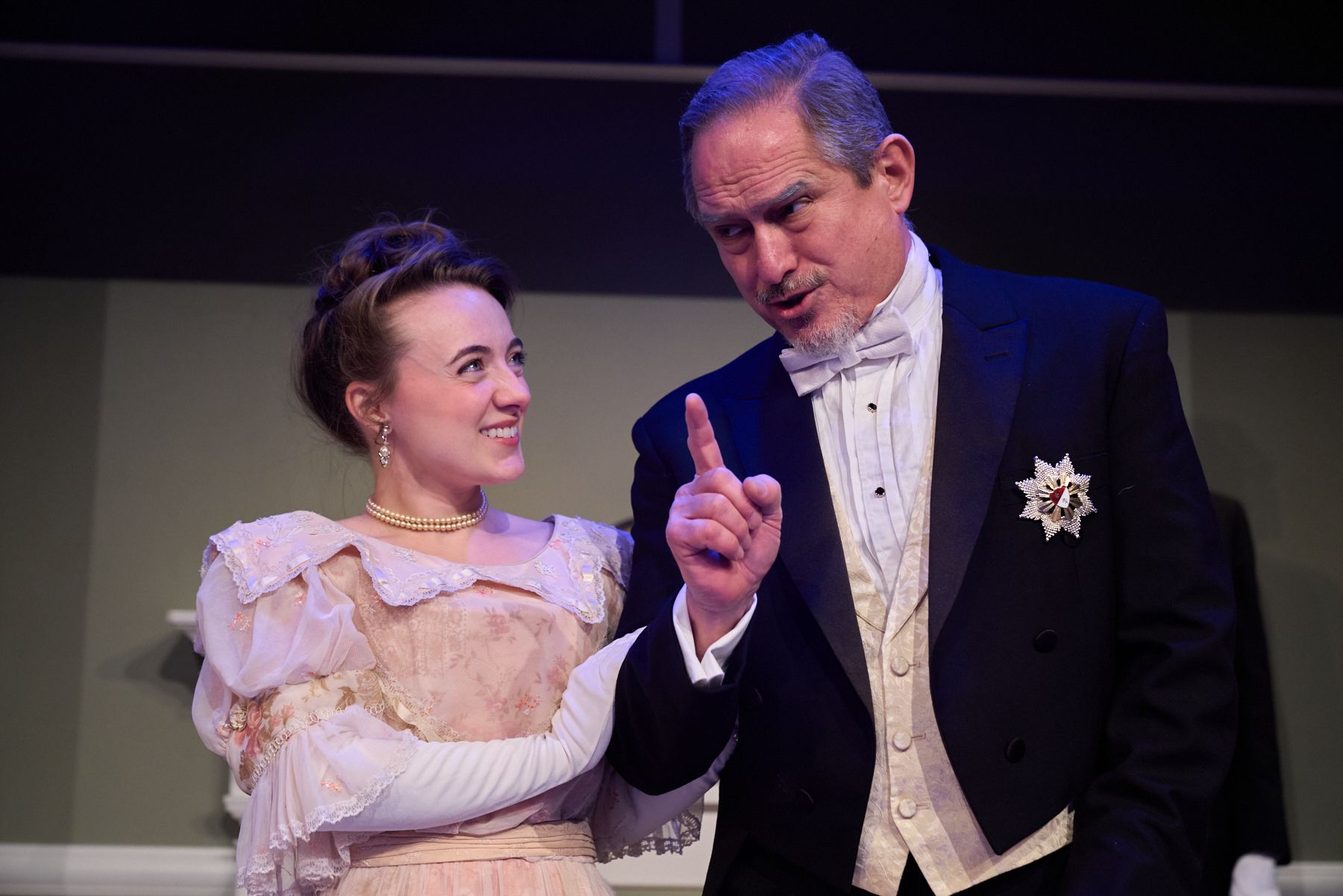
This production meets Wilde’s blithe and winding diatribes—and not a few fine-tailored moral critiques—with excellent success. In a curiously provocative design, Daniel Prosky divides the audience in two—the stage in the center, flanked by two wings—not merely complicating the boundaries between discretions of public space and private lives, but in self-conscious transparencies of our judgment; enacting our judgment for the characters and ourselves. Equal efforts can be said of Dobbins’s measured direction, whose sparse blocking within the stifling, socialite parlor allows for only the most minimal choices of action: oppressive posturing, a meddling of angst and catharsis.
With such a task, this well-complemented cast makes great zeal and lucidity of Wilde’s sometimes too-witty-for-its-own-good wordplay, and remains faithful to the play’s sentimental truth.
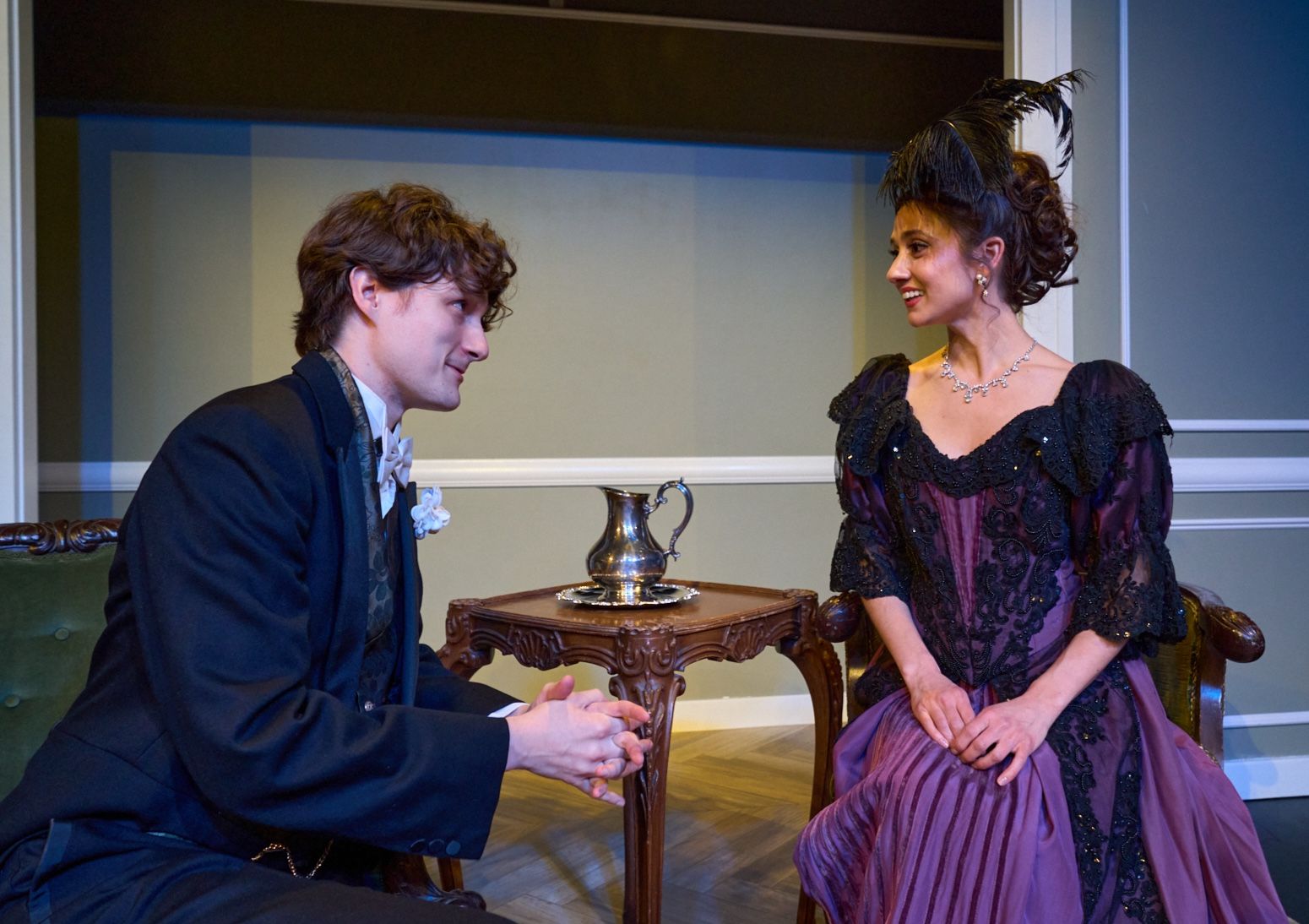
Chase Bishop, in the role of Lord Goring, is a dead-ringer for Wilde with the timing of Alan Alda, and an ideal intermediary between the comic and conscientious, whose exuberant sincerity carries the drama, occasionally at his expense. While Goring’s funnier lines seemed upstaged in the service of giving seriousness to Robert’s woes—and the same for his farcical riffs with Lord Caversham (Carl Pasbjerg), which went unnecessarily cold—we are compensated by his exquisite chemistry with Mabel Chiltern, played by Heather Olsen, an irresistibly radiant concoction of charm and cleverness.
Monaghan and Peterson make such touchingly comparable figures of their roles, as their complicated interiorities exude the elaborate facades of their characters.
As Mrs. Chevely, Castanzo, the portrait of political cunning and conniving disdain, gives the night’s performance a particularly good seal of quality.
“An Ideal Husband” poses the ideal scenario to an ethical dilemma, and gives an immodest answer. Is a person indefinitely condemned to their past? Should a man be castrated merely for having faults? Or do stringent, moral standard bearings stand in the way of ordinary people doing extraordinary deeds? The answer to this demands Wilde’s most contemplative compassion, good faith, trust in our better angels, and a blind love all but devoid from our everyday dialogue. The conversation will not be perfect. Love lies in the embrace of the not-so-ideal.
There is “An Ideal Husband” waiting for you. Catch it before he gets away.
For tickets, visit www.stormtheatre.com.