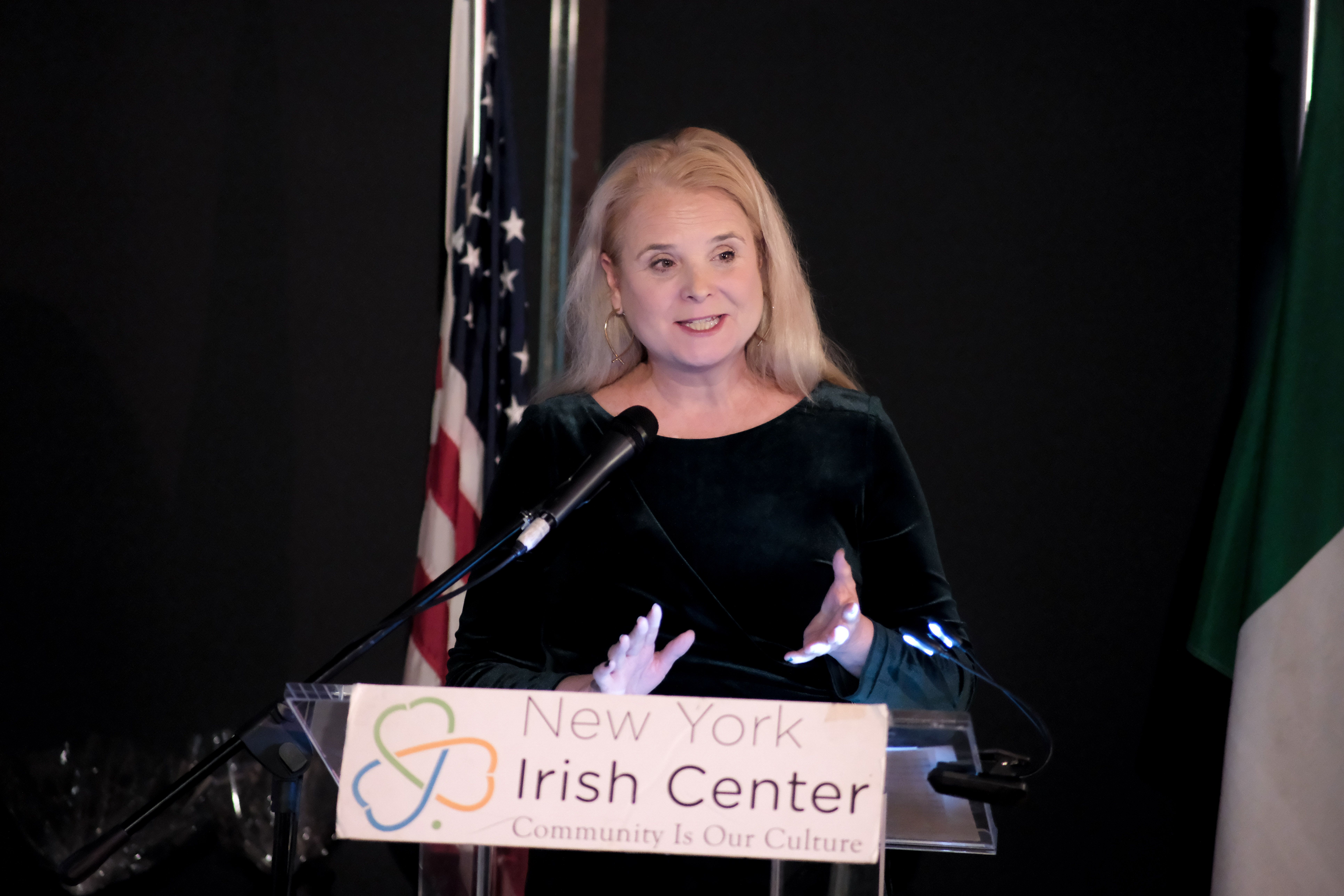
Was Saint Brigid a feminist? Absolutely, journalist Sadhbh Walshe told a packed house in the New York Irish Center on Feb. 2. They were there to celebrate the Women of Ireland Awards, an annual event inaugurated by NYIC after Ireland made Saint Brigid’s Day a national holiday in 2023.
Brigid was not “just a nun,” as a male columnist recently wrote in the Sunday Independent, Walshe said—to appreciative boos from the crowd. Walshe detailed how Abbess Brigid showed her female muscle in many ways, among them giving leprosy back to a cured leper who was insufficiently grateful.
And Brigid showed her feminine wiles in achieving one of the first and biggest Christian settlements in Ireland. “We all know the story of the cloak,” Walsh said, alluding to Brigid’s first miracle, which Irish school children learn.
Well, for those who aren’t familiar, here’s a reporter’s summary: Refused ground on which to build a church by the fifth century King of Leinster province, Brigid requested just as much ground as her cloak would cover. He agreed and the cloak miraculously extended itself over many acres. The settlement, in modern day Kildare, gave its name to the county (in Irish, Cill Doire, “cill” meaning church and later widely anglicized in Irish place names that start with “Kil”).

Some readers may have woven a Celtic cross, known as St. Brigid’s Cross, even though the Christian holiday was overlaid on a pagan festival celebrating the imminent arrival of Spring. That festival was “Imbolg,” which, Walshe noted, comes from the Irish “bolg” for “stomach,” signifying lambs to be born.
Whether Brigid, Bridget, or Brid, Imobolg or Imbolc, the day of celebration was traditionally Feb. 1. Now, Ireland honors her only female saint with a holiday on the first workday (Monday) in February.
By contrast, in New York, some 150 attendees came out after work for the occasion in abnormally cold weather—many navigating slushy snowbanks in high heels and dainty dresses.
The cocktail evening at the NYIC in Queens featured both a panel discussion and an awards ceremony.
Three awards were presented: one to Mary Courtney, a musician who founded the first all-female trad band, Morning Star; one to Treasa Goodwin-Smyth, best known for presenting the St Patrick’s Day parade on NBC television; and another to Human Rights Watch lawyer Aisling Reidy.
Gemma Allen, a Forbes contributor, whose many concurrent job listings on LinkedIn, start with “Mom,” moderated the panel. She set the fun and irreverent tone by opening with, “We’re not going to talk about our resumes and all that s***e.”
Instead, “mna na h-Eireann” talked about unlikely paths into what they do now: from art college to CEO, in the case of Sarah Clarke, CEO America’s for Intuition, a Dublin-based online learning firm; or from a doctorate in science into promoting Irish tech and cybersecurity firms abroad for Claire Walsh PhD and Senior Vice President of Enterprise Ireland.
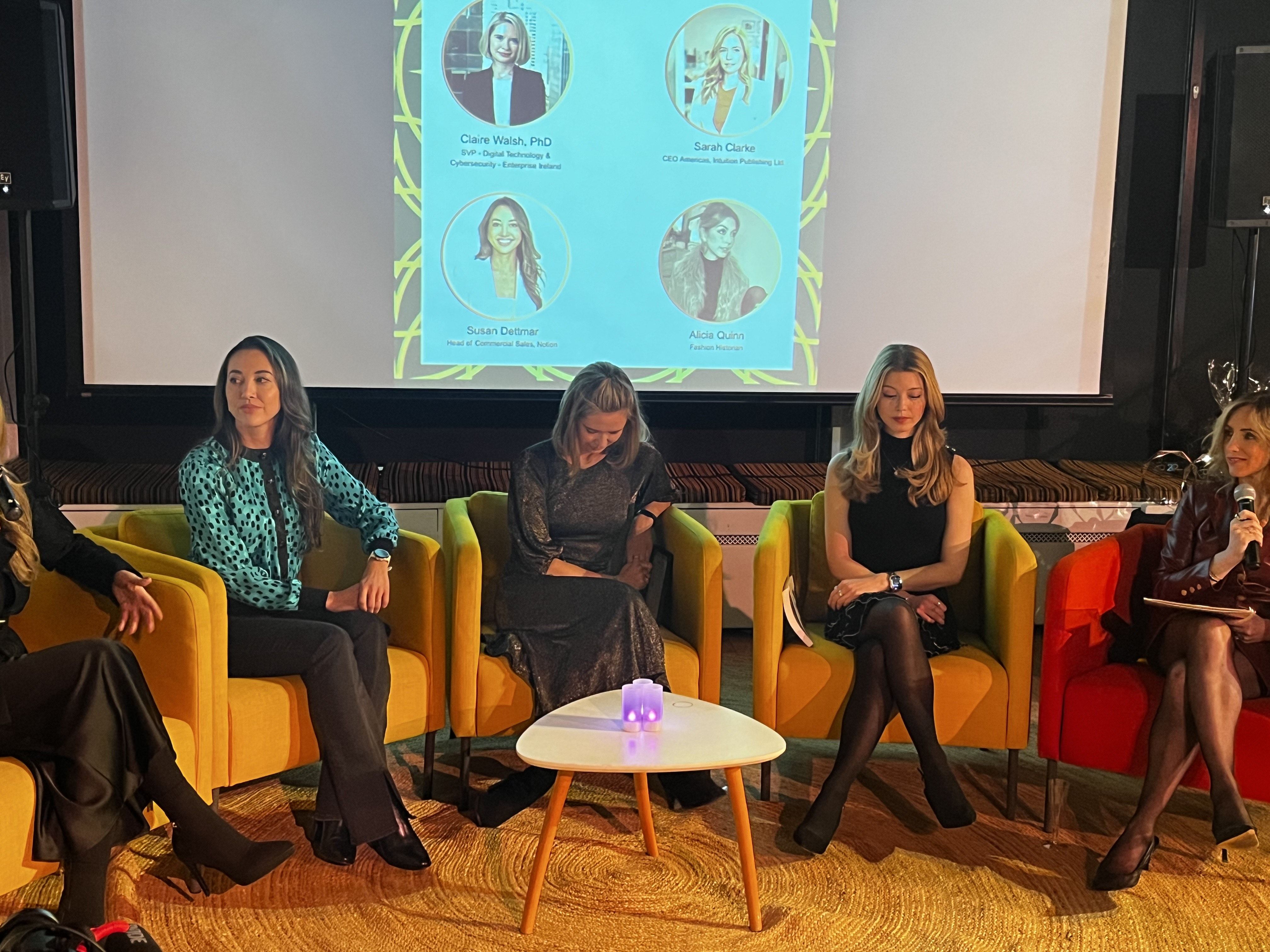
A panel discussion took place as part of the New York Irish Center’s Saint Brigid’s Day event.
They talked of personal passions: dancing professionally, in the case of Susan Dettmar, Head of Commercial Sales for software firm, Notion, and fashion history, for Alicia Quinn, who works alongside Allen on broadcasts from the bastion of male power that is the New York Stock Exchange. They report, for example, on tech firms’ initial public offerings for an online entity, theCUBE.
Real-world discussion the Monday before last included life-changing events, such as the death of a parent. Dettmar evoked a feminized version of power. She recently struggled to adequately describe in an obituary the achievements of her mother, who had “no professional title,” she said. Yet, the daughter knew that more important was how her mother made people feel. Now, Dettmar always keeps that in mind when managing the 45 people who report to her.