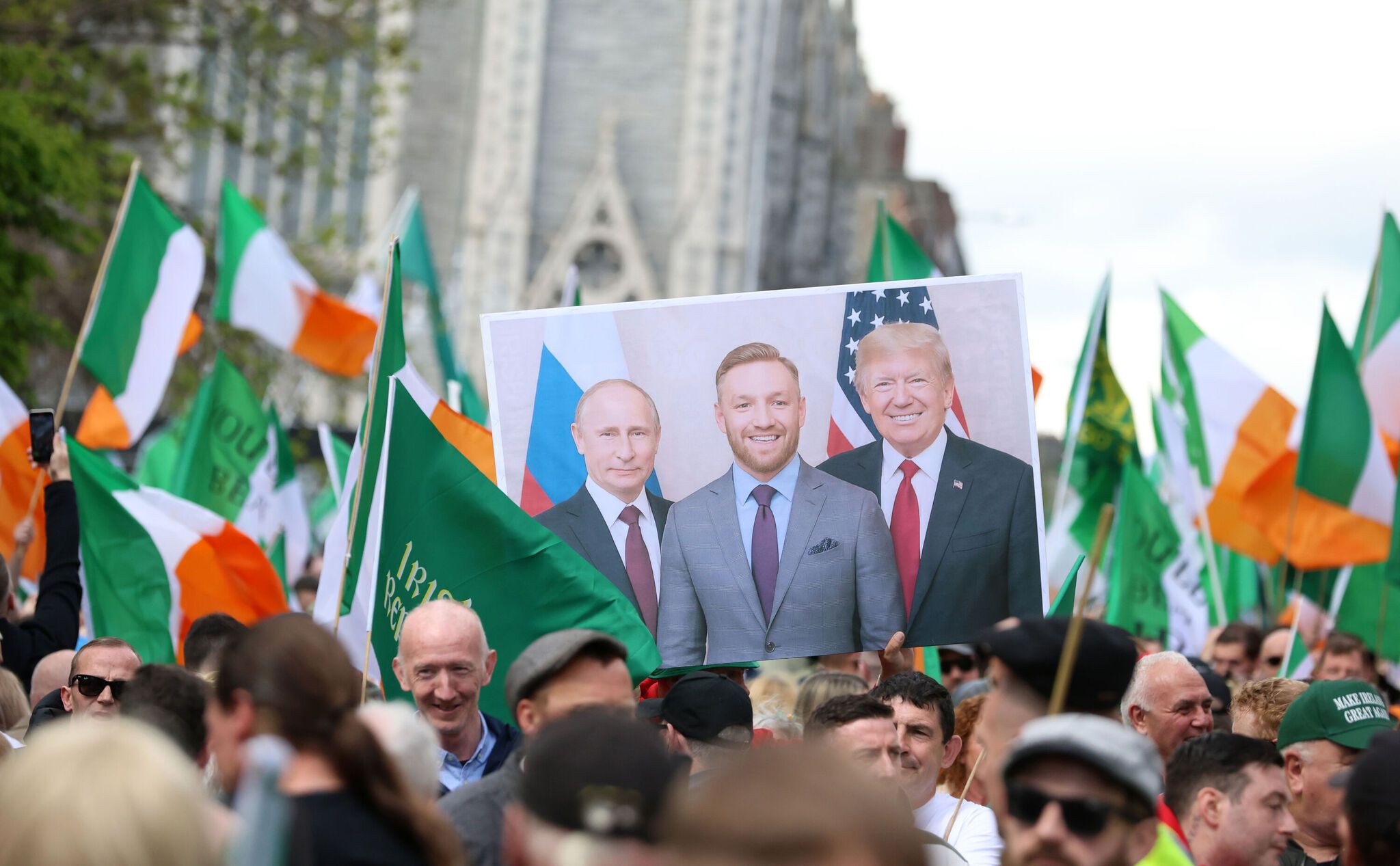
Last March 17 was a St. Patrick’s Day at the White House like no other. President Trump created a firestorm on the holiday in Ireland and in Irish America by inviting far-right former mixed-martial arts champion Conor McGregor to the White House. Though Trump had continued the tradition of meeting with the Irish Prime Minister, or Taoiseach, when Micheál Martin visited a week earlier, inviting McGregor to the White House was a slap in the face to the Irish government and a politicization of the holiday that no American president had ever done before.
The Dublin-born McGregor had made comments that were incendiary to say the least. Addressing the political situation in Ireland, McGregor stated, “Our government has long since abandoned the voices of the people of Ireland.” Referring to the large number of immigrants and asylum seekers who have entered Ireland, he added, “Ireland is at the cusp of potentially losing its Irishness.”
Speaking of his anti-immigrant and anti-government message, he claimed, “Forty million Irish Americans need to hear this.” The mixed martial artist then went on to praise Trump’s “inspiring” work ethic and contrast it with an Irish government which in McGregor’s opinion does nothing for the Irish people. Meeting with McGregor, Trump calling him a "great fighter” and named him as his “favorite Irish person.”

Though they might have responded with diplomatic language publicly, privately the Irish government must have fumed at Trump and his administration for brazenly allowing an Irish citizen a platform to denounce a government elected by the Irish people.
Before Trump, no American president would have ever dreamed of using the St. Patrick’s Day celebrations to inject itself into Irish politics and take a swipe at the sitting government, but Trump is a unique American president in many ways, including his relationship to Ireland.
Several Irish people and the country’s political leadership largely reacted with outrage and condemnation of McGregor's White House invitation, particularly his anti-immigration comments made during his St. Patrick's Day visit with President Donald Trump. Tánaiste (Deputy Prime Minister) Simon Harris clarified that McGregor was at the White House in a "personal capacity" and "does not speak for Ireland.” Several Irish women also expressed outrage that McGregor, a man was found liable for sexual assault in a civil suit brought by a woman in Ireland in 2024, should be invited to the White House.
McGregor appeared at the White House with his own political agenda. The same week as his appearance at the White House McGregor announced his own bid to become president of Ireland, a bid that he subsequently gave up. Though he renounced his aspirations to be president, McGregor continues to serve as the poster child of the Irish far right, thanks in part to his fame as the first person in history to hold two UFC belts simultaneously, while rising to become the world’s highest paid sport star in 2021, according to Forbes. With some 19 million social media followers, McGregor has a platform to air his views no Irish politician could dream of.
McGregor has voiced his support for anti-immigrant groups, including paying for supporters to attend protests, and his pub, the Black Forge, serves as a meeting spot for far-right activists. He often speaks the language of historical Irish republicanism, appealing to a sense of Irish identity and traditionalism. Ciaran O’Connor a senior analyst with the Institute for Strategic Dialogue, a think tank that researches online hate and disinformation, said of McGregor, “The far-right are promoting McGregor as the voice of the people, taking advantage of his platforms to boost their ideology.”
It is little wonder that Trump and McGregor admire one another as both men see their countries as threatened by immigrants and both have often used social media to make outlandish claims.
Some Irish people react positively to McGregor and his xenophobic message, especially many people of limited income who feel forgotten and marginalized in modern Ireland. They see McGregor as a hero whose tweets capture the rage that many Irish people feel about social, economic and political forces they feel powerless to control. On Nov. 22, 2023, McGregor stoked anti-immigrant sentiment in Ireland claiming, “Ireland, We are at war,” on X, which used to be known as Twitter. The day after McGregor’s “war” tweet, a stabbing outside a school in central Dublin left three children and an adult injured. Hours later, rioters with links to the far-right descended on the city, plunging it into an orgy of violence and destruction of property. O’Connor told CNN, adding that he believes McGregor’s “tweets in the lead up to the riot were a call to action against illegal immigration.” The Telegram channels that had circulated McGregor’s declaration of war the night before the stabbing claimed asylum seekers posed an innate, existential threat to Ireland’s citizens.
After the riot on Nov. 23, 2023, Garda Commissioner Drew Harris said, “What is clear is that people have been radicalized through social media,” before describing rioters as “a complete lunatic hooligan faction driven by far-right ideology.” As riots raged in Dublin, McGregor approvingly posted on X, “You reap what you sow.”
It is not clear if Trump will invite his favorite Irishman back to the White House in 2026, but the 2025 invitation to McGregor showed Trump taking sides in Irish politics, expressing his support for the anti-immigrant forces in the country. Before Trump, St. Patrick’s Day united Irish Americans of all persuasions, but Trump has turned the White House celebrations into a wedge to create division and sow conflict. I would hope that Irish Americans of all political persuasions could unite in a belief that the holiday should be about celebrating Ireland’s many contributions to this country and not about throwing salt into the political wounds of the Republic of Ireland.