Rediscovering William Bourke Cockran, Irish-born orator who inspired Churchill By Harry Keaney
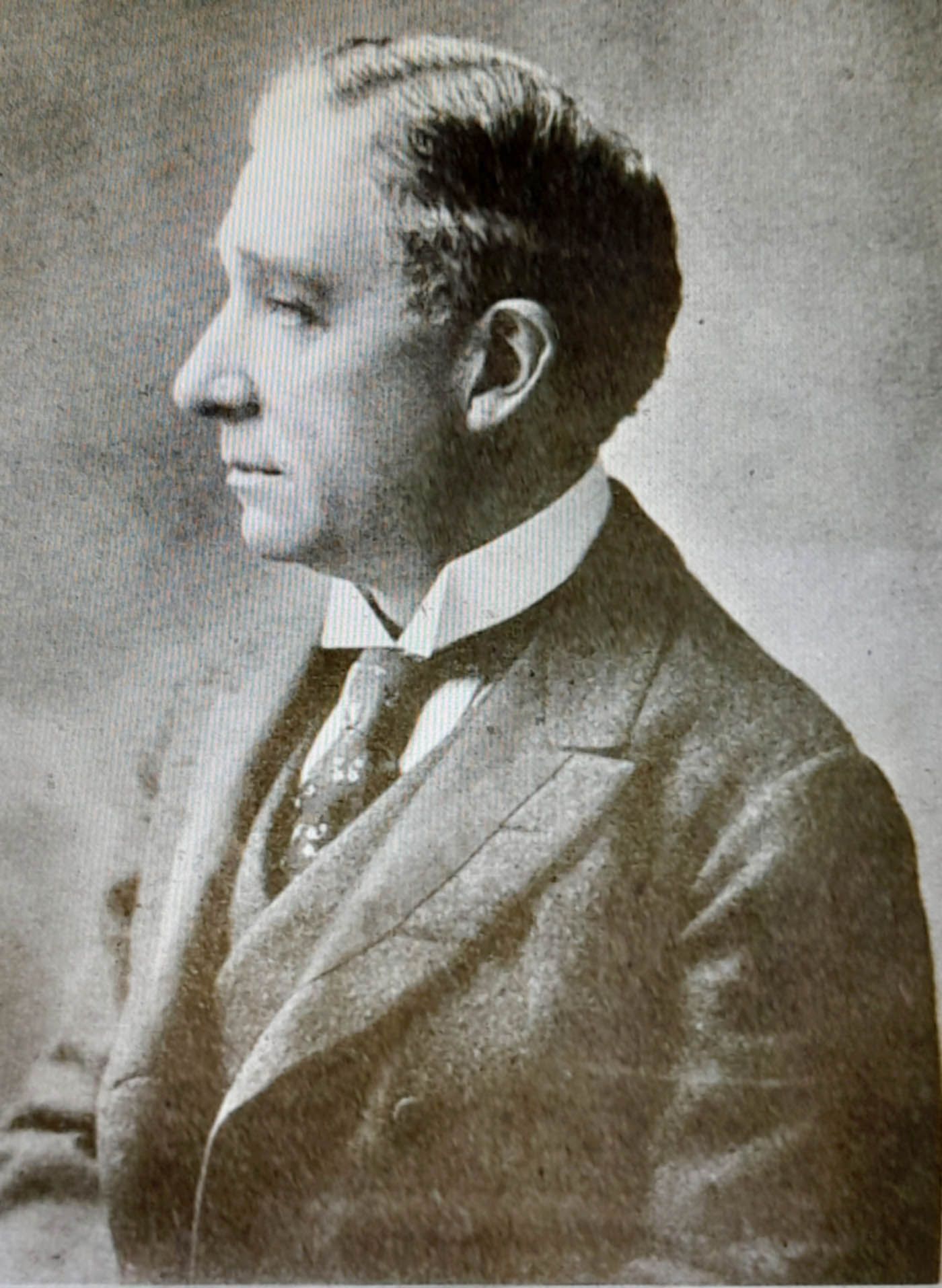
SLIGO --- In the late 19th and early 20th centuries, Sligo-born William Bourke Cockran was one of the best-known Irish men in America. Teacher, lawyer, six-term U.S. Congressman from New York, he was confidant to U.S. Presidents Cleveland, McKinley and Roosevelt.
Above all, he was a renowned speaker, holding audiences in thrall with his rhythmic, spell-binding "visionary rhetoric" oratory. Britain's war-time prime minister Winston Churchill credited the Sligoman with making him the awe-inspiring speaker he became.
Bourke Cockran died on March 1st 1923, after a party to celebrate his 69th birthday. An avalanche of appreciation, tributes and eulogies followed. The U.S. Foreign Relations Committee passed a joint resolution of both Houses mourning his death.
Congressman Hamilton Fish Jr., from New York, declared at the time: "The life story of William Bourke Cockran is synonymous with the growth and industrial development of the United States since Reconstruction and more especially with New York City.
In my opinion, he was one of the greatest Americans of our generation." Clan na Gael Leader Judge Daniel F. Cohalan corroborated by saying: "William Bourke Cockran was one of the most remarkable and outstanding Americans of his day.

He was a lover of liberty, whose passion it was to see it preserved in our country and extended to his native land."
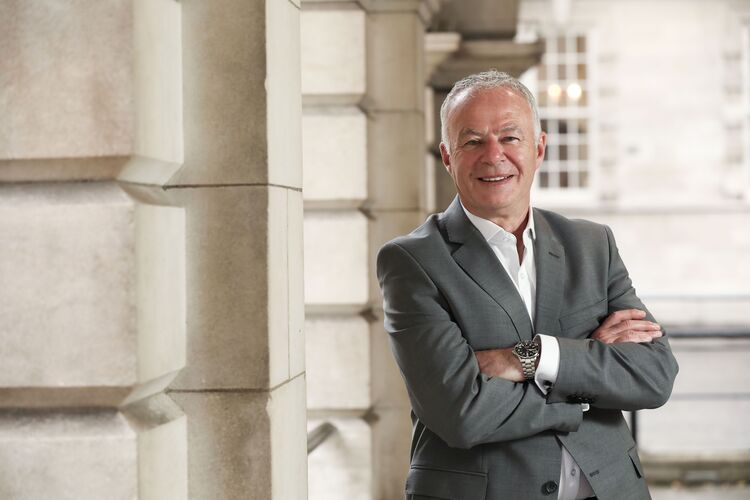
Keville Burns at the grave of William Bourke Cockran and his wife Anne Louis Ide in Gate of Heaven Cemetery, Hawthorne in Westchester County, New York.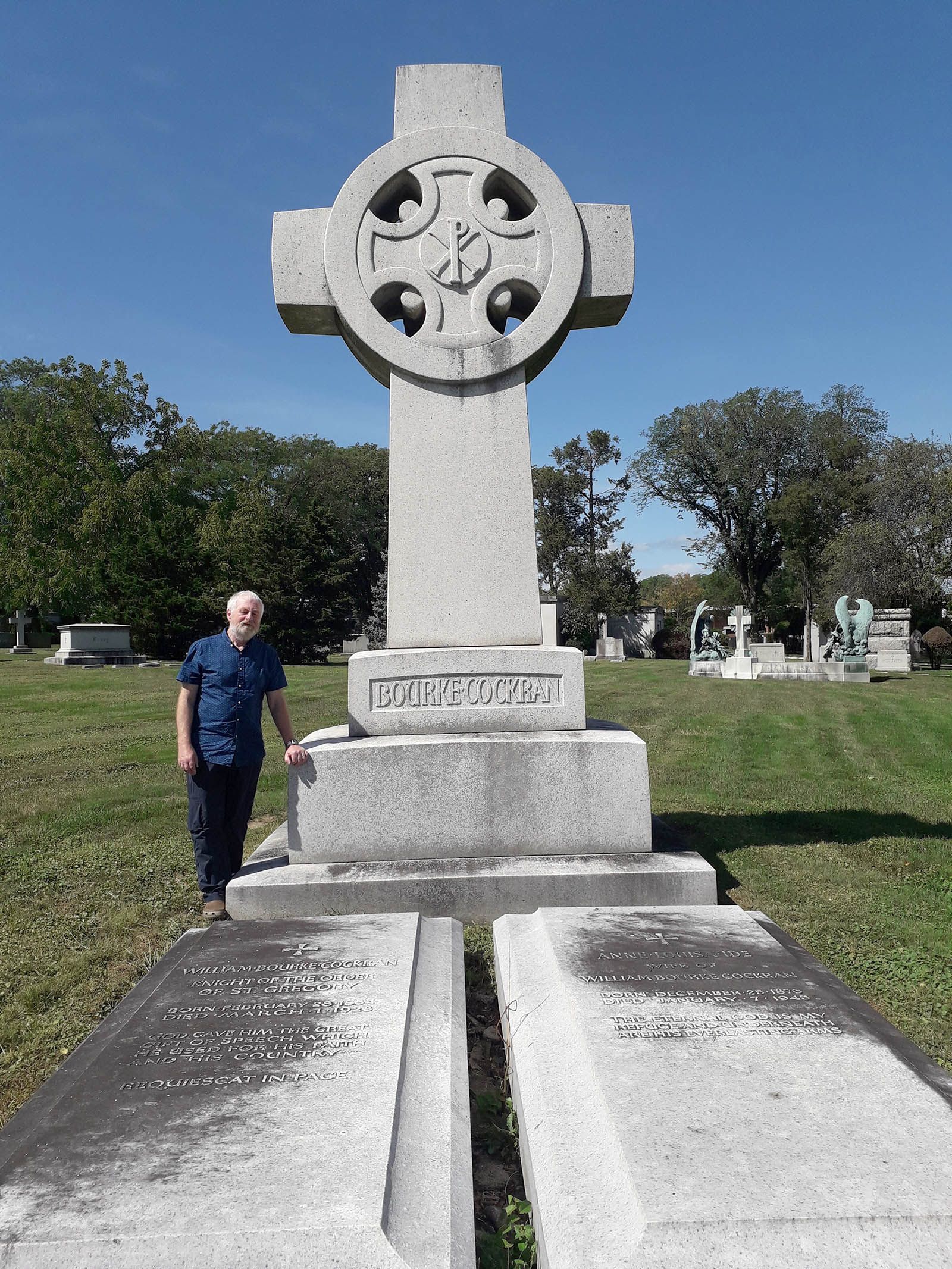
Caroline Astor, founder of the 400 Club in New York, said: "I have dined with a large proportion of the men now in public and social life on both sides of the Atlantic. Mr. Cockran is decidedly the most interesting character I have met."
Laid to rest beneath the sloping sod of Gate of Heaven Cemetery in Hawthorne, New York, Bourke Cockran's gravestone tells us he was a Knight of the Order of St. Gregory, an honour bestowed by the Pope.
The inscription on his headstone adds: "God gave him the great gift of speech which he used for his faith and his country." Beside him rests the remains of his third wife, Anne Louis Ide, who died in 1948. A large Celtic-style stone cross looms over their graves. Bourke Cockran had been married three times; he had no children.
And with the passage of time, the one-time colossus from Sligo was slowly forgotten. Until now. It was another W. B. -- the Nobel literature laureate William Butler Yeats -- who led Keville Burns of Sligo to his discovery of Bourke Cockran.
Burns, who is chairman of the Bourke Cockran Society in Sligo, explained: 'I was in the Yeats Society in Sligo and in reading about the great poet, I came across this other W.B., William Bourke Cockran.
I have lived here in Sligo all my life and I had never heard of Bourke Cockran. "I thought, why isn't this extraordinary son of Sligo better known? That thought just kept nagging at me.
I suppose you could say I became obsessed with him." The efforts of the Bourke Cockran Society reached a crescendo just before Christmas with two major events in Sligo.
One was a widely-acclaimed week-long exhibition on Bourke Cockran hosted by Sligo County Council in Sligo Town Hall.
The second was a day-long seminar in the Sligo Park Hotel, both set in the context of historic turn-of-century events in Ireland, the U.S., and the wider world. Now the Bourke Cockran Society is hoping to reignite awareness of the Sligoman across the Atlantic, ideally in New York, the place where the man had his home, career, political base and, in the end, his final resting place.
The first step in that effort, Burns suggests, could be the re-staging in New York of the hugely-successful Sligo seminar and exhibition that has now thrust Bourke Cockran back into the consciousness of his native place.
Indeed, Burns has already pitched his idea to the U.S. volunteer group Irish America 250, which is celebrating the semiquincentennial of the U.S. Declaration of Independence this year. "I feel there could be a place for Cockran in these 250th anniversary celebrations," Burns insists.
He added: "The exhibition is suitable for museums, universities, libraries and cultural centres across the U.S. It would be accompanied by public lectures, panel discussions and educational materials, enabling host institutions to engage audiences with themes such as leadership in an age of global change and the Irish diaspora as shapers of American governance."
From the outset, Bourke Cockran was not an ordinary son of Sligo. His mother, Hariet Knight-White, was the third daughter of Michael Bourke-White, of Ballinvirick, County Limerick, and his wife, Susan Knight.
They were a distinguished Protestant family, with Michael having been head of the county's Grand Jury. Bourke Cockran's paternal grandfather, Thomas, was known as the Mayor of Ballinacarrow in County Sligo.
He was the proprietor of a large farm and substantial business establishment, possibly a public house.
Before there was a chapel in Ballinacarrow, Thomas set aside a room in his house in the village for use as a Mass house. When the first chapel of Ballinacarrow was built in 1826, Thomas was joint benefactor with the local landlord, Colonel Perceval, of Templehouse. (The grandson, William Bourke Cockran, continued this tradition by substantially funding the building of a new church in Ballinacarrow in the early 1900s).
William Bourke Cockran's father, Martin, was born in 1825 in Ballinacarrow. Unusually for a Catholic, he became a prosperous farmer. By 1858 he was leasing a holding of more than 93 acres from Major Charles O'Hara.
According to information in the Sligo Town Hall exhibition, Harriet Knight-White met Martin Cockran in 1851 following a court case in Dublin, where she successfully defended the inheritance of a fortune. Martin rode into the courtyard of the hotel where she was staying and, it appears, it was love at first sight.
They married within a week, despite opposition from both families. She was 36, he was 23. They had five children, among them William who was born on February 28th 1854 at Rock Lodge, in the townland of Claragh, in the parish of Kilvarnet, near Ballinacarrow.
In 1857, their father further extended his land holdings, purchasing 105 acres from the Landed Estates courts before reselling the property two years later for £1,500.
He had also leased Carrowkeel House from John McDonagh, the county coroner.
Tragedy struck in 1859 with Martin Cockran's sudden death. He broke his neck while attempting a water jump in a steeplechase. He was 35.
His widow was now left with an encumbered estate, heavy debts, and five young children, among them five-year-old William Bourke.
However, she was determined that her children would receive a good education. In 1860 she advertised the sub-letting of Carrowkeel House and lands and, in 1862, moved her young family to Wine Street in the centre of Sligo Town, some 15 miles away.
Here, he attended the Marist Brothers Academy in Chapel Street for a short time. With the help of a family friend, the renowned historian Archdeacon Terence O'Rorke, Cockran's mother sent him to a Marist school in Beauchamp, near Lille, in northern France.
There he was joined by his older brother in 1864.
On a return visit to Sligo in 1865, Martin contracted diphtheria and died. Shortly after, their mother moved the family to Dublin.
Having spent five years in Beauchamp, William Bourke returned to study at St. Jarlath's College in Tuam, County Galway and, later, Summerhill College, then located in Athlone, before its move to Sligo Town in 1880.
In her home in Rathmines, Dublin, Hariet White Cockran entertained a lively and artistic crowd. One of them was the founder of the Home Rule movement, Isaac Butt, whose oratory had a major influence on the young Bourke Cockran.
In the spring of 1871, at the age of 17, he set sail for America. On his arrival in New York he found a city dominated by Irish-American political and social upheaval, with "Boss" William Tweed the head of Tammany Hall, the Democratic Party political machine.
Wealth and poverty existed side by side. Cockran got his first job in New York teaching Latin, Greek and French at the St. Teresa's Academy for Young Ladies, a private Catholic school on Rutgers Street.
After briefly returning to Ireland as a correspondent for the New York Herald to cover the political situation and the unveiling of a monument to Daniel O'Connell in Dublin, he declined a position at the foreign news desk. Instead, he became principal of a public school in Tuckahoe in Westchester County.
Amid the array of opportunities apparently open to him in New York, it was the law and politics that appealed to him most. A chance meeting with Abraham B. Tappan, a New York Supreme Court justice, helped set Bourke Cockran on his distinguished legal career.
After four years studying, he was admitted to the New York Bar in 1878. He opened his first office in Mount Vernon, later moving to Broadway in Manhattan. He became an authority on public utility law.
Among his clients were publisher Joseph Pulitzer, the New York Central Railroad, the New York, New Haven and Hartford Railroad, Long Island Rail Road and the Brooklyn Union Gas Company.
Among the courts in which he argued was the Supreme Court of the United States. Despite savoring success, tragedy loomed. In 1876 he married 22-year old Mary Jackson but she died in childbirth, leaving him a widower at the age of 23.
In 1888 he was married for the second time, to Rhoda Mack, the daughter of a prominent financier. In 1895, she died, aged 31, after a brief illness, leaving him a widower again.
In 1906 he married Anne Louis Ide, daughter of a judge, Henry Clay Ide.
Meanwhile, with a growing reputation as an outstanding orator, Cockran was much in demand at political rallies. And among those he mentored was a young Winston Churchill whom he met when the 20-year old Churchill disembarked off the boat on a visit to New York in 1895.
Cockran, a widower by this time, was reputed to have become a lover of Churchill's mother after her husband's death; she was Jennie Jerome, better known as the American heiress and socialite Lady Randolph Churchill. In later life, her famous son never hesitated to acknowledge his debt to the Sligoman.
For example, in 1953, Churchill told the contender for the Democratic nomination for president, Adlai Stevenson: "It was an Irishman who inspired me when I was 19 years old.
He taught me how to use every note of the human voice like an organ. He was my model. I learned from him how to hold thousands in thrall." Churchill also referred to Cockran in his famous "Iron Curtain" speech delivered at Westminster College, Missouri in 1946.
Cockran's influence, however, extended far beyond his oratory, as Keville Burns explains: "He was a passionate advocate for justice, equality and democracy. He championed causes such as labour rights, economic reforms, civil liberties, the 'sound money' Gold Standard, and Ireland's right for independence and self-determination, including supporting and helping raise money for Parnell, de Valera and the new Irish State.
For more than forty years, Cockran's was the world's most powerful voice raised on behalf of the Irish people. "He was an Irish-born U.S. congressman, public intellectual, world-famous orator and constitutional thinker whose influence on American political and commercial life remains strikingly under-recognised."
With this in mind, Burns insists the effort to raise a new awareness of William Bourke Cockran is "not merely to commemorate a forgotten son of Sligo, not about Democrat or Republican, but to restore one of history's remarkable figures to his rightful place amid the panoply of the greats in the extraordinary story of Ireland, America, and Irish-America."
For further information on Bourke Cockran or to help with the effort to raise awareness in the U.S. of this extraordinary Sligoman, contact Keville Burns at keville.burns@gmail.com
Harry Keaney was a reporter, writer and associate editor of the Irish Echo during the 1990s. He now lives in his native Sligo.