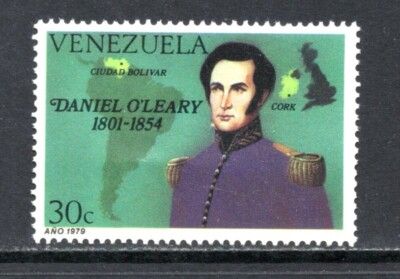
With the American seizure of Venezuelan President Nicholas Maduro over the recent weekend the world has been focusing on Caracas, the Venezuelan capital city. In the heart of that city there is a verdant park named to honor one of the heroes of the Venezuelan revolution who liberated the country from Spanish colonial rule. Amazingly, that park, Plaza O’Leary is named after a Corkman, Daniel O’Leary, whose body lies in the pantheon of Venezuelan national heroes next to his close friend Simón Bolívar, the legendary liberator of Latin America. O’Leary is considered a Venezuelan national hero and one of the most fascinating Irishmen in the history of Latin America.
Daniel Florence O’Leary was born in Cork in 1801, the eighth of 10 children into a merchant family. In 1817, the 16-year-old O’Leary joined the British Legion, a battalion of mostly Irish volunteers sent by Britain to South America to support rebel troops fighting to liberate Latin America from Spanish colonial rule.
He quickly learned to speak Spanish and then travelled to Guyana to join the troops being organized there by Bolívar. O’Leary was chosen for the Dragoon Squadron of the Guard of Honor and within two years of his arrival in the new world he was promoted to the rank of First Adjutant of the Dragoons.

A valiant soldier, O’Leary received a serious facial wound from a sabre blow in July 1819 at the battle of Pantano de Vargas, which led to false reports at home in Cork of his death. He rose through the ranks with at a dizzying pace being promoted to lieutenant at the age of 19, captain at 20, lieutenant-colonel when he was just 21, and full colonel at the age of 25. O’Leary distinguished himself in numerous battles and became aide-de-camp to one of the revolutionary generals. By September of that year, he had so impressed Bolivar with his abilities that the liberator named him as one of his aides-de-camp and the two men became close friends.
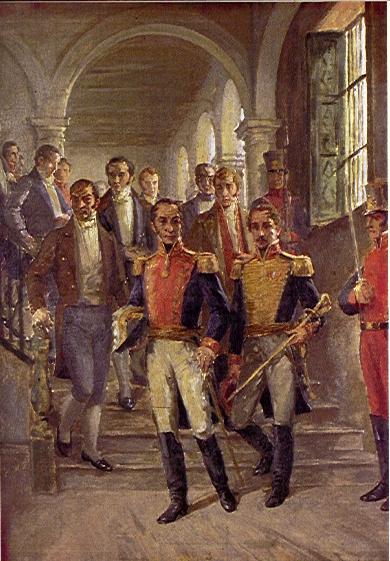
Simón Bolívar depicted, center, during the Congress of Cúcuta in October 1821.
Bolívar also recognized O’Leary’s considerable diplomatic skills. In 1823, he sent him on a secret mission to Chile. In 1826, Bolivar dispatched him to Bogotá and to Caracas on missions of conciliation, and then Bolivar chose O’Leary to represent him at the great Columbian constitutional convention. That same year he married Soledad Soublette, sister of his colleague, Gen. Carlos Soublette, who later became president of Venezuela. Daniel and Soledad would have nine children together.
After Bolívar's death from tuberculosis in 1830 at age 47, O'Leary disobeyed orders to burn the general's personal documents. He spent much of the rest of his life organizing them, along with writing his own memoirs (spanning 34 volumes) recalling his time fighting in the revolutionary wars with Bolívar. A highly skilled diplomat, In 1834, the government of Venezuela sent him on a mission to Europe to seek recognition of their new status as a nation.
Still a British subject, his diplomatic talents gained recognition. In January 1841, after his return from Europe, he was appointed acting British consul at Caracas, and later he became British chargé d'affaires and consul-general at Bogotá where he remained until his death in 1854.
In 1882, his body was moved to the Venezuelan Pantheon of heroes. A bust and plaque honoring O'Leary were presented by the Venezuelan Government to the people of Cork and unveiled on May 12, 2010, by the Venezuelan Ambassador to Ireland. O'Leary is still fondly remembered in South America as the author of the monumental historical work “Las memorias,” his history of the war of independence and of Bolívar. A plaque was also erected on Barrack Street in Cork City at O’Leary’s birthplace.