The “Big Snow” of early 1947 was a catastrophic three month-long winter storm in Ireland, which included 50 hours of continuous blizzard conditions, up to 15-20 foot drifts and temperatures of minus-14 degrees Celsius.
In the following excerpt from my memoir, “Call of the Lark,” I recall the Big Snow which took place when I was 6 years old.
****
During that winter of 1947, I’d draw aside the kitchen curtain and watch the countless white flakes dancing through and between each other. They filled the area between the gray sky and the fields that were no longer green. Pulling on my boots and coat, I ran outside to find the oak tree I’d climbed in the spring. It loomed over the garden wall and looked like a huge ghost with too many limbs as it reached out to gather as many flakes as its ghostly arms could hold. In the garden I found that the gooseberry and currant bushes had turned into snow hills. When my eyes couldn’t distinguish the hawthorn from the cherry tree, I blinked and tried to focus on the space beyond the Well Field. There I noticed that the holy mountain, Croagh Patrick, no longer visible in the horizon had hid itself from gathering winds that rattled our windows at night, whistled down the chimney and swiped wisps of thatch from the roof.

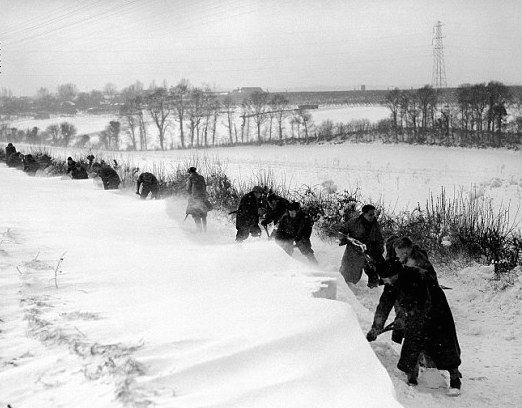
Clearing a road in the winter of 1947. [www.turtlebunbury.com]
Sitting by the warm turf fire, Mam looked at Dad and said, “This blasted snow will torment us for weeks to come and we won’t have a tail to wag with all the shoveling that’ll be in it.” Dad nodded, put “The Farmers’ Almanac” back on the shelf over the fireplace and went to get the shovel from the shed.
My sisters, Mag, 5, and Bridie, 3, joined me in screams of delight jumping up and down pleading to play in the snow.
“Well and good,” Mam finally agreed. “But let ye not be tormenting me with trampin’ wet snow through the house.”
We pulled on heavy hand knitted socks that warmed our toes. Mam said not to forget to wear our pixies. These hand-knitted hats that tied under our chins and kept our ears warm made us look like elves.
The Big Snow continued to fall day and night, covering the path Dad shoveled to the barn that also served as an outhouse. Dad shoveled another path to the main road, so we could take walks. Trudging along the cleared space, I felt boxed in, surrounded by tall cold white walls that were higher than myself.
I looked on with other village children as our neighbor, Tom Murphy, bridled his horse and slung a pair of pardógs across the horse’s back. These straw baskets would carry tea, sugar and flour to share with neighbors. “Look,” says Johnny Carney who lived in the house beyond The Well Field. “The snow is higher than the horse’s belly.”
At dusk, when Mam stuck a newspaper taper into the fire to get a light for the paraffin oil lamp, I sat close to the fire drinking hot cocoa and dangling my socked feet over the hot coals. Mam pushed a canvas flour bag under the door to block the cold air but still the chill managed to reach us. The heavy topcoats we used as extra blankets on the beds, felt damp in spite of the airing Mam gave them on the backs of two chairs in front of a roaring fire. Huddled between my two sisters, I’d eventually fall asleep with the familiar aroma of Plug tobacco that reached out from the pockets of my father’s overcoat inducing a dream of spring. But Spring forgot to come that year. I dreamt about the song of the lark that rose from the white-flowered hawthorn and the pink cherry blossoms behind the rick of turf. I wanted to pick gooseberries and currents that would ripen on the bushes when daisies filled the now snow-covered field beyond the three steps in front of our house.