A language lives or dies on its relevance to modern life.
And nothing is more relevant than news - the clue, after all, is in the word.
So let's ask then how the governments we have here in Belfast fund, through our taxes, and the public service broadcaster we fund through our licence fee is doing when it comes to provision of Irish language news and current affairs output on BBC Radio Ulster and BBC Northern Ireland television.
Wait a mo 'til I check through the last year's news and current affairs output. All done — and didn't take too long for the answer is a big fat Zero.
No news programmes on TV or radio. No digital news service. No current affairs programmes.
It's not that Irish speakers in these benighted Six Counties expect our betters in the BBC to put us on a par with BBC Persian, a 24-hour TV channel which broadcasts via satellite, on livestream and on YouTube at a cost of £15m per annum.
Consider us easily-satisfied, even simple, folk: if we had the £1m-£3m spend of the BBC World Service on Gujarati (spoken in the West Indian state of Gujarat) or Uzbek, national language of Uzbekistan, we could retire contented to our lean-tos below the Black Mountain.
By my estimate - broadcast mandarins in London, feel free to correct - BBC Northern Ireland spends around £950,000 on Irish language programmes on radio and TV. That's, by a long shot, less than they spent libelling Gerry Adams.

Let's see how it should be done by crossing the Straits of Moyle.
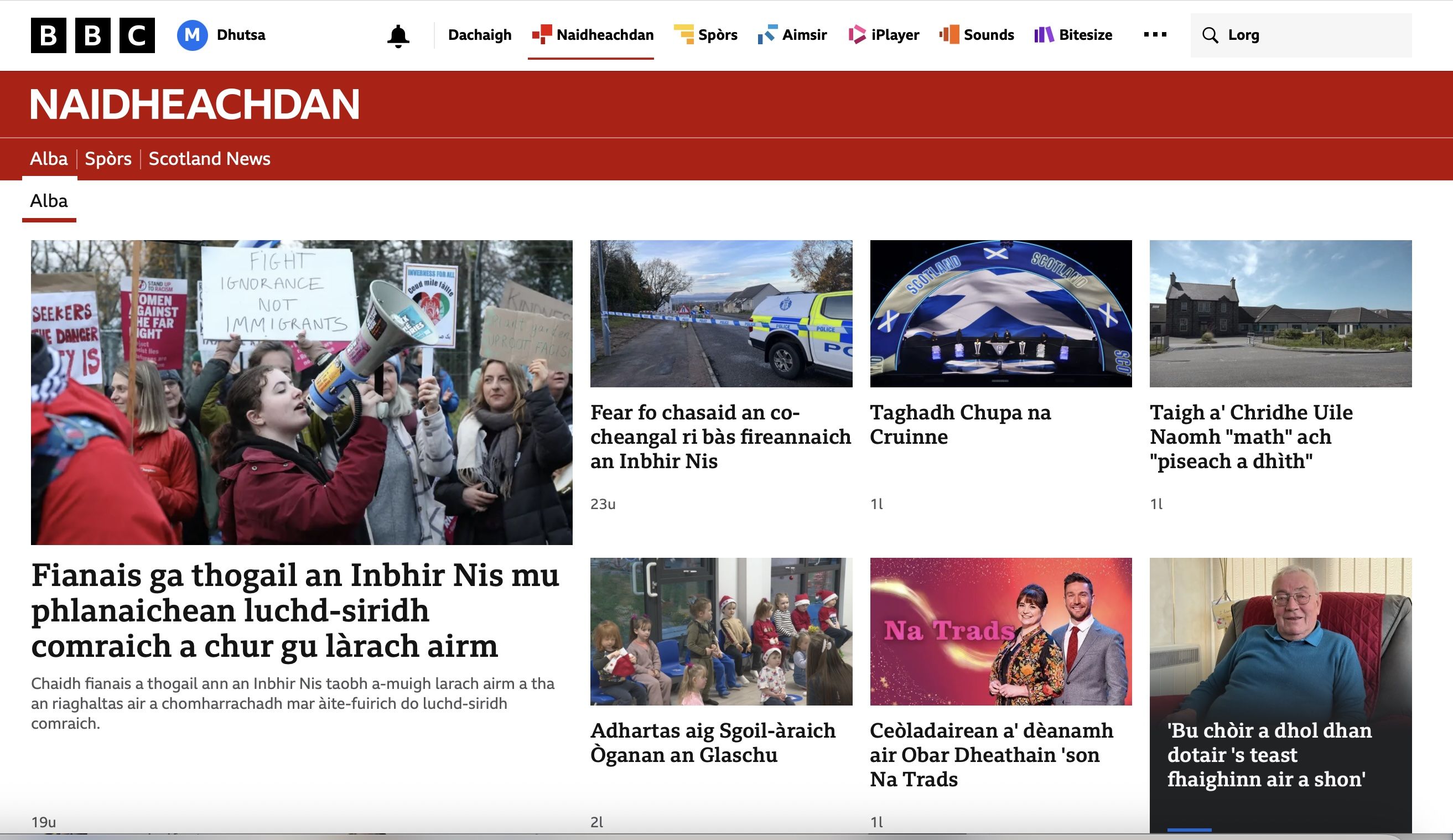
Chaidh fianais a thogail ann an Inbhir Nis taobh a-muigh làrach airm a tha an riaghaltas air a chomharrachadh mar àite-fuirich do luchd-siridh comraich. https://t.co/J5oCJ7FmOL
— BBC Naidheachdan (@bbcnaidheachdan) December 6, 2025
In Scotland, by my estimate, Gaelic broadcasting enjoys almost £30m in funding, mainly for its distinct TV and digital channel BBC Alba - about £14m of that sum comes from the licence fee via the BBC (£4m for radio, the remainder for BBC Alba). The top-up comes from MG Alba ('Meadhanan Gàihlig Alba - A' Toirt Gaidhlig Chugaibh'), a broadcasting authority for Scottish Gaelic. MG Alba's budget from Holyrood this year is £14.8m (including a tidy £1.8m increase).
Those funds are put to excellent use in terms of providing a dynamic news service deserving of Gaelic, a language teetering on the edge with just 60,000 speakers, according to the Scottish census. BBC Naidheachan, the Gaelic news unit, in addition to its digital output, boasts a daily TV, 30-minute round-up of news called An Lá. It tops that up on Sunday with Seachd Lá, a review of the week in the news, and a highly-regarded, international current affairs programme Eorpa. In short, this suite of programmes makes Gaelic relevant and vital in Scotland, ensuring where politicians or authority figures are gathered, there is a need to put your case in Gàidhlig.
"Tha croitearan às na h-eileanan a’ mothachadh le gach bliadhna mar a tha talamh ga chall ris a' mhuir."#Eòrpa looks at the consequences of climate change ahead of COP26.https://t.co/k2fNDcyt4a #BBCALBA #climatechange #globalwarming #COP26 pic.twitter.com/XvZCia7ZzD
— BBC ALBA (@bbcalba) October 28, 2021
Let's break down those figures then.
With a population of 5.5m, Scotland spends about £30m on public service broadcasting in Gáidhlig or about £5.50 per person. However, if you calculate spend per Gáidhlig speaker, then that's around £500 per person.
BBC Northern Ireland allocates £950,000 from the licence fee to Irish and that is supplemented by the excellent Irish Language Broadcast Fund which receives £3.2m from the Department of Culture, Media and Sport in London. Let's call that £4.2m.
Per person in a statelet of 2m people, that's £2 per head, about 40 per cent of Scotland's spend. Per Irish speaker - 72,000 people identified as Irish speakers in the last Northern Ireland Census - that's £58 per head. One ninth of the spend in Scotland.
Prince Charles, since elevated to the kingship, once said of Scottish Gaelic, in a memorable and heartfelt speech, "If Gaelic dies in Scotland, it dies in the world. If it flourishes in Scotland, then it sends out a message of inspiration and optimism..." He added: "For those who wish to communicate through a minority language like Gaelic it must at times feel like an uphill task to maintain a spoken language to which there has sometimes been indifference and even hostility."
We know his pain: no institution we fund from our own pockets is more hostile to the Irish language, more indifferent to its fate, more neglectful of its obligations than BBC Northern Ireland.
That may be news to the Beeb, but it's not news, or even nuacht, to the Irish language community.